
Für den Zugriff auf die beiden Plattformen können Sie jeweils dasselbe Saxo-Konto verwenden.

Apple’s record high is a strike price
Options

Summary: Apple is about 2.6% below the highest price it has ever closed at. For an investor who already owns the shares, that gap turns into a question with two parts: at what price would the shares be sold, and on how many of them. A covered call answers both, and it does not have to cover the whole holding.
Writing calls against part of a holding sets a sale price on those shares and leaves the rest alone.
Apple closed at USD 331.34 on 15 September 2026, up 5.1% since the USD 315.34 close on 9 September, the day of the iPhone Duo and iPhone 18 Pro launch. The record closing high of USD 340.08 was set on 28 July 2026, and the intraday record of USD 344.57 came the next session. Two days after that Apple reported fiscal third-quarter results and fell 7.4% (Source: Saxo, as of 15 September 2026). Past performance is not indicative of future results.
Apple is approaching a price it reached once and did not hold. Whether it clears it is not knowable in advance, and its call premiums sit near the middle of their range for the past year (Source: Saxo, as of 15 September 2026 close), so in our view there may be no unusual pricing to chase. Two things are left to decide, the strike and the expiry. Options carry a high risk of rapid loss and are not suitable for every investor.
Important note: The strategies and examples provided in this article are purely for educational purposes. They are intended to assist in shaping your thought process and should not be replicated or implemented without careful consideration. Every investor or trader must conduct their own due diligence and take into account their unique financial situation, risk tolerance, and investment objectives before making any decisions. Remember, investing in the stock market carries risk, and it’s crucial to make informed decisions.
Covering part of the position
Selling a covered call means selling someone the right to buy shares already owned, at a set price called the strike, up to a set date called the expiry. The seller takes cash up front, the premium, and keeps it either way, giving up any gain above the strike. One contract covers 100 shares, and it does not have to cover the whole holding.
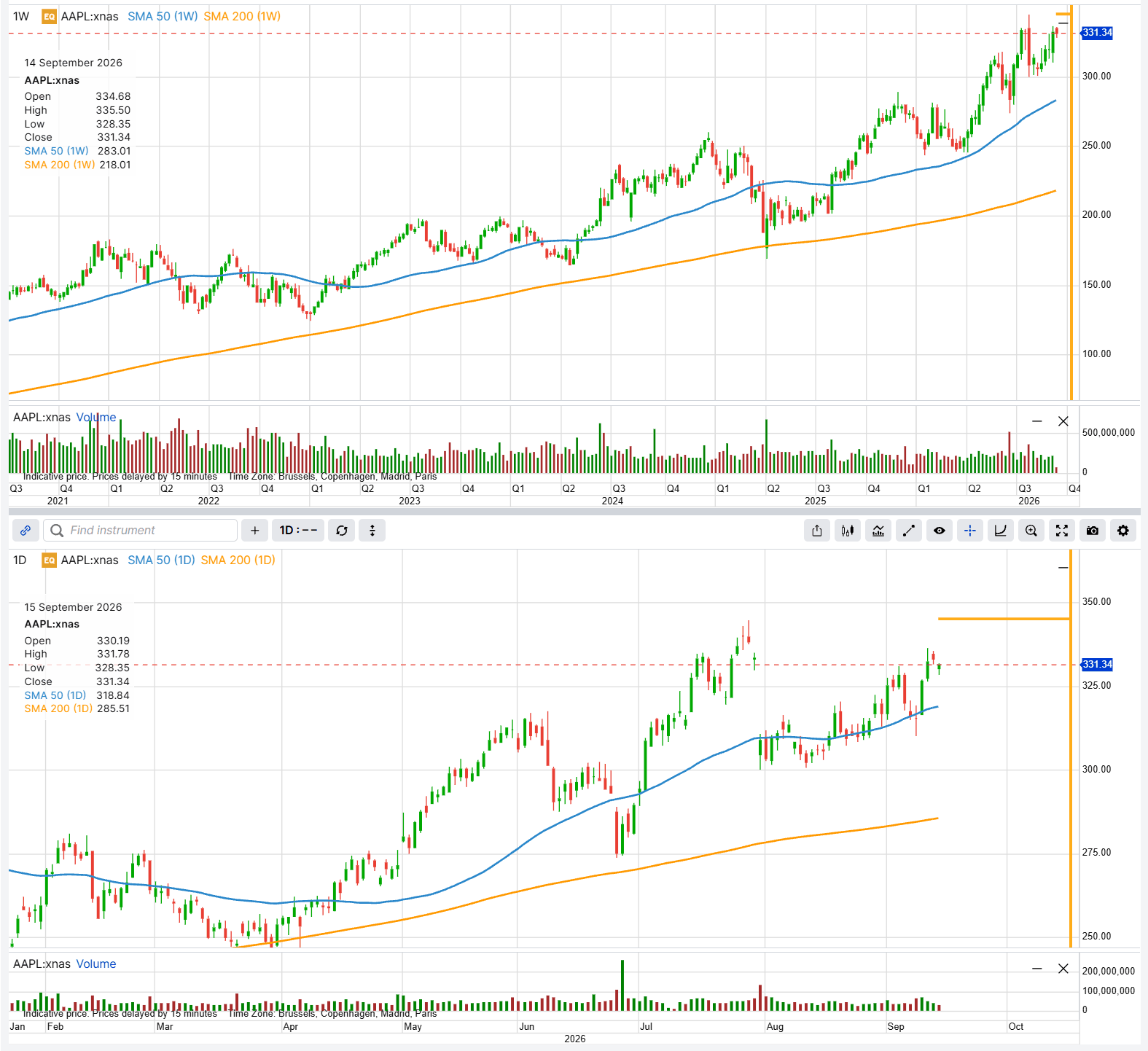 Apple weekly and daily to the 15 September 2026 close, with the 50 and 200 period moving averages and the 345 strike marked. Source: SaxoTrader. Illustrative and educational only, not predictive. Past performance is not indicative of future results.
The following example is hypothetical and for educational use only. It is not advice or a trade recommendation.
Example structure (illustrative only - not a trade recommendation)
- Holding: 500 Apple shares, worth approximately USD 165,670 at the 15 September close
- Sell 2 Apple calls, strike 345, expiry 16 October 2026, a standard monthly contract 30 days away
- Premium: USD 4.35 bid, USD 4.55 offered, a mid of USD 4.45 per share, so USD 445 per contract and USD 890 for the two, in exchange for giving up any gain above 345 on 200 shares
- Risk: the 500 shares keep their full downside and the USD 890 offsets only a small part of any fall, while gains on the 200 covered shares stop above 345. Short calls carry early-assignment risk
- The premium works out at about 1.3% of the 200 shares committed over those 30 days, or 0.5% across the full holding, against an upside capped above 345. A period figure, not an annual one
- Delta approximately 0.30, open interest 26,935 (Source: Saxo, as of 15 September 2026 close; verify in the live chain)
- If assigned, meaning the buyer exercises and those shares are sold, the effective sale price is approximately USD 349.45 before costs, about 2.8% above the record close, and any move above that level accrues only to the 300 uncovered shares. Hypothetical, for education only
Note where 345 sits. It is above the record close of USD 340.08 and a fraction above the intraday record of USD 344.57, so the contract asks whether the shares would be sold at a price Apple has never closed above. Options carry a high risk of rapid loss and are not suitable for every investor. Costs and charges apply to each transaction; see Saxo pricing for costs and applicable charges at home.saxo/rates-and-conditions/pricing-overview.
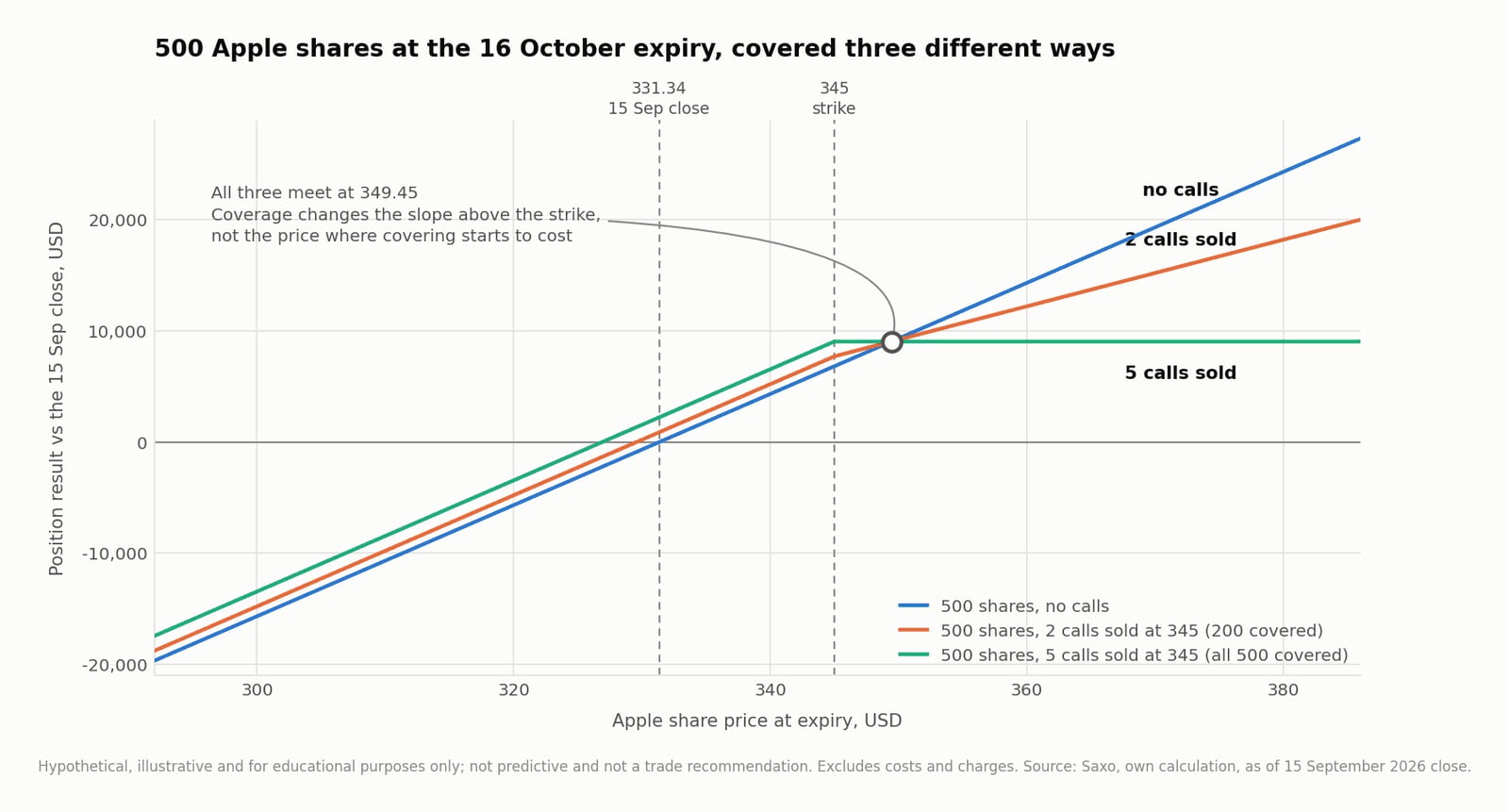 Result at the 16 October expiry for 500 Apple shares, with and without 2 calls sold at 345. The covered position is ahead by the premium up to 349.45 and behind above it. Source: Saxo, own calculation. Modelled payoff, illustrative and educational only, not predictive, and excludes costs and charges. Past performance is not indicative of future results.
Strategy insight - partial coverage is a dial, not a switch. The proportion written against expresses conviction without requiring a forecast. Covering 40% keeps most of the upside and collects a smaller premium; covering everything does the reverse. Both leave the downside on the shares exactly where it was. Illustrative only. Not a trade recommendation.
What this looks like in practice (hypothetical, for education only)
- If Apple falls to 300, the 500 shares are worth roughly USD 15,670 less and the USD 890 offsets about 6% of that. Selling the call changed nothing here
- If Apple finishes below 345 on 16 October, the calls expire worthless and the USD 890 is kept, though the shares may still be worth less than at the 15 September close
- If Apple reaches 380, the holding is up roughly USD 24,330 and the 200 covered shares give up about USD 6,110 of that. The other 300 give up nothing
Which expiry
Three events fall between the two nearest monthly expiries. Apple has not confirmed its next reporting date, though based on prior years it is expected between 29 October and 2 November 2026 (Source: Market Chameleon, as of 15 September 2026). Its estimated ex-dividend date is 10 November, at USD 0.27 (Source: DividendHistory), and the US midterm elections fall on 3 November. The 16 October expiry ends before all three.
That difference is visible in the price. The same 345 call was quoted around USD 445 for 16 October and around USD 998 for 20 November (Source: Saxo, as of 15 September 2026 close). The later contract pays roughly USD 553 more, and in our view that may reflect what the market charges for holding a sold call across the earnings report. That report moved the shares 7.4%, about USD 2,450 on 100 shares, so the extra premium is small next to what the event itself can do. Costs and charges apply to each transaction; see Saxo pricing. Past performance is not indicative of future results. Options carry a high risk of rapid loss and are not suitable for every investor.
The election is a date rather than a forecast, and the seasonal argument around midterms is not supported by the data (Source: U.S. Bank, 1900-2025). That leaves earnings as the event with a demonstrated move behind it.
If the premise is wrong
For an investor who believes Apple will clear the record and keep going, selling that upside works against the view, and in our view zero contracts may fit. The counterweight is that some of that optimism may already sit in the price, with Apple on a forward price/earnings ratio of 38.2 on next-twelve-month consensus earnings (Source: Bloomberg, as of 15 September 2026).
An investor who thinks the move has gone too far is not served by this structure either, since the premium offsets only a fraction of a decline. Between the two sits the investor who would hold Apple through either outcome and would be content to sell part of it above the record, where the only open question is how large that part should be. Options carry a high risk of rapid loss and are not suitable for every investor.
Points an investor might weigh
Illustrative only. Not a trade recommendation.
- The gap between the buying and selling price at the chosen strike, which on the October 345 call was USD 4.35 against USD 4.55
- What the premium works out to as a percentage of the shares committed, over the days to expiry
- How many contracts the holding supports, and how many to write
- Whether an earnings date, ex-dividend date or other event falls inside the expiry
Assignment risk note: Apple options are American-style, so the buyer can exercise at any time up to expiry. A call that has been sold can be assigned early if Apple trades above the strike, particularly close to expiration or around the ex-dividend date. The buyer of a put or a call faces no assignment risk.
Final thoughts
Writing a call near a record high does not sell the shares. The investor keeps them, keeps the full downside, and sells the gain above a chosen price, for a defined period, on a chosen number of contracts. It does require answering a question buy-and-hold investors rarely face, namely at what price these shares would be sold. Writing against part of a holding survives being wrong about the breakout, because the uncovered shares carry on regardless. Options carry a high risk of rapid loss and are not suitable for every investor. Past performance is not indicative of future results.
Sources: Saxo, as of 15 September 2026 close; Bloomberg; Market Chameleon; DividendHistory; U.S. Bank.
The author does not hold positions in any of the instruments mentioned in this article. The Author is permitted to wait at least 24 hours from the time of the publication before they trade the instruments themselves.
This content will not be changed or subject to review after publication.
| Related articles/content |
|---|
| Selling cash-secured puts on QQQ why the premium is smaller than the headlines suggest | 15 Sep 2026 Silver ETF SLV what a long-dated call buys you instead of the shares | 13 Aug 2026 Adyen earnings an investors options playbook | 6 Aug 2026 Rheinmetall how to use options on a share that costs EUR 1139 | 31 Jul 2026 Shell into second-quarter earnings two ways to use options for income | 24 Jul 2026 LVMH through results season what mini options change for a smaller portfolio | 22 Jul 2026 Options on leveraged ETFs how investors actually use them | 7 Jul 2026 Adding options to your portfolio what actually changes | 26 Jun 2026 What investors misunderstand about covered calls | 10 Jun 2026 Covered call or cash-secured put | 2 Jun 2026 From shareholder to options user | 26 May 2026 |
| More from the author |
|---|