
Für den Zugriff auf die beiden Plattformen können Sie jeweils dasselbe Saxo-Konto verwenden.

Adyen earnings: an investor's options playbook
Options

Summary: Adyen has fallen a third this year, and options on the stock are pricing one of its richer earnings moves yet. The real question, before any strategy, is whether that move is even worth trading.
The stock is down about a third this year. The options market is pricing a double-digit move on the print. That combination raises a question worth answering before any strategy does: is this a set-up worth trading with options at all?
Adyen (ADYEN) reports first-half 2026 results on 13 August 2026, before the market opens, with a call scheduled for 15:00 CET the same day. The shares have fallen approximately 33% year to date, from EUR 1,397.20 at the start of January to EUR 937.50 as of 5 August 2026 (Source: Saxo price history). Past performance is not indicative of future results. Over that period the stock has underperformed the AEX index by a wide margin, and options on the name are currently pricing a larger-than-typical move around this print, reflecting implied volatility that sits high relative to its own past-year range (Source: Bloomberg, via Bloomberg Terminal, 5 August 2026).
For an investor who already holds Adyen, or is watching it from the sidelines, that combination of a battered share price and richly priced options creates several different ways to engage with the event. Before choosing one, it helps to understand what the options market is actually pricing, and whether trying to capture the earnings move directly is the right instinct in the first place.
Important note: The strategies and examples provided in this article are purely for educational purposes. They are intended to assist in shaping your thought process and should not be replicated or implemented without careful consideration. Every investor or trader must conduct their own due diligence and take into account their unique financial situation, risk tolerance, and investment objectives before making any decisions. Remember, investing in the stock market carries risk, and it’s crucial to make informed decisions.
Should you even trade the earnings gap with options?
Implied volatility, the level of expected movement priced into an option, is currently elevated on Adyen relative to its own recent history. Adyen’s 30-day at-the-money implied volatility stands at approximately 66.2%, close to but still below the 52-week high of 76.4% reached the day before the February 2026 full-year print. One way to describe where that level sits relative to its own history is IV Rank, which shows where today’s implied volatility falls within the past year’s range: an IV Rank of approximately 79 means current implied volatility is higher than roughly 79% of daily readings over the last twelve months (Source: Bloomberg, via Bloomberg Terminal, 5 August 2026).
A common way to estimate the market-implied move is to add the at-the-money call premium and the at-the-money put premium for the expiry capturing the event. On the Amsterdam weekly expiring 14 August 2026, the day after the release, the 940 strike call and put together were quoted at approximately EUR 128.17, or about 13.7% of the current share price. That weekly book is thin, so the figure is indicative rather than tradeable. The nearest liquid alternative, the 21 August 2026 monthly expiry, prices the same 940 straddle at approximately EUR 134.13, or 14.3% of the share price, a close enough match to treat the roughly 13-14% range as a reasonable estimate of what the market expects (Source: SaxoTrader, 5 August 2026).
Whether that expected move is worth trading directly is a separate question from whether it is priced correctly. Adyen’s own earnings history argues for some caution about assuming a large move is coming. Actual EPS has missed consensus twice in the past four years, by 0.3% and 12.1% during the post-pandemic normalisation, and beaten by as much as 23.5% once, in the second half of 2023. In our view, more relevant to this print is that the last four halves have all landed within roughly 6% of consensus, a tighter pattern than the earlier years (Source: Bloomberg, via Bloomberg Terminal, 5 August 2026). A market that has gotten better at modelling a company’s earnings, in our view, tends to compress the realistic range of outcomes even when implied volatility stays elevated.
There is also a structural pattern worth knowing before entering any options position here: implied volatility on Adyen has historically spiked into each earnings release and collapsed sharply afterward, from a 52-week high of 76.4% in February down to a post-print low of 28.1% by August 2025 (Source: Bloomberg, via Bloomberg Terminal, 5 August 2026). That collapse, sometimes called IV crush, works against anyone who buys options purely to bet on volatility, and in favour of strategies that involve selling premium into the event. It does not, on its own, say anything about which direction the stock will move. Past performance is not indicative of future results, and this pattern, however consistent historically, is not a guarantee it repeats on this print.
Put this together and, in our view, trying to predict the direction of a release still more than a week away, on a stock that has already re-rated by a third this year, is a difficult way to use options directly. The three approaches below are built around that view rather than a direction call. None of them requires guessing whether Adyen beats or misses. Each starts from an existing view, holding the stock, wanting to hold it, or wanting downside protection, and uses options to express that view with a defined outcome. Options carry a high risk of rapid loss and are not suitable for every investor.
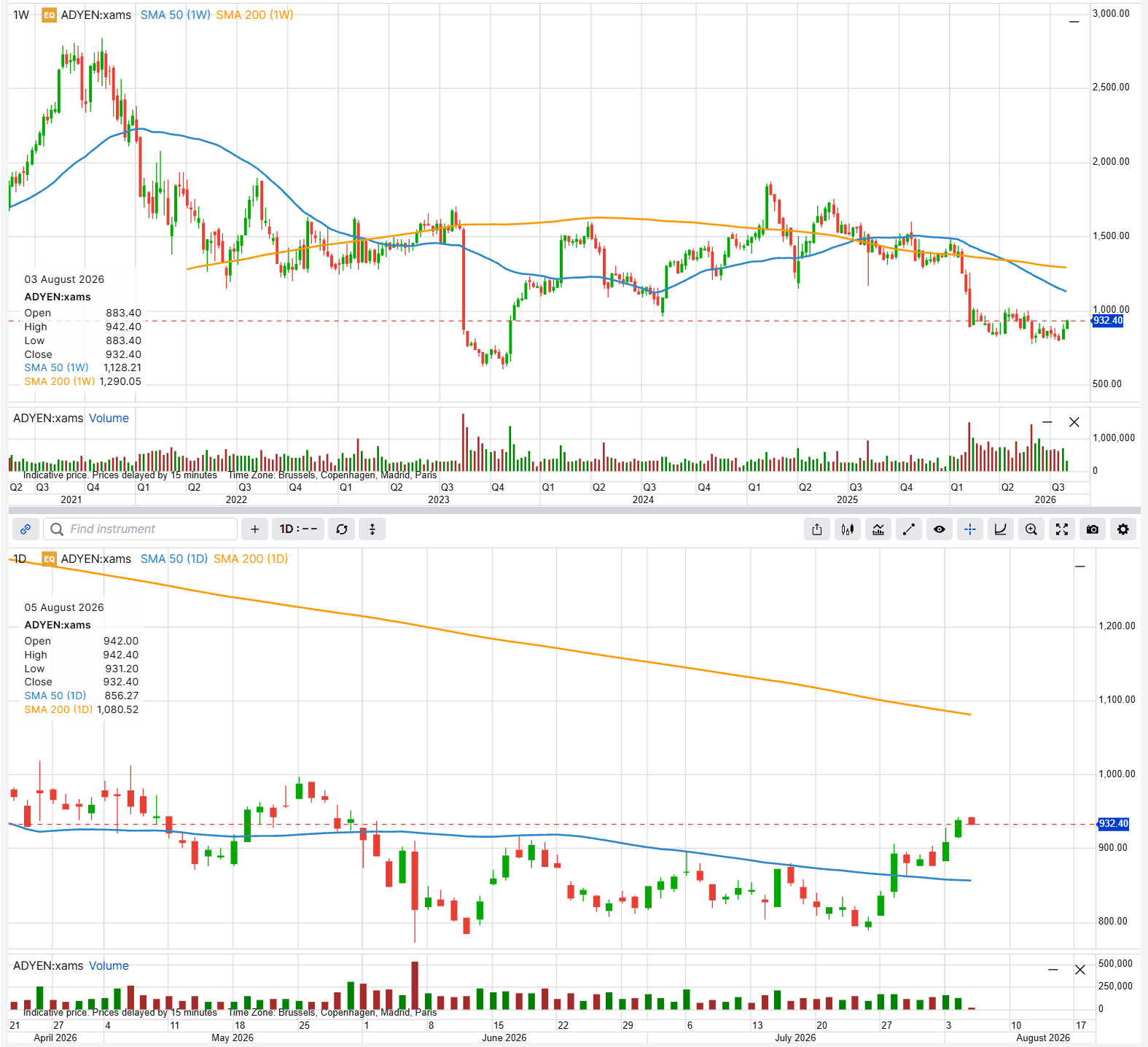 Adyen weekly and daily price chart with 50-day and 200-day SMAs, showing the 2026 decline and recent basing action. Past performance is not indicative of future results; figures are illustrative and not predictive. Source: SaxoTrader
Income approach: the covered call
Thesis. An investor already holding Adyen shares can sell a call option against that position to collect premium, in exchange for agreeing to sell the shares at the strike price if the stock is above that level at expiry. The thesis here is not a view that Adyen will rally hard into the print. It is closer to the opposite: an investor willing to accept a cap on the upside, in exchange for income today, because they see limited reason to expect a sharp re-rating from current levels within the next few weeks.
Mechanics. Selling the call means giving up any gain above the strike, in return for the premium, which is kept regardless of what happens next. Theta, the measure of time decay, works in the seller’s favour here: the option loses a small amount of value each day, which the call seller benefits from as a premium collector.
The following examples are hypothetical and for educational use only; they are not advice or trade recommendations.
Example structure (illustrative only - not a trade recommendation)
- Sell 1 Adyen 21 August 2026 1050 call at approximately EUR 29.00 (bid EUR 27.30, ask EUR 30.00)
- Strike sits approximately 12.0% above the EUR 937.50 spot
- Premium received: approximately EUR 290.00 across the 10-share contract (hypothetical, for education only)
- Maximum profit, combined with the shares: approximately EUR 1,415.00, reached at or above the 1050 strike, assuming the shares are held from the current EUR 937.50 level (hypothetical, for education only)
- Break-even on the combined position: approximately EUR 908.50, the current share price less the EUR 29.00 per-share premium
Risk: the investor retains the full downside risk of holding the shares below the EUR 29.00 per-share cushion; a decline beyond that continues into an unrealised loss on the stock, with no further offset from the option. Costs and charges apply to this trade; see Saxo pricing for full details. Options carry a high risk of rapid loss and are not suitable for every investor.
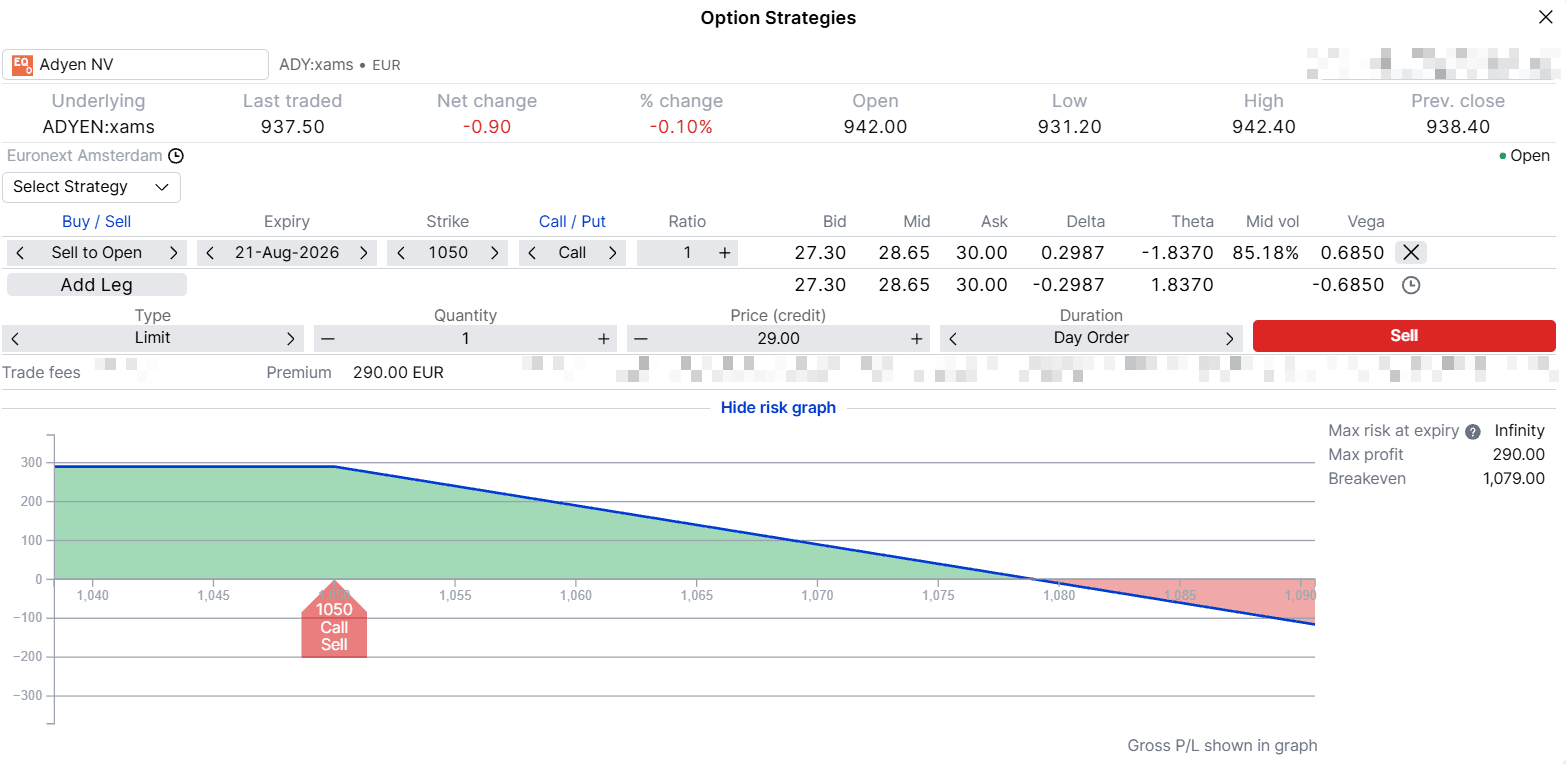 Covered call risk graph, Adyen 21 August 2026 1050 call, SaxoTrader Option Strategies view, 5 August 2026. This view shows the short call leg only. Illustrative and educational, not predictive. Source: SaxoTrader
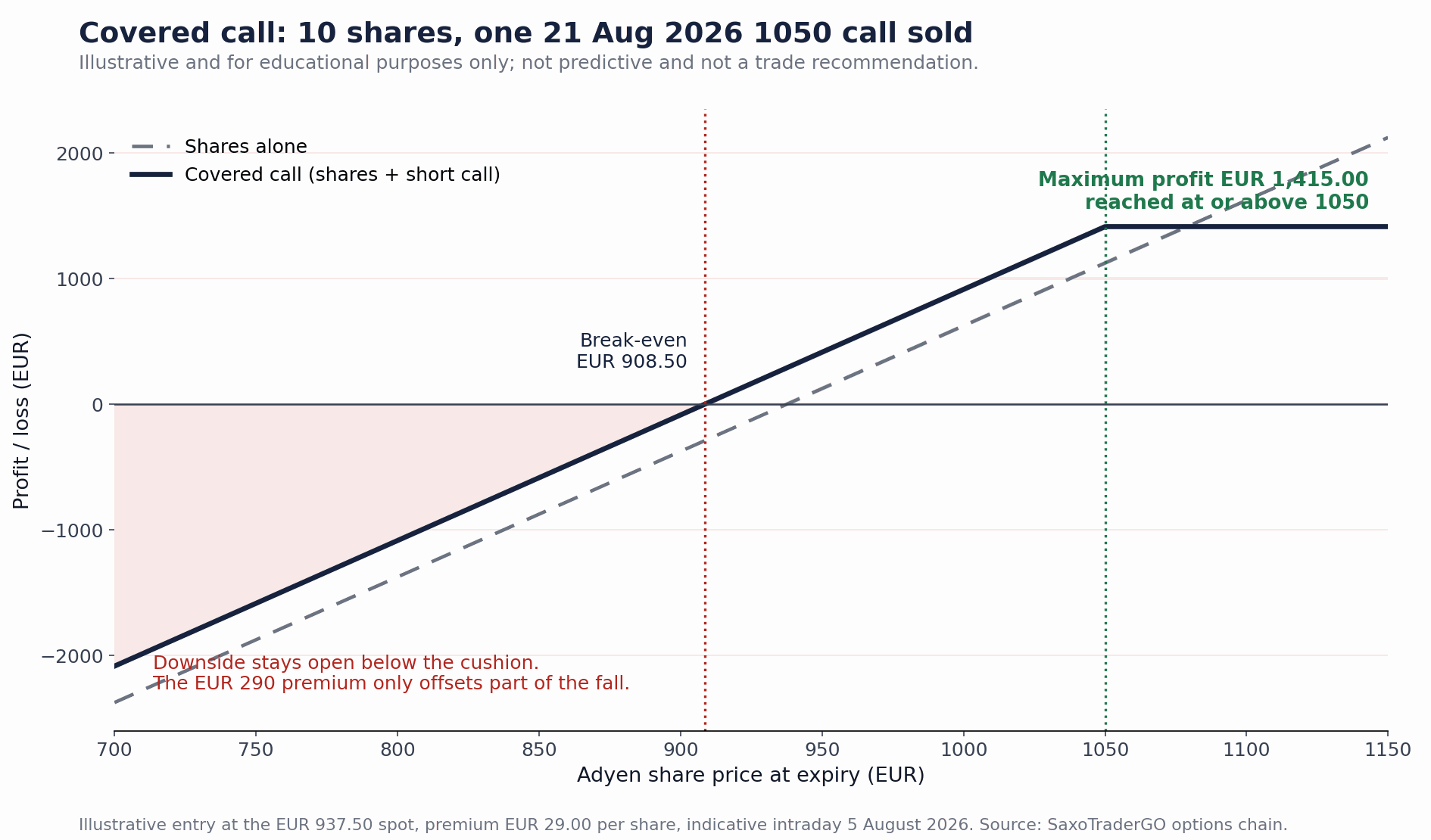 Covered call payoff combined with the underlying shares, Adyen 21 August 2026 1050 call, illustrative entry at the EUR 937.50 spot. Illustrative and educational, not predictive. Source: Saxo options chain, 5 August 2026
Strategy insight - the trade-off is real, not cosmetic. The investor retains the full downside risk of holding the shares. The premium received provides a partial offset, roughly EUR 29.00 per share, but it does not protect against a significant decline in the stock price, and the position still owns Adyen through whatever the print produces. What the premium does buy is compensation for capping the upside in a stock the investor may already believe has limited near-term rally potential.
Entry approach: the cash-secured put
Thesis. An investor who does not currently hold Adyen, but is comfortable owning it at a lower price, can sell a put option and set aside the cash to buy the shares if assigned. The thesis is an entry decision, not a prediction: the investor is willing to own Adyen at a level meaningfully below today’s price, and is being paid to wait for that level rather than placing a resting limit order for nothing.
Mechanics. Selling a cash-secured put means agreeing to buy 100 shares, or a multiple of the 10-share Amsterdam contract, at the strike if the stock falls there by expiry. In exchange, the investor collects the premium today. Theta again works in the seller’s favour, and the same is true for whoever wrote the call above.
The following examples are hypothetical and for educational use only; they are not advice or trade recommendations.
Example structure (illustrative only - not a trade recommendation)
- Sell 1 Adyen 21 August 2026 800 put at approximately EUR 17.55 (bid EUR 15.10, ask EUR 19.55)
- Strike sits approximately 14.7% below the EUR 937.50 spot, close to the June 2026 closing low of EUR 817.40
- Collateral required: approximately EUR 8,000, being the strike across the 10-share contract
- Premium received: approximately EUR 175.50 (hypothetical, for education only)
- Break-even at expiry: approximately EUR 782.45, about 16.5% below the current share price
Risk: the maximum risk is owning Adyen at EUR 800 per share with no further downside protection below the EUR 17.55 premium collected; if the shares fall well below the strike, the loss on the stock acquired exceeds the premium. Costs and charges apply to this trade; see Saxo pricing for full details. Options carry a high risk of rapid loss and are not suitable for every investor.
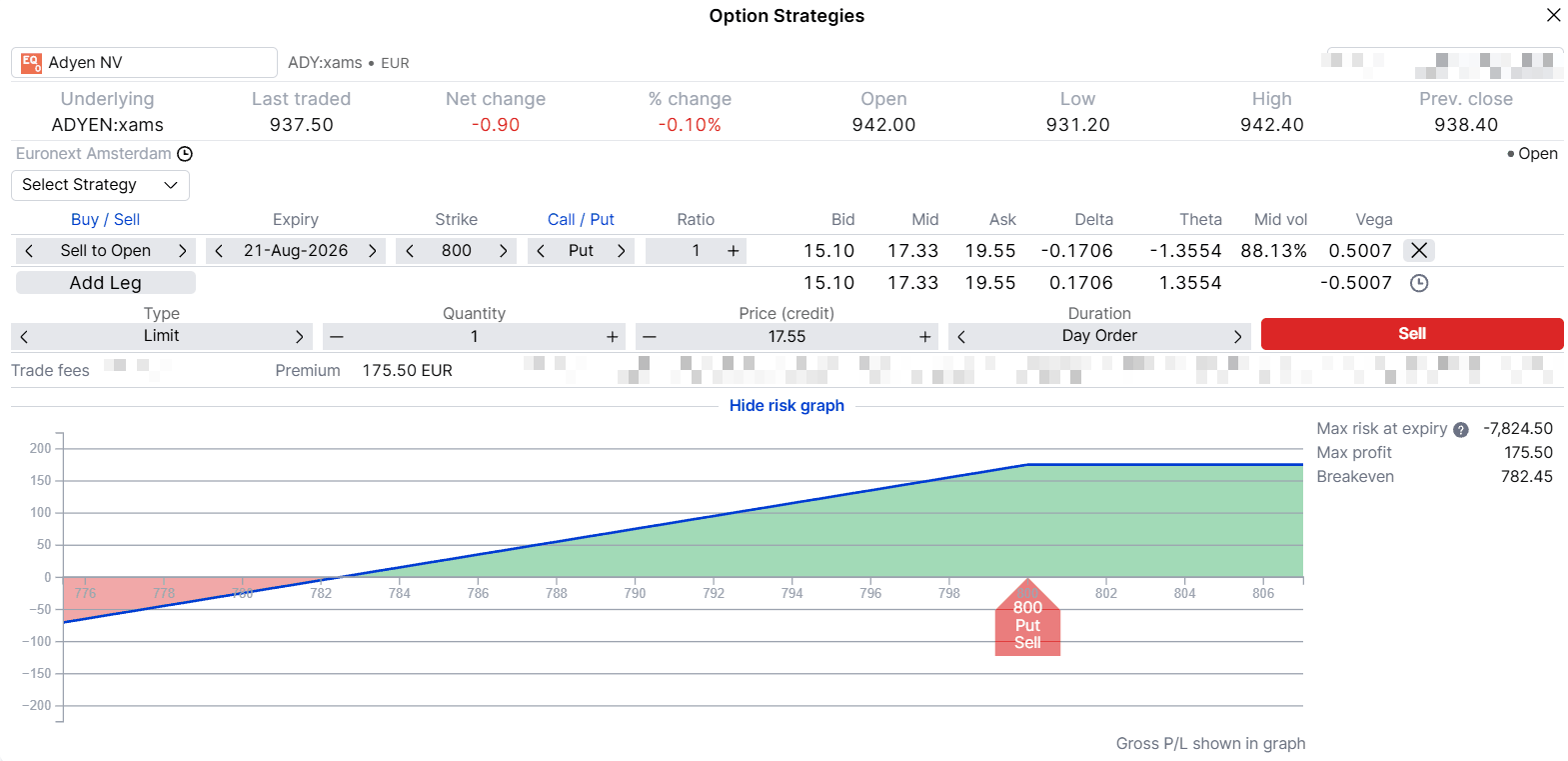 Cash-secured put risk graph, Adyen 21 August 2026 800 put, SaxoTrader Option Strategies view, 5 August 2026. This structure carries no existing share position until assignment, so the view shown here already reflects the strategy's full risk and profit profile. Illustrative and educational, not predictive. Source: SaxoTrader
Strategy insight - the risk is ownership, not just the premium. The maximum risk on this structure is owning Adyen at EUR 800 per share if the stock continues falling well below that level, offset only by the EUR 17.55 premium collected. That risk is the same risk as placing a limit order to buy the stock at EUR 800, with the premium as compensation for taking on the obligation early. The 800 strike also sits close to where Adyen bottomed in June 2026, so an investor using this approach is, in effect, deciding whether that level still represents a level worth owning the stock at.
Protection approach: the collar
Thesis. An investor holding Adyen who wants to limit the downside through the print, without selling the shares, can combine a protective put with a covered call to build a collar. A protective put works like insurance: the investor pays a premium for the right to sell at the strike, which limits downside, in exchange for a cost that reduces the position’s upside slightly. Financing that put by selling a call against the same shares, as a collar does, can reduce or, as in this case, eliminate that cost.
Mechanics. Delta measures how much the put gains for every euro Adyen falls, so the protection increases as the shares decline. Vega measures sensitivity to implied volatility. Because implied volatility is already elevated heading into the print and tends to fall sharply afterward, the put’s value from Vega is more exposed to that post-earnings collapse than the call’s, which is a cost worth being aware of even in a structure funded by the call premium.
The following examples are hypothetical and for educational use only; they are not advice or trade recommendations.
Example structure (illustrative only - not a trade recommendation)
- Buy 1 Adyen 21 August 2026 820 put at a mid of approximately EUR 21.65 (bid EUR 20.30, ask EUR 23.00)
- Sell 1 Adyen 21 August 2026 1050 call at a mid of approximately EUR 28.65 (bid EUR 27.30, ask EUR 30.00)
- Net credit at the mid: approximately EUR 7.00 per share (EUR 28.65 from the call, minus EUR 21.65 for the put); the live combined quote showed approximately EUR 6.50 per share, or approximately EUR 65.00 across the 10-share contract
- Protection begins below the 820 strike, approximately 12.5% below spot
- Upside is capped above the 1050 strike, approximately 12.0% above spot (hypothetical figures, for education only)
Risk: losses below the 820 strike are limited to the gap between spot and the strike, not eliminated, while gains above the 1050 strike are given up entirely; the structure redefines the range of outcomes rather than removing risk. Costs and charges apply to each leg; see Saxo pricing for full details. Options carry a high risk of rapid loss and are not suitable for every investor.
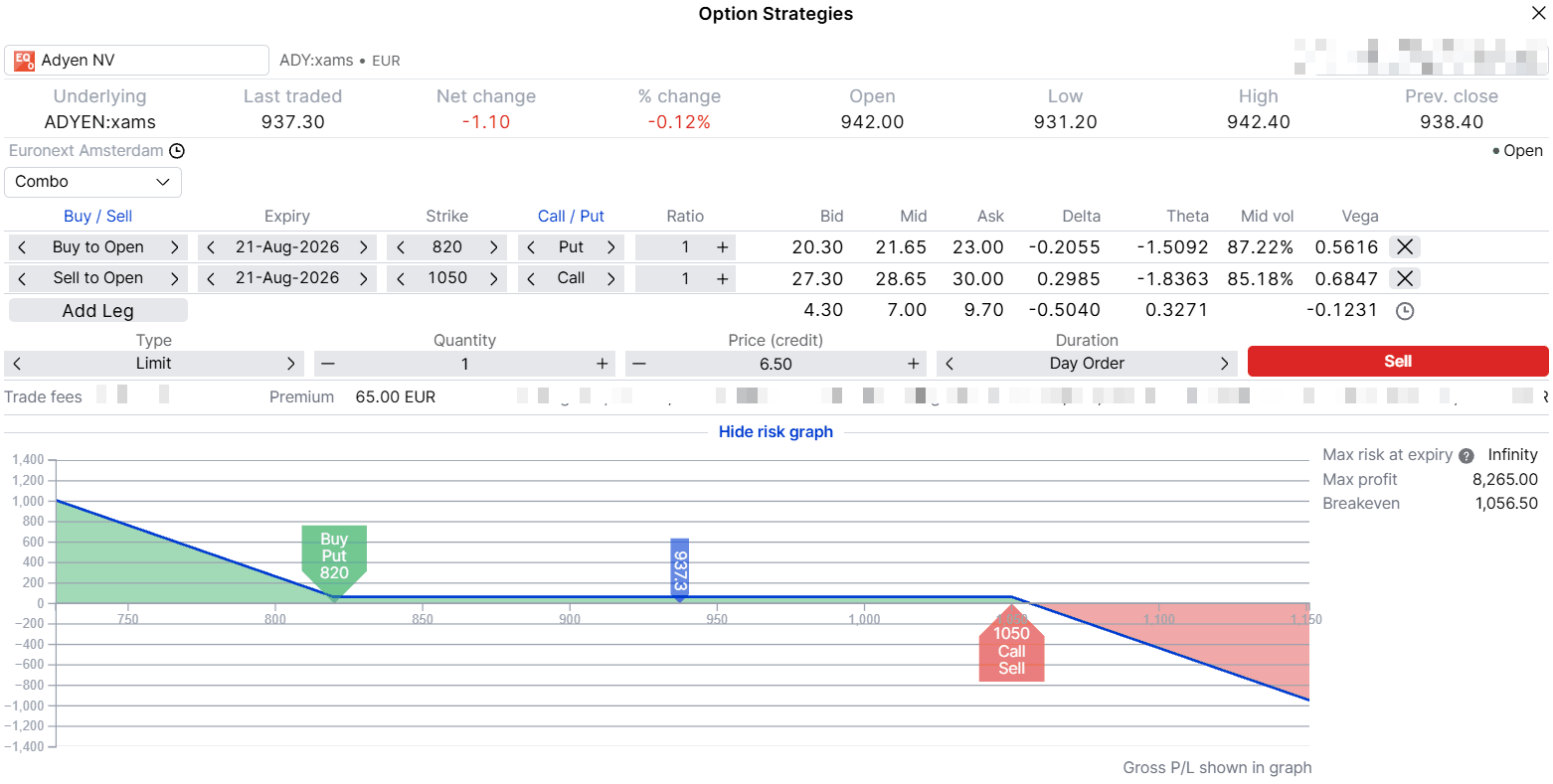 Collar risk graph, Adyen 21 August 2026 820 put / 1050 call combo, SaxoTrader Option Strategies view, 5 August 2026. This view shows the two option legs only. Illustrative and educational, not predictive. Source: SaxoTrader
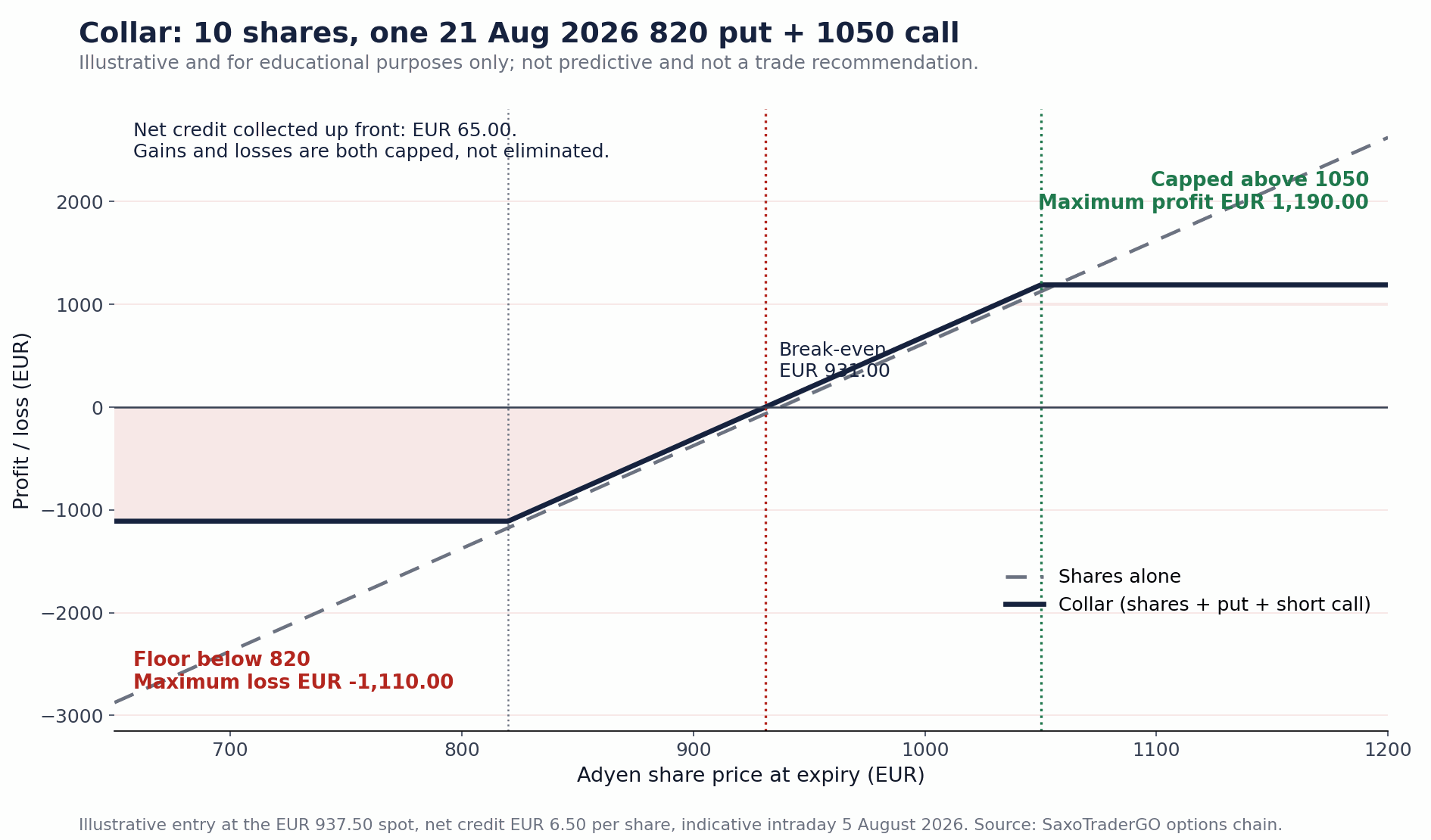 Collar payoff combined with the underlying shares, Adyen 21 August 2026 820 put / 1050 call combo, illustrative entry at the EUR 937.50 spot. Illustrative and educational, not predictive. Source: Saxo options chain, 5 August 2026
Strategy insight - protection funded by upside, not by cash. Because the call premium exceeds the put premium at these strikes, this collar can be put on for a net credit rather than a net cost, an unusual result that reflects Adyen’s options being priced with a modest premium on the call side at this particular distance from spot. The trade-off is symmetry: gains above EUR 1,050 and losses below EUR 820 are both given up, in exchange for a defined range through the print and a small credit today. A collar does not need to be held to expiry. If the shares fall or implied volatility rises before 21 August, the put may be sold in the market to recover some or all of the hedge benefit without waiting for assignment.
See Saxo pricing for costs and applicable charges: https://www.home.saxo/rates-and-conditions/pricing-overview
Before placing the trade, check
- Bid/ask spreads - several of the strikes above quote wide relative to their mid, which can erode the theoretical edge at entry
- Volume and open interest - confirm liquidity at the selected strike and expiry before entering; the 800 put and 1050 call both show meaningful open interest, but always check the live book
- Expiry type - the 21 August 2026 expiry used throughout is the standard monthly, not a weekly; the nearer 14 August weekly exists but trades thin, and several of its strikes carry no quote at all
- Whether earnings are before market open or after market close - Adyen reports before the open on 13 August 2026, so the shares will already reflect the news when the market opens that day
- IV relative to realised volatility - is the market pricing more movement than Adyen has typically produced after recent prints?
- Exit plan - define it before entering, especially for the collar, where managing one leg without the other changes the position’s risk
- Assignment risk - see note below
Assignment risk note: Because Adyen options are American-style, short legs, the call in the covered call and collar, and the put in the cash-secured put, can be assigned before expiry if they move in the money, particularly close to expiration. Monitor short options and understand the platform’s assignment process before entering any of these trades. As the buyer of the protective put in the collar, there is no assignment risk; only the seller of an option faces it.
Final thoughts
None of the three approaches above requires a correct guess about which way Adyen moves on 13 August. The covered call and cash-secured put both start from a view the investor may already hold, willing to own the stock, or willing to let some upside go in exchange for income, and use the elevated pre-earnings premium to get paid for that view rather than simply waiting. The collar starts from a different place: an investor who wants to keep holding Adyen through an event that has, this year, produced some of its largest single-day moves, without carrying the full risk of another sharp decline.
The wider point carries beyond this print. Adyen’s own history, mixed earnings surprises, a sharp IV crush after each release, and options that reprice significantly in the days around results, is not unusual among large, closely watched names. Positions built around these structures can often be adjusted or closed before expiry if the picture changes, rather than held rigidly to the strike. Options give an investor who already has a view on a stock more ways to express it. They are not, on their own, a way to know in advance which way an earnings print will go. Past performance is not indicative of future results.
This content is marketing material and should not be regarded as investment advice. Trading financial instruments carries risks and historic performance is not a guarantee of future results.
The Author is permitted to wait at least 24 hours from the time of the publication before they trade the instruments themselves. The author does not hold positions in any of the instruments mentioned in this article.
The instrument(s) referenced in this content may be issued by a partner, from whom Saxo receives promotional fees, payment or retrocessions. While Saxo may receive compensation from these partnerships, all content is created with the aim of providing clients with valuable information and options.
This content will not be changed or subject to review after publication.
| Related articles/content |
|---|
| Rheinmetall how to use options on a share that costs EUR 1139 | 31 Jul 2026 Shell into second-quarter earnings two ways to use options for income | 24 Jul 2026 LVMH through results season what mini options change for a smaller portfolio | 22 Jul 2026 Options on leveraged ETFs how investors actually use them | 7 Jul 2026 Adding options to your portfolio what actually changes | 26 Jun 2026 Protecting your gains without selling how to hedge a tech portfolio with options | 19 Jun 2026 What investors misunderstand about covered calls | 10 Jun 2026 Covered call or cash-secured put | 2 Jun 2026 From shareholder to options user | 26 May 2026 |
| More from the author |
|---|