
Für den Zugriff auf die beiden Plattformen können Sie jeweils dasselbe Saxo-Konto verwenden.

Novo Nordisk results: your shares are Danish, the options are American
Options 10 minutes to read

Summary: Novo Nordisk reports nine-month results on 4 November 2026. Many investors hold the shares in Copenhagen, but the options at Saxo trade on the New York ADR. What does that change for a cash-secured put or a covered call?
Same company, two share lines. Before results day, it helps to know which one an option is written on.
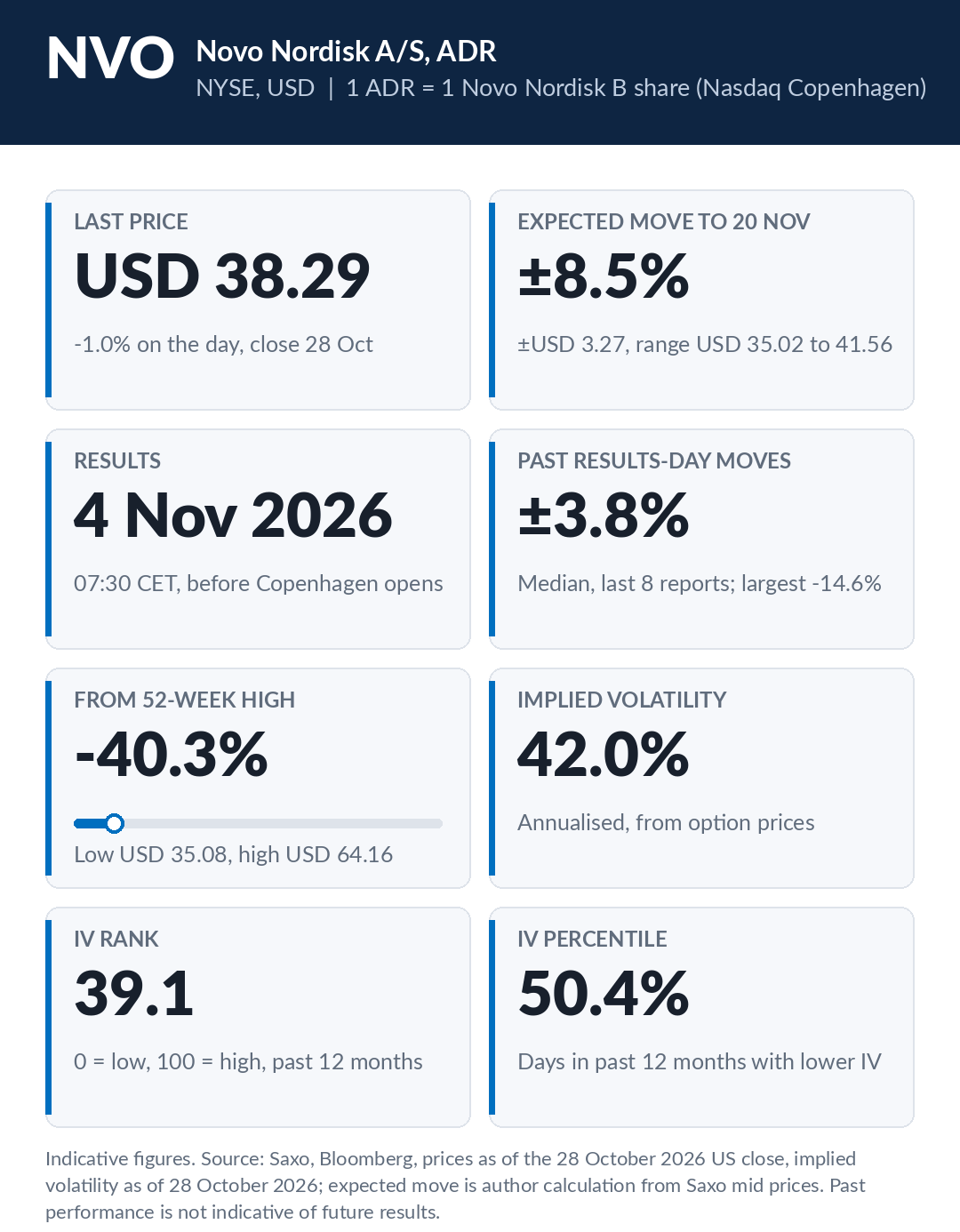 Key information on the NVO ADR. Indicative figures. Source: Saxo, Bloomberg, as of the 28 October 2026 US close. Past performance is not indicative of future results.
Novo Nordisk is scheduled to publish its nine-month 2026 results on Wednesday 4 November 2026, before the Copenhagen market opens. The focus is the 2026 outlook, raised in August but still pointing to lower sales than last year (Source: Novo Nordisk).
Many Danish investors own Novo Nordisk B shares on Nasdaq Copenhagen. At Saxo, the listed options on the company sit on a different line: the American Depositary Receipt (ADR) traded in New York under the ticker NVO. For anyone thinking about options around this report, that is the first thing to understand.
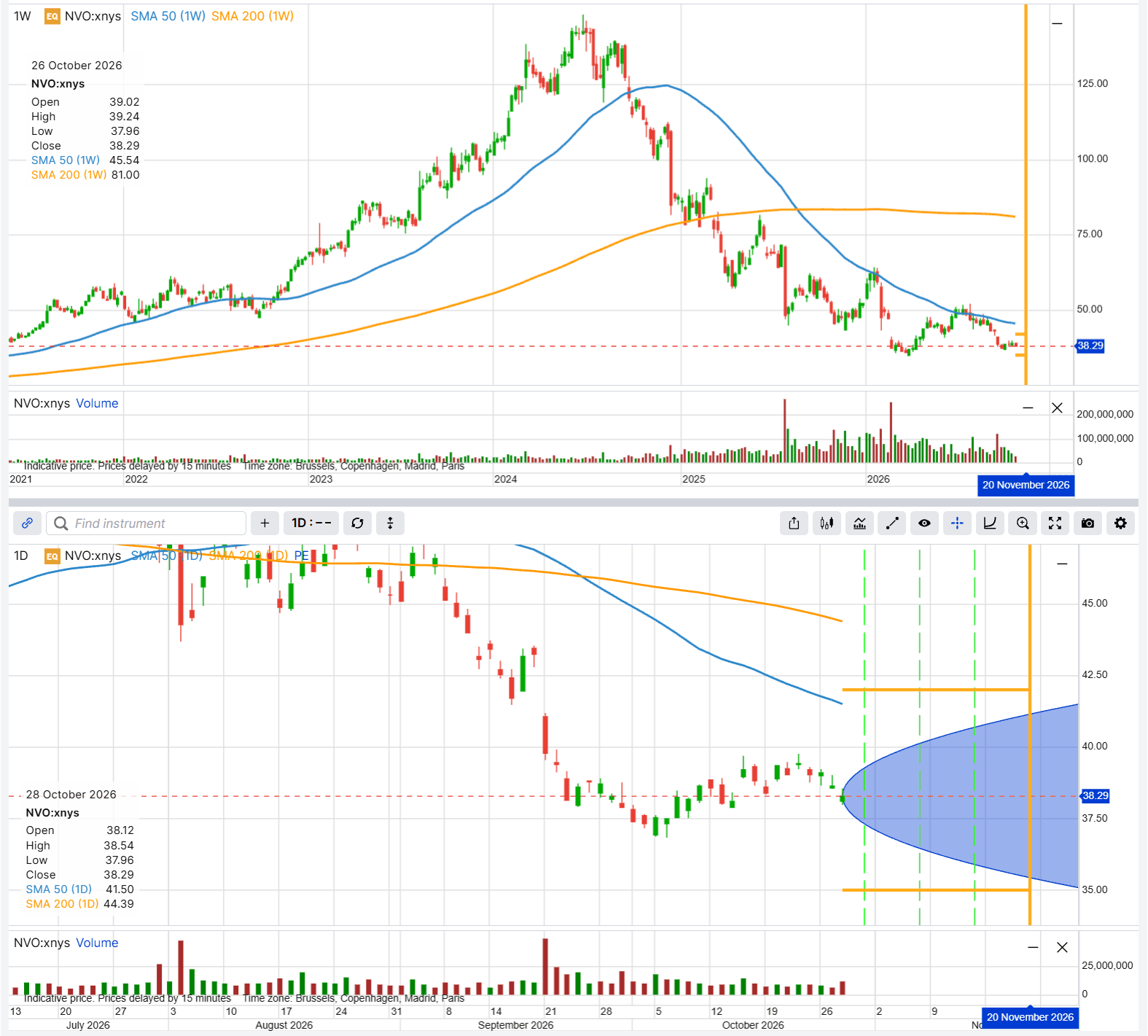 NVO ADR share price with the two example strikes and the 20 November 2026 expiry marked. Illustrative and educational, not predictive. Past performance is not indicative of future results. Source: SaxoTrader, indicative prices, as of 28 October 2026.
One company, two share lines
An ADR is a certificate traded in the US that stands for shares of a foreign company. Each NVO ADR represents one Novo Nordisk B share (Source: Novo Nordisk investor relations), but the two are different securities. The ADR trades in US dollars, on the New York Stock Exchange, from 15:30 to 22:00 CET. The B shares trade in Danish kroner in Copenhagen, which closes at 17:00 CET.
That has three practical effects. The dollar-krone exchange rate moves the result on top of the share price, in either direction. A report at 07:30 CET trades in Copenhagen for hours before New York opens. And a covered call is covered only by the security the option is written on. One NVO contract covers 100 ADRs, so a call sold against Copenhagen shares is not covered at all. It is a short call with open-ended risk.
Sizing the move from option prices
Adding the price of the call and the put at the strike closest to the share price gives a rough idea of how far the market thinks a share could move. For the 20 November expiry, that points to about 8.5% in either direction, over every trading day to expiry, not only results day.
- 38 strike: call 1.815 + put 1.435 = 3.25
- 38.50 strike: call 1.595 + put 1.69 = 3.285
- At the ADR price of USD 38.29: about USD 3.27, or 8.5%, a rough range of USD 35.02 to USD 41.56
- (Source: Saxo, indicative mid prices, as of the 28 October 2026 US close; author calculation)
On most of the last eight results days, the ADR moved less than 6%. The exception was February 2026, when an outlook released the evening before sent the ADR down about 15% and the Copenhagen shares about 17% (Source: Saxo, Bloomberg, closing prices). Past performance is not indicative of future results.
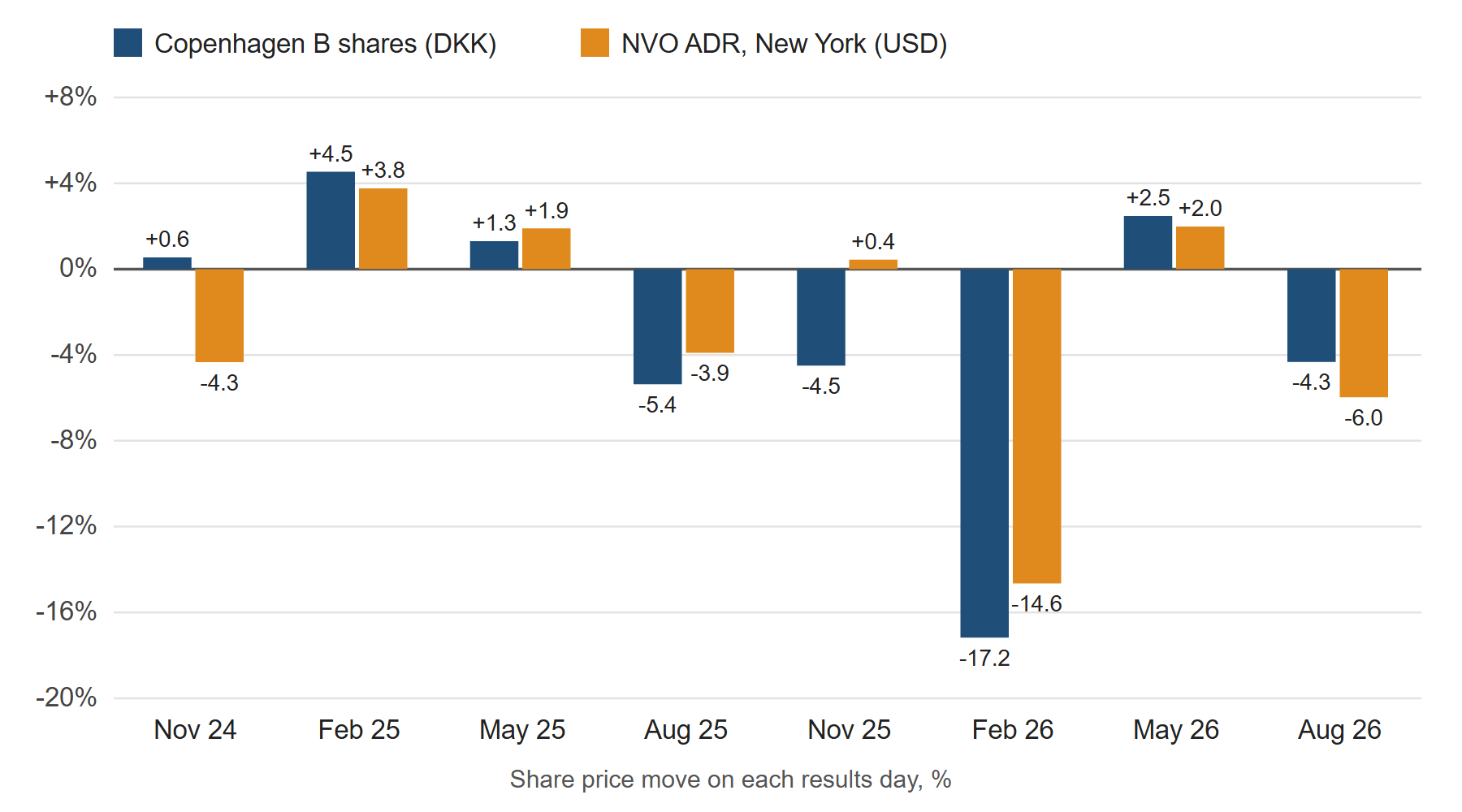 Share price move on the last eight Novo Nordisk results days, Copenhagen B shares and NVO ADR. Past performance is not indicative of future results; figures are illustrative and not predictive. Source: Saxo, Bloomberg, closing prices, November 2024 to August 2026.
A weekly for traders, a monthly for investors
A weekly NVO option expires on Friday 6 November 2026, two days after the report. That is a tool for short-term traders. The examples here use the monthly expiry on Friday 20 November 2026, a horizon closer to how an investor thinks. The premium is larger, but it pays for more than the report: it also covers two extra weeks of ordinary price movement.
Part of every option price right now is a payment for the uncertainty of results day. Once the numbers are out, that part usually shrinks. The seller collects it up front and carries the risk of a large move. Future outcomes are uncertain and may result in losses. In February and August 2026, Novo released its numbers the evening before the scheduled date, while New York was still trading (the US close is 22:00 CET); an early release would still fall well before 20 November.
Important note: The strategies and examples provided in this article are purely for educational purposes. They are intended to assist in shaping your thought process and should not be replicated or implemented without careful consideration. Every investor or trader must conduct their own due diligence and take into account their unique financial situation, risk tolerance, and investment objectives before making any decisions. Remember, investing in the stock market carries risk, and it’s crucial to make informed decisions.
Naming a lower purchase price: a cash-secured put at 35
Selling a cash-secured put means agreeing to buy 100 ADRs at the strike if NVO is below it at expiry. In exchange, the seller receives a premium today and keeps the full purchase amount set aside in cash. The view behind it: an investor who would be willing to own Novo, but only at a lower price.
The following example is hypothetical and for educational use only; it is not advice or a trade recommendation.
Example structure (illustrative only - not a trade recommendation)
- Sell 1 NVO 20 November 2026 35 put at about USD 0.42 (bid 0.40, ask 0.44), with NVO at USD 38.29
- Net credit: USD 42 (0.42 x 100), hypothetical, for education only
- Cash set aside: USD 3,500
- Break-even at expiry: USD 34.58, the strike less the premium, about 10% below the current price
- Maximum risk: USD 3,458 (hypothetical, for education only), if NVO fell to zero; Maximum profit: the USD 42 premium (hypothetical, for education only)
- (Source: Saxo, indicative prices, as of the 28 October 2026 US close)
The risk comes first. Below the break-even, the loss grows dollar for dollar, exactly as for a shareholder, while the premium is the whole gain however far NVO rises. A repeat of February’s fall would take the ADR to about USD 33, below the strike, and the seller would own the ADRs at a loss. Options carry a high risk of rapid loss and are not suitable for every investor. Costs and charges apply to each leg and vary by account and venue; check the applicable rates before entering any position.
Why 35: it is the first listed strike below the lower edge of the rough range, so a move of the size the options point to would not reach it.
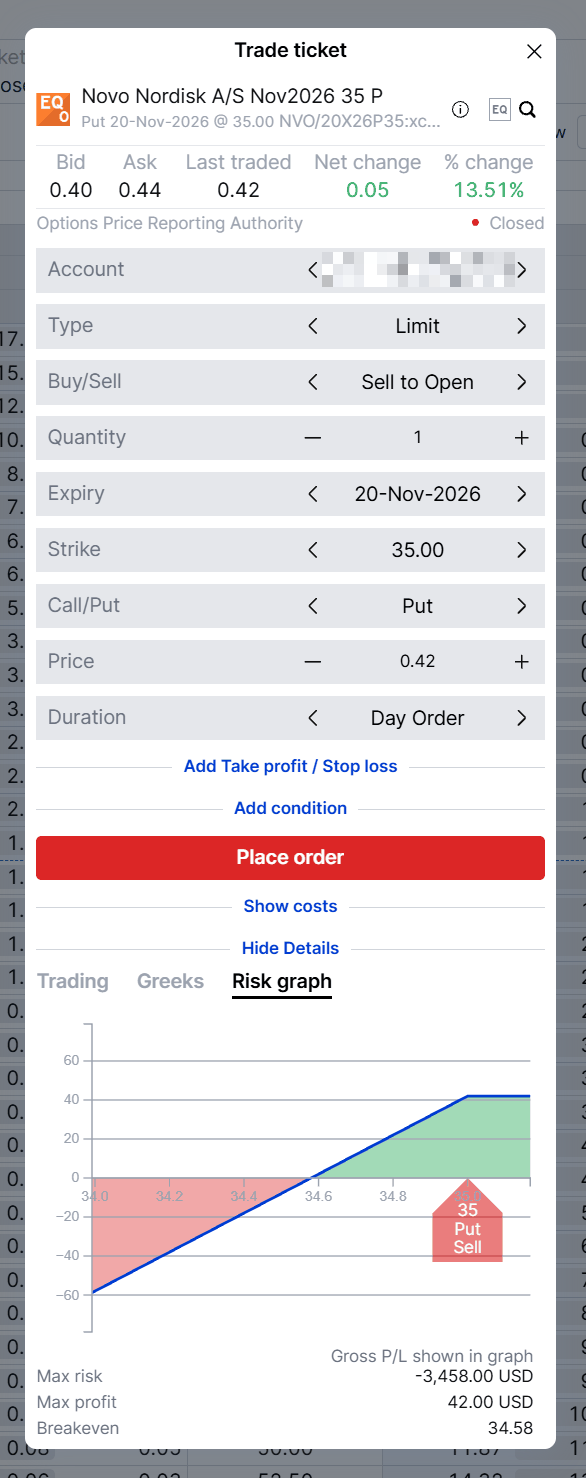
The 35 put in the SaxoTrader trade ticket, with the platform’s risk graph. Hypothetical, for education only. Past performance is not indicative of future results; figures are illustrative and not predictive. Source: SaxoTrader, indicative prices.
Naming a sale price for ADRs already held: a covered call at 42
Selling a covered call means agreeing to sell 100 ADRs already owned at the strike if NVO is above it at expiry, for a premium received today. This example is narrow on purpose: it fits only an investor who already holds NVO ADRs and has already settled on a price at which they would sell some. Whether Novo looks cheap or expensive after this year’s fall is each investor’s own judgement; the call does not answer that question.
The following example is hypothetical and for educational use only; it is not advice or a trade recommendation.
Example structure (illustrative only - not a trade recommendation)
- Own 100 NVO ADRs; Sell 1 NVO 20 November 2026 42 call at about USD 0.47 (bid 0.44, ask 0.50), with NVO at USD 38.29
- Net credit: USD 47 (0.47 x 100), about 1.2% of the USD 3,829 ADR value, hypothetical, for education only
- Break-even at expiry: USD 37.82, the ADR price less the premium
- Maximum profit: USD 418 (hypothetical, for education only), USD 371 of gain up to 42 plus the premium, if NVO is at or above 42 at expiry; Maximum risk: USD 3,782 (hypothetical, for education only), if NVO fell to zero
- (Source: Saxo, indicative prices, as of the 28 October 2026 US close)
The risk comes first. The investor retains the full downside risk of holding the ADRs. The premium received provides a partial offset, but it does not protect against a significant decline in the share price: a fall like February’s would cost roughly USD 560 on 100 ADRs, against USD 47 received. If results lift the shares well above 42, the holder also gives that gain away until expiry. Options carry a high risk of rapid loss and are not suitable for every investor. Costs and charges apply to each leg and vary by account and venue; check the applicable rates before entering any position.
Why 42: it is the first listed strike above the upper edge of the rough range.
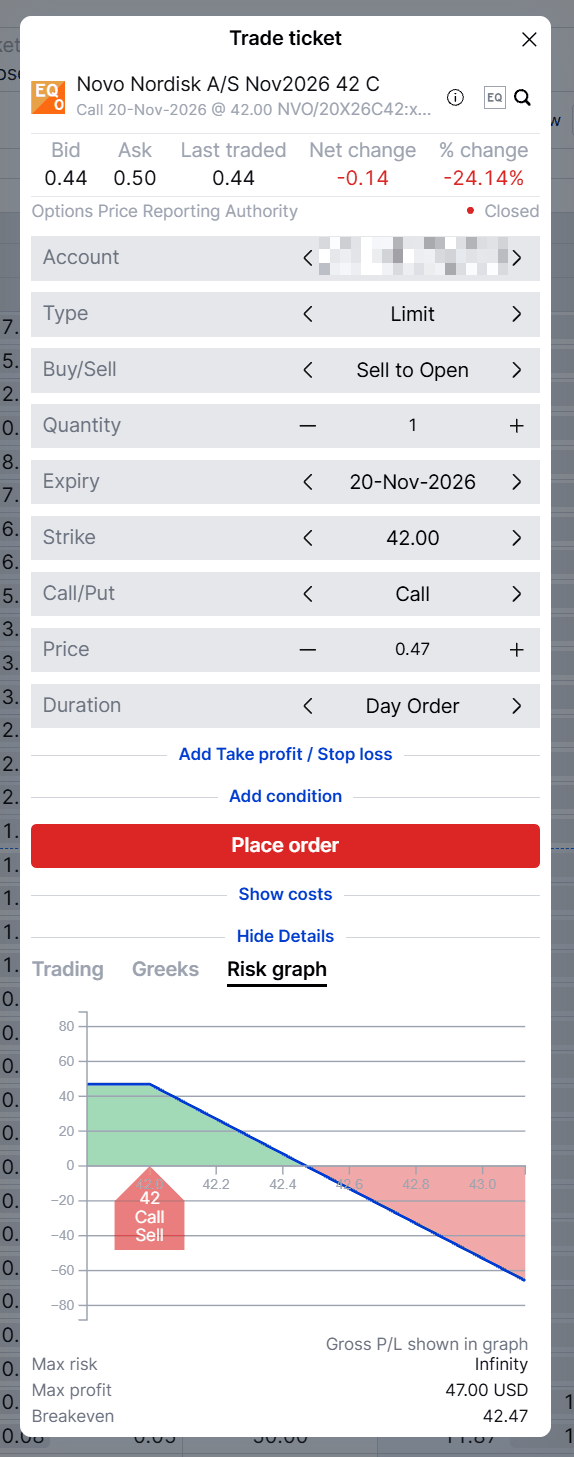
The 42 call in the SaxoTrader trade ticket. The ticket shows the call on its own, so it reports unlimited risk; held against 100 NVO ADRs, a rise above 42 is covered by the ADRs, and the remaining risk is a fall in the share price. Hypothetical, for education only. Past performance is not indicative of future results; figures are illustrative and not predictive. Source: SaxoTrader, indicative prices.
What neither example protects against
Neither example protects against a large fall. The put seller may end up owning ADRs bought above the market price, and the call seller still owns the ADRs. Next to a move like February’s, the premium is small.
An investor who believes the shares have fallen far enough sees it from the other side: the covered call may give away the part they care about most, a recovery. An investor who does not want to own Novo has no use for the put. For both, and for anyone who prefers to wait for the numbers, doing nothing is a valid outcome. Tax treatment of options and ADRs depends on each investor’s own situation and local rules.
Before placing the trade, check:
- The gap between bid and ask, and the open interest at the strike
- The expiry: Friday 20 November 2026, and that the strike is listed
- The report timing: scheduled 07:30 CET on 4 November 2026, with an early release on the evening of 3 November possible
- That the account holds USD for the cash set aside, or what a currency conversion would cost
- For the covered call, that the position is in ADRs, not Copenhagen shares
- Commission, charged per contract and larger in proportion on a small premium
- An exit plan, decided before the report
Assignment risk note: NVO options are American-style, so a short option can be assigned on any day before expiry if it moves in the money. Settlement is by delivery of ADRs, not Copenhagen shares. Only the seller of an option faces assignment risk.
Back to the Copenhagen holding
For a Copenhagen holder, the main lesson around this report is a practical one. The options available at Saxo sit on the ADR, so they bring a second currency, a second trading session and, for the covered call, a second holding. In our view, those details may matter as much as the choice between a put and a call. Either example can be closed before expiry, but neither removes the size of a results-day move. Options carry a high risk of rapid loss and are not suitable for every investor.
The author does not hold positions in any of the instruments mentioned in this article. The Author is permitted to wait at least 24 hours from the time of the publication before they trade the instruments themselves.
| More from the author |
|---|