
Für den Zugriff auf die beiden Plattformen können Sie jeweils dasselbe Saxo-Konto verwenden.

Novartis results: buying lower or selling higher, when the big moves come from elsewhere
Options 10 minutes to read

Summary: Novartis reports its third-quarter results on 27 October 2026. Results days have been calm; its sharpest fall this year came from trial news. One investor wants to buy lower, another already owns the shares. How can each name a price and be paid to wait?
An option does not only pay for the results day. It pays for every day until it expires, and the news those days bring.
Novartis publishes its third-quarter 2026 results on Tuesday 27 October 2026, before the Swiss market opens (Source: Novartis investor relations, as of 22 October 2026). The shares closed at CHF 128.88 on 22 October 2026 (Source: Saxo). In July, the company kept its 2026 outlook: sales growing slightly, and core operating income, its main profit measure, slightly lower, as cheaper copies of its heart drug Entresto take US sales (Source: Novartis, second-quarter results, 21 July 2026).
Results days have been calm for Novartis. Over the last eight, the shares typically moved about 1.9% on the day, and never more than 4.2%. The sharpest fall in that period came on another day. On 8 September 2026, after its second late-stage trial failure in a week, the shares fell 10.9% (Source: Saxo price data; Novartis, 8 September 2026). Past performance is not indicative of future results.
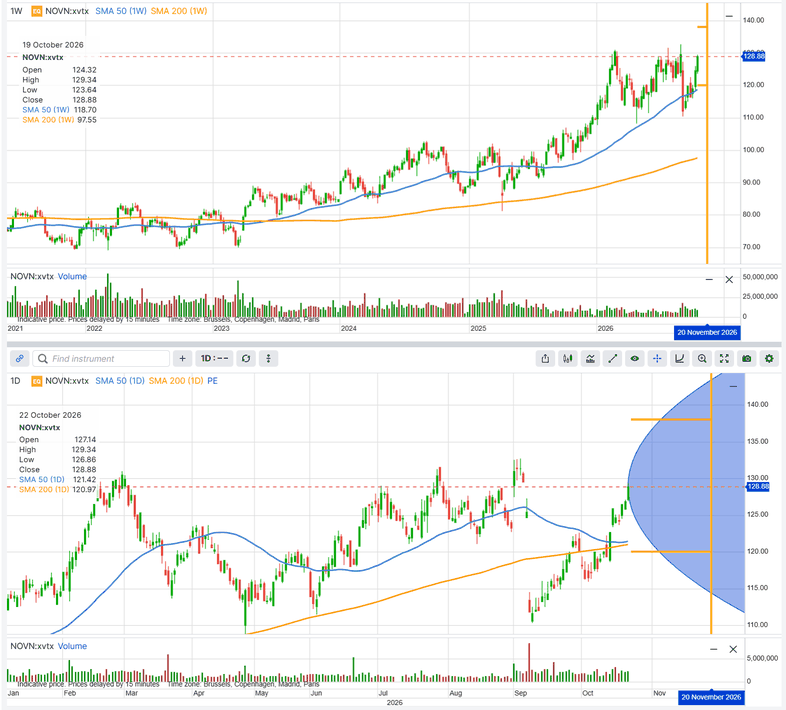
Novartis, with the 120 and 138 strike prices and the 20 November 2026 expiry marked. Illustrative and educational, not predictive. Past performance is not indicative of future results. Source: SaxoTrader, indicative prices, as of 23 October 2026.
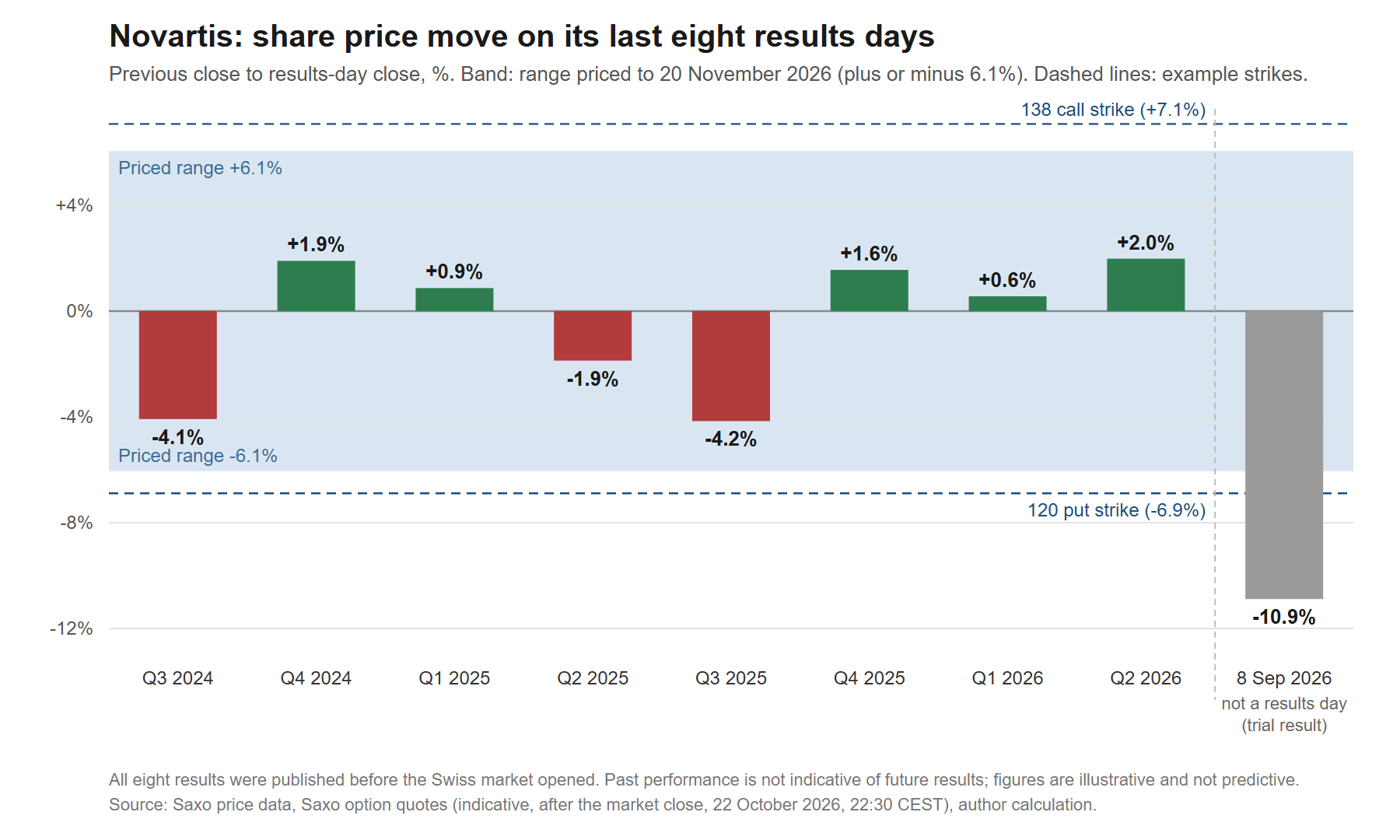 Novartis share price move from the previous close to the close on results day, last eight results, and the 8 September 2026 trial-result day for comparison, against the range priced by the 20 November 2026 options (indicative Saxo quotes after the market close, as of 22 October 2026, 22:30 CEST). Those options run more than three weeks after the report, so the band is not a one-day estimate. Past performance is not indicative of future results; figures are illustrative and not predictive. Source: Saxo price data, Saxo option quotes, author calculation.
What the options market expects
Option prices give a rough idea of how far the market thinks a share could move. Add the price of the call and the put with a strike closest to today’s share price. For 20 November, that points to a move of about 6.1% in either direction, or roughly CHF 121 to CHF 137 (at the 128 strike, call CHF 4.60 plus put CHF 3.20 makes about CHF 7.80, on a share price of CHF 128.88. Source: Saxo, indicative prices after the market close, as of 22 October 2026, 22:30 CEST).
That is about three times the typical results-day move. The reason is time. The first Novartis options to expire after the report run until 20 November, 24 days later. So the 6.1% covers the report and more than three weeks of other news. After September, investors know that other news can matter more than the report.
Option prices on Novartis are also high compared with their own past year (Source: Saxo, as of 22 October 2026). In our view, that may be the September falls still showing in the price. For a seller of options, a higher price means a larger payment for the same promise. It also means the market sees more risk.
What happens to the option price after the report
Part of an option’s price pays for uncertainty, including the report. Once the numbers are out, that payment usually shrinks, even if the shares hardly move. Traders call this IV crush. With Novartis, the report is one day in a 24-day option, so in our view the drop after 27 October may be modest. A seller should not count on a quick gain. Options carry a high risk of rapid loss and are not suitable for every investor.
Important note: The strategies and examples provided in this article are purely for educational purposes. They are intended to assist in shaping your thought process and should not be replicated or implemented without careful consideration. Every investor or trader must conduct their own due diligence and take into account their unique financial situation, risk tolerance, and investment objectives before making any decisions. Remember, investing in the stock market carries risk, and it’s crucial to make informed decisions.
Why the 20 November expiry
The examples use the monthly Novartis options on Eurex, the European options exchange, expiring Friday 20 November 2026. Each contract covers 100 shares and is priced in Swiss francs. Saxo lists no weekly Novartis options before that date, so 20 November is the first expiry after the report. December options pay more but add another month of risk.
For the investor who wants to buy Novartis lower: a cash-secured put at 120
The idea: Novartis is worth owning, but this investor would rather buy lower than today’s price. The seller of the put agrees to buy 100 shares at CHF 120 if Novartis is below that price on 20 November. In return, the seller receives a payment today, called the premium. "Cash-secured" means the money to buy the shares is set aside.
Hypothetical, for education only. Not advice or a trade recommendation.
Example structure (illustrative only - not a trade recommendation)
- Sell 1 Novartis 20 November 2026 120 put at about CHF 0.93 per share (bid 0.76, ask 1.10), with Novartis at CHF 128.88
- Net credit: about CHF 93, all from the one put (CHF 0.93 on 100 shares), against CHF 12,000 of cash set aside
- Break-even at expiry: CHF 119.07, the strike less the premium, about 7.6% below the price at the time
- Maximum profit: CHF 93 (hypothetical), if Novartis is at or above 120 at expiry
- Maximum risk: CHF 11,907 (hypothetical), if Novartis fell to zero
- (Source: Saxo, indicative prices after the market close, as of 22 October 2026, 22:30 CEST)
Why 120: it is the first listed strike below the range the market expects for the month. None of the last eight results days would have taken Novartis that low. The 8 September fall would have.
Risk: CHF 93 is the most the seller can earn. If Novartis ends below CHF 119.07, the seller loses money, as a shareholder would. Options carry a high risk of rapid loss and are not suitable for every investor. Costs and charges apply to each leg and vary by account and venue; check the applicable rates before entering any position.
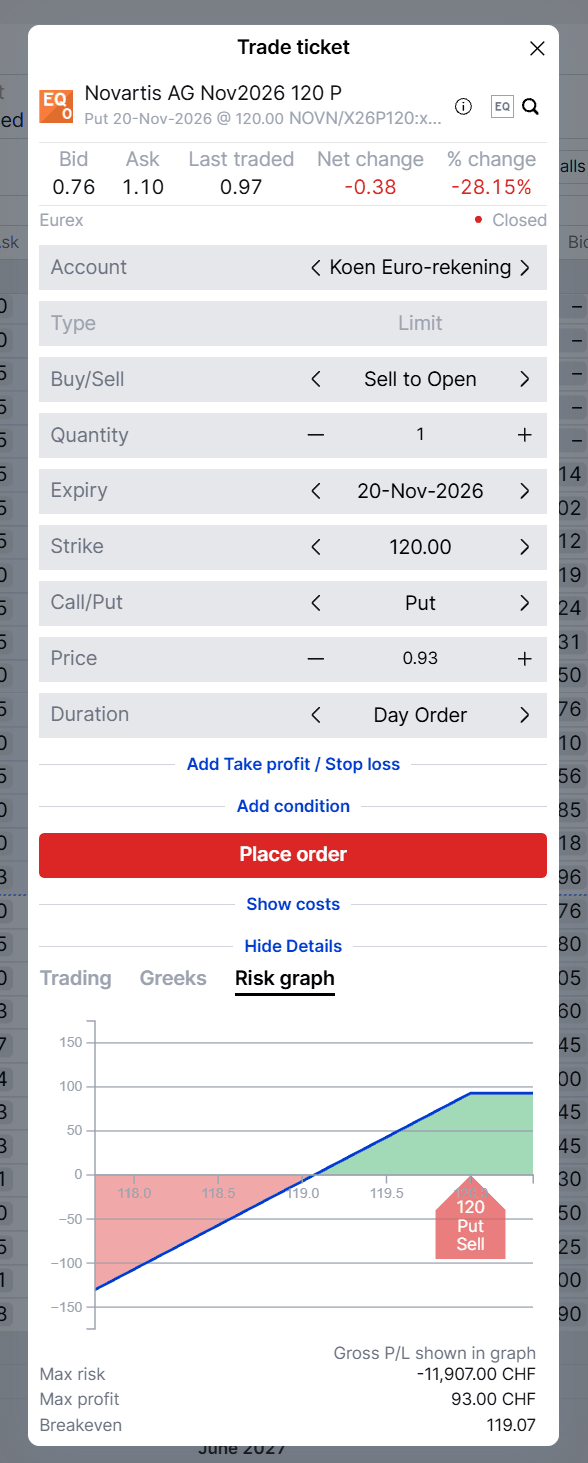 The 120 put in the SaxoTrader trade ticket, with the platform’s risk graph, max risk, max profit and break-even. Hypothetical, for education only. Past performance is not indicative of future results; figures are illustrative and not predictive. Source: SaxoTrader, as of 23 October 2026.
For the investor who already holds Novartis: a covered call at 138
The idea: this investor owns Novartis and would be happy to sell at CHF 138, about 7% higher. The seller of the call agrees to sell 100 shares at CHF 138 if Novartis is above that price on 20 November, and receives a premium today. "Covered" means the seller already owns the shares.
Hypothetical, for education only. Not advice or a trade recommendation.
Example structure (illustrative only - not a trade recommendation)
- Own 100 Novartis shares; Sell 1 Novartis 20 November 2026 138 call at about CHF 0.96 per share (bid 0.78, ask 1.14), with Novartis at CHF 128.88
- Net credit: about CHF 96, all from the one call (CHF 0.96 on 100 shares), around 0.7% of the CHF 12,888 share value
- Break-even at expiry: CHF 127.92, the share price less the premium
- Maximum profit: about CHF 1,008 (hypothetical) on shares and call together, if Novartis is at or above 138 at expiry
- Maximum risk: CHF 12,792 (hypothetical), the share value less the premium, if Novartis fell to zero
- (Source: Saxo, indicative prices after the market close, as of 22 October 2026, 22:30 CEST)
Why 138: it sits just above the range the market expects for the month. No results day in the last eight came close to a 7% rise. That is what the investor gives up: a rare jump, in exchange for a small, certain payment.
Risk: the investor retains the full downside risk of holding the shares. The premium received provides a partial offset, but it does not protect against a significant decline in the stock price. A repeat of the 10.9% fall on 8 September would cost about CHF 1,400 on 100 shares at today’s price, against CHF 96 received. Options carry a high risk of rapid loss and are not suitable for every investor. Costs and charges apply to each leg and vary by account and venue; check the applicable rates before entering any position.
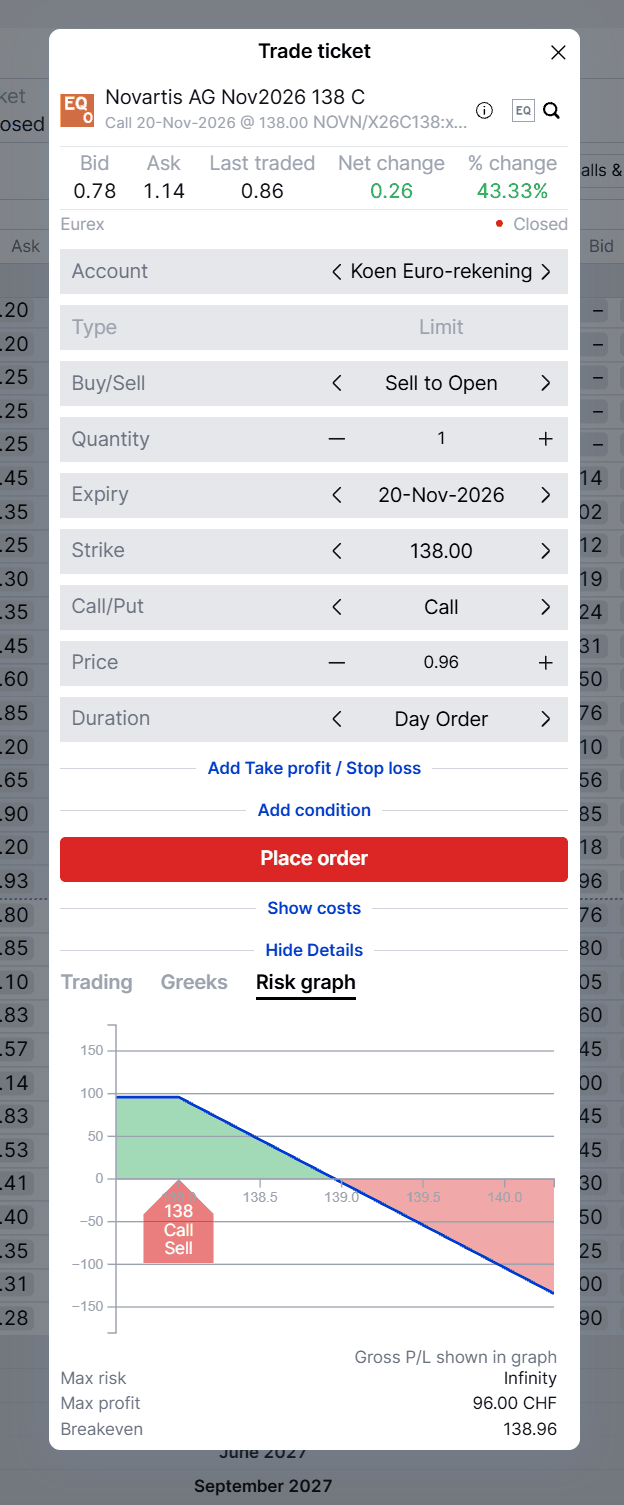 The 138 call in the SaxoTrader trade ticket. The ticket shows the call on its own, which is why it reports unlimited risk: that applies only to a call sold without the shares. Held against 100 Novartis shares, a rise above 138 is covered by the shares, and the remaining risk is a fall in the share price. Hypothetical, for education only. Past performance is not indicative of future results; figures are illustrative and not predictive. Source: SaxoTrader, as of 23 October 2026.
And if neither view fits
Both examples assume the investor wants to own Novartis. Another investor may think September was not the last bad news. In our view, the put may not suit that investor: CHF 93 is little comfort when buying a share that keeps falling. A holder with that view may prefer to sell some shares, or buy a put as protection, which costs money instead.
A holder who expects the shares to recover what they lost in September gives part of that rise away with the covered call. And doing nothing is always an option.
Before placing the trade, check:
- The gap between the buying and selling price
- How many contracts are open at that strike, a sign of how easy it is to trade
- The report timing: 27 October 2026, before the Swiss market opens
- Commission, charged per contract
- Whether the cash is really set aside
- An exit plan, decided before the report
Assignment risk note: Novartis options can be exercised on any day before expiry. So a seller may have to buy or sell the shares early if the share price passes the strike. Only the seller of an option faces this.
Final thoughts
The two examples are one idea seen from both sides. The put seller names a lower price to buy at, the call seller a higher price to sell at, and both are paid for the uncertainty of the coming weeks, not only the report.
That is the point Novartis makes clearly this year. Results days have been calm; the sharp move came from news on an ordinary day. In our view, selling an option on Novartis may suit only an investor comfortable owning the shares after a day like 8 September. Either position can be closed early if the view changes. Options carry a high risk of rapid loss and are not suitable for every investor.
The author does not hold positions in any of the instruments mentioned in this article. The Author is permitted to wait at least 24 hours from the time of the publication before they trade the instruments themselves.
| More from the author |
|---|