
Für den Zugriff auf die beiden Plattformen können Sie jeweils dasselbe Saxo-Konto verwenden.

Covered calls, step by step: getting paid to wait
Options

Summary: A covered call pays an investor a known amount today in return for capping the gain on shares already owned. This step-by-step guide follows one example through three outcomes and the prices that matter.
What if the shares you already own could pay you something while you wait?
Think of a landlord. The house stays his, and a tenant pays rent to use it. A covered call works in a similar way. An investor keeps the shares, and someone else pays for the right to buy them later, at a price fixed today.
This page follows one example from start to finish. The company is fictitious, and all numbers are made up to show the mechanism.
Important note: The strategies and examples provided in this article are purely for educational purposes. They are intended to assist in shaping your thought process and should not be replicated or implemented without careful consideration. Every investor or trader must conduct their own due diligence and take into account their unique financial situation, risk tolerance, and investment objectives before making any decisions. Remember, investing in the stock market carries risk, and it’s crucial to make informed decisions.
Step 1: The idea
Suppose an investor owns 100 shares of Fictitious Inc., bought at USD 100. The shares are a long-term holding, and the investor would not mind selling at a higher price.
A call option is a contract. The buyer pays a fee, called the premium, and gets the right to buy 100 shares at a set price, the strike, until a set date, the expiry. The investor can be the one who sells that contract. Selling a call against shares already owned is called a covered call. "Covered" means the shares are there if the buyer uses the right.
Step 2: What the investor agrees to
In the example, the investor sells one call contract with these terms:
Example structure (illustrative only, not a trade recommendation):
- Own 100 Fictitious Inc. shares at USD 100
- Sell 1 call, strike USD 110, expiry in 30 days, at USD 1.50 per share
- Premium received: USD 150 (USD 1.50 × 100 shares)
- Maximum profit: USD 1,150, if the shares are at or above USD 110 at expiry (USD 1,000 gain on the shares plus the USD 150 premium)
- Maximum risk: USD 9,850, if the shares fell to zero, since the shares are still owned and only the USD 150 premium offsets the fall
This is a hypothetical example for education only. The investor keeps the full downside risk of owning the shares. The premium softens a fall a little but does not protect against a large one.
The USD 150 arrives straight away and is kept whatever happens. In return, the investor agrees to sell the 100 shares at USD 110 if the price is above USD 110 at expiry. That is the trade: income now, in exchange for a limit on the gain.
Time works in the seller’s favour here. An option loses a little value every day as expiry gets closer. This is called time decay, or theta. The seller of the call benefits from it. The buyer pays for it.
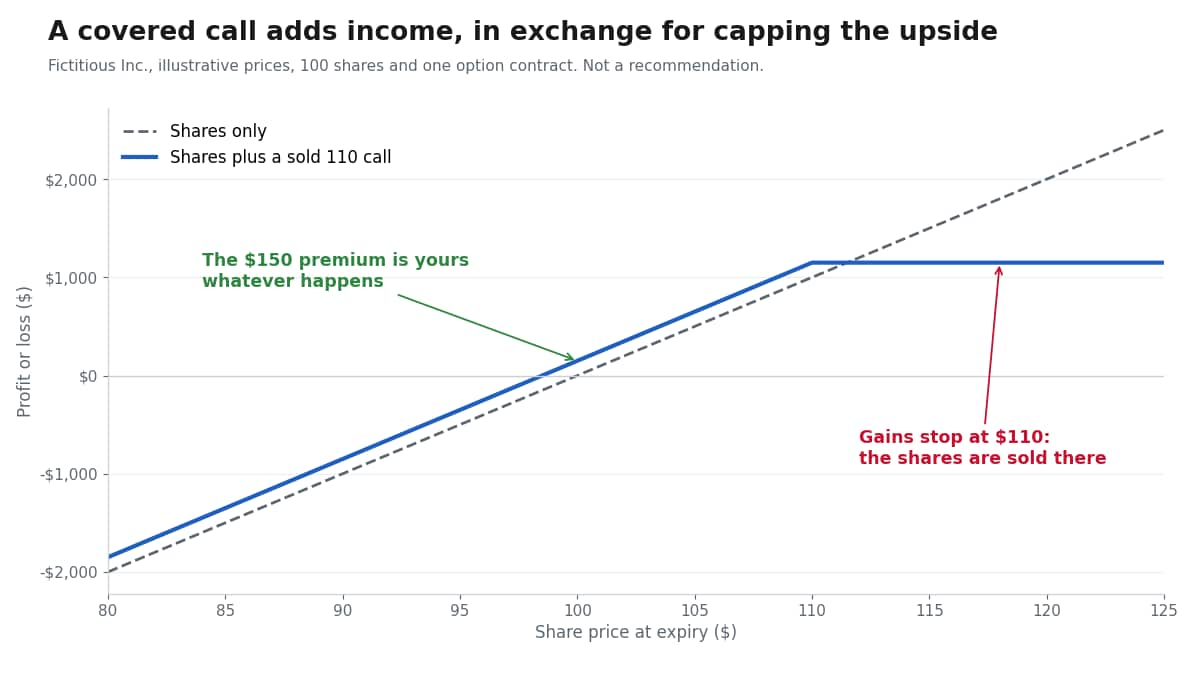 Illustrative example with a fictitious company and made-up prices. Not a recommendation. Past performance is not indicative of future results. The chart is illustrative and not predictive.
Step 3: Three possible outcomes
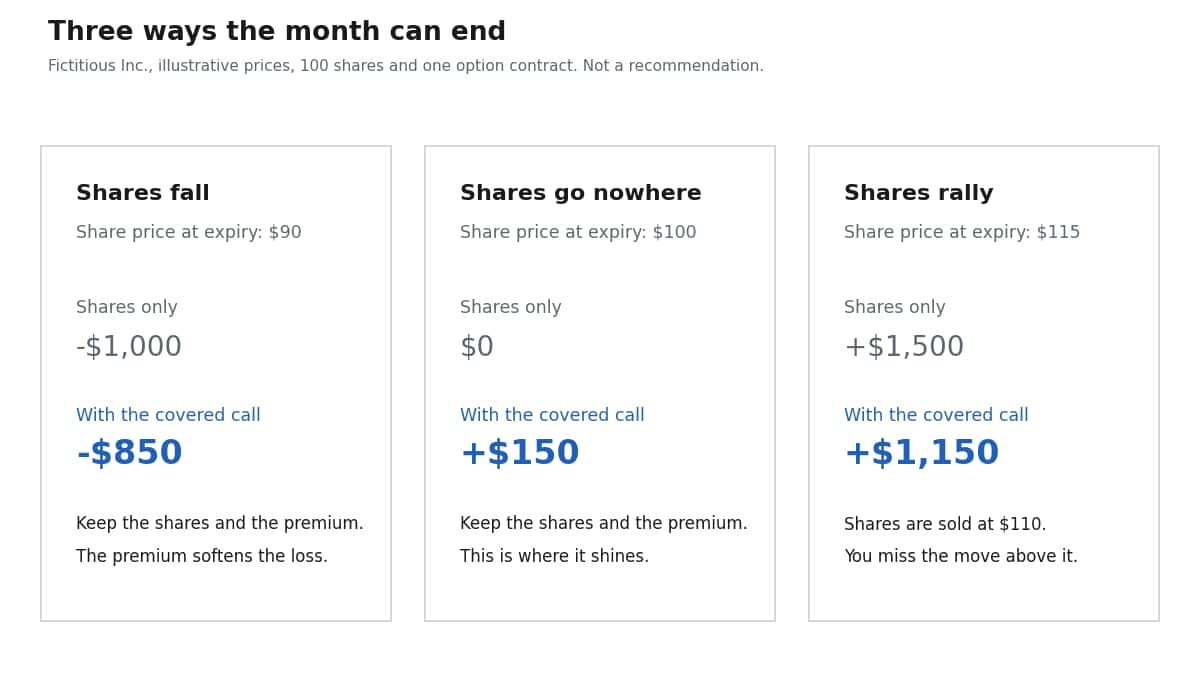
Here is what the position would look like at expiry in three cases, compared with simply holding the shares.
 Illustrative example with a fictitious company and made-up prices. Not a recommendation.
The shares fall to USD 90. Holding shares alone would lose USD 1,000. With the call sold, the loss is USD 850, because the USD 150 premium is kept. The call expires worthless. The premium softens the fall. It does not stop it.
The shares stay at USD 100. The call expires worthless and the investor keeps the USD 150 and the shares. This is the case where the strategy works best.
The shares rise to USD 115. The buyer uses the right, and the shares are sold at USD 110. The result is a gain of USD 1,150. Holding the shares alone would have gained USD 1,500. The USD 350 difference is the part of the move above USD 110 that the investor gave up. In a strong rally, the covered call earns less than the shares alone would have.
These outcomes are hypothetical and for education only. In the first case the investor still loses money.
Step 4: The prices that matter
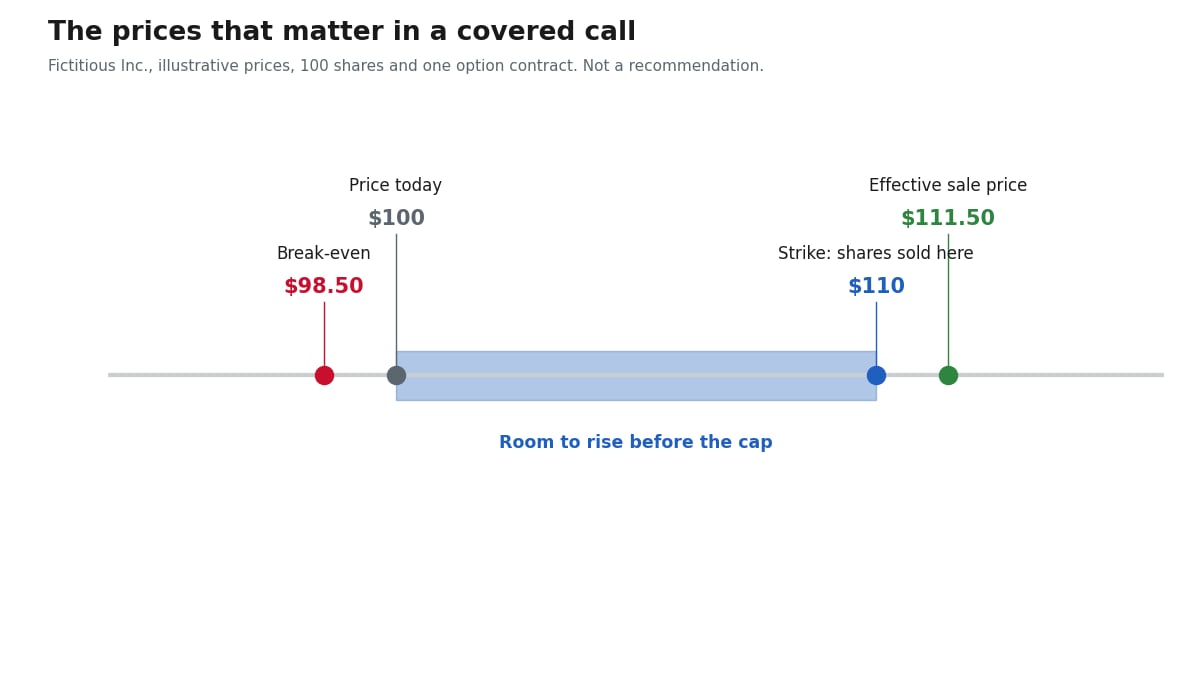
Three prices describe the whole position.
 Illustrative example with a fictitious company and made-up prices. Not a recommendation.
The break-even is USD 98.50. This is the purchase price minus the premium. Below that level the position loses money at expiry. The strike is USD 110. Above it, the shares are sold and the gain stops growing. The effective sale price is USD 111.50, the strike plus the premium received.
Step 5: When it fits, and when it does not
A covered call tends to suit an investor who would be fine selling the shares at the strike price, and who expects the price to stay calm or rise a little. In that case, the premium is a payment for something the investor was willing to do anyway.
It tends to fit badly in two cases. The first is shares the investor never wants to part with. If the price jumps past the strike, the shares may be called away. The second is the period before an event that could move the price a lot, such as an earnings report. If the shares jump, the gain above the strike goes to the buyer of the call.
Fees and commissions are charged per contract and weigh more on a small premium, so check the costs in the trading platform first.
Options carry a high risk of rapid loss and are not suitable for every investor.
Step 6: What assignment means
If the shares are above USD 110 at expiry, the investor is assigned. The 100 shares are sold at USD 110 and the cash arrives in the account. That is not a penalty: it is the deal the investor agreed to, and the USD 150 premium is still kept. Assignment can also happen before expiry, mostly when the share price is well above the strike.
What to take away
A covered call swaps some of the upside for money received today. The premium is known up front, the extra gain is capped, and the risk of owning the shares stays in place.
| Related articles/content |
|---|
| Protective puts step by step insurance for your shares | 26 Nov 2026 What investors misunderstand about covered calls | 10 Jun 2026 Covered call or cash-secured put | 2 Jun 2026 From shareholder to options user | 26 May 2026 |
| More from the author |
|---|