
You can access both of our platforms from a single Saxo account.

What is a LEAPS call? Palo Alto Networks as a worked example

Summary: What does a long-dated call option change compared with owning the shares? Using Palo Alto Networks as a worked example, this article compares the two in a fall, a flat year and a rise, and shows where the call falls short.
Less cash, a known maximum loss and a price for time: how does a long-dated call compare with owning the shares?
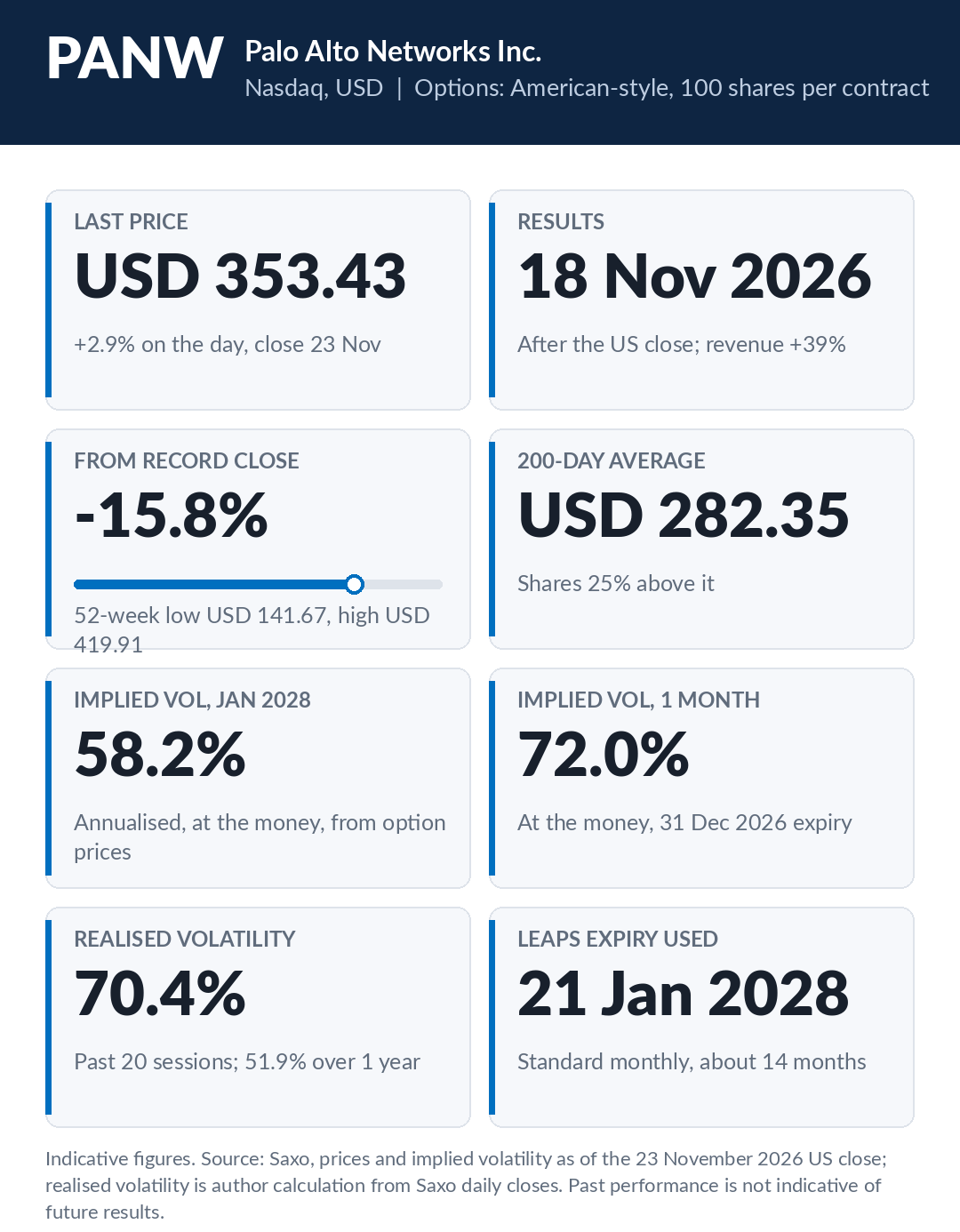 Key information on Palo Alto Networks. Indicative figures. Source: Saxo, as of 23 November 2026. Past performance is not indicative of future results.
Palo Alto Networks reported fiscal first-quarter results after the US market close on 18 November 2026. Revenue grew 39% from a year earlier and the company raised its outlook for the full fiscal year (Source: Palo Alto Networks earnings release, 18 November 2026). The shares nearly doubled between the end of 2025 and 23 November, though not in a straight line: a record close near USD 420 in early October, a slide to about USD 309 by mid-November, a jump around the results, and a 5% drop on 20 November when the wider US market fell sharply (Source: Saxo). Past performance is not indicative of future results.
That mix of rapid revenue growth, high expectations and large price swings makes the company a useful case study for a question many investors ask: what does a long-dated call option change compared with buying the shares? Our colleague Ruben Dalfovo looks at the business side of digital security in his recent article; this piece looks only at how the option works.
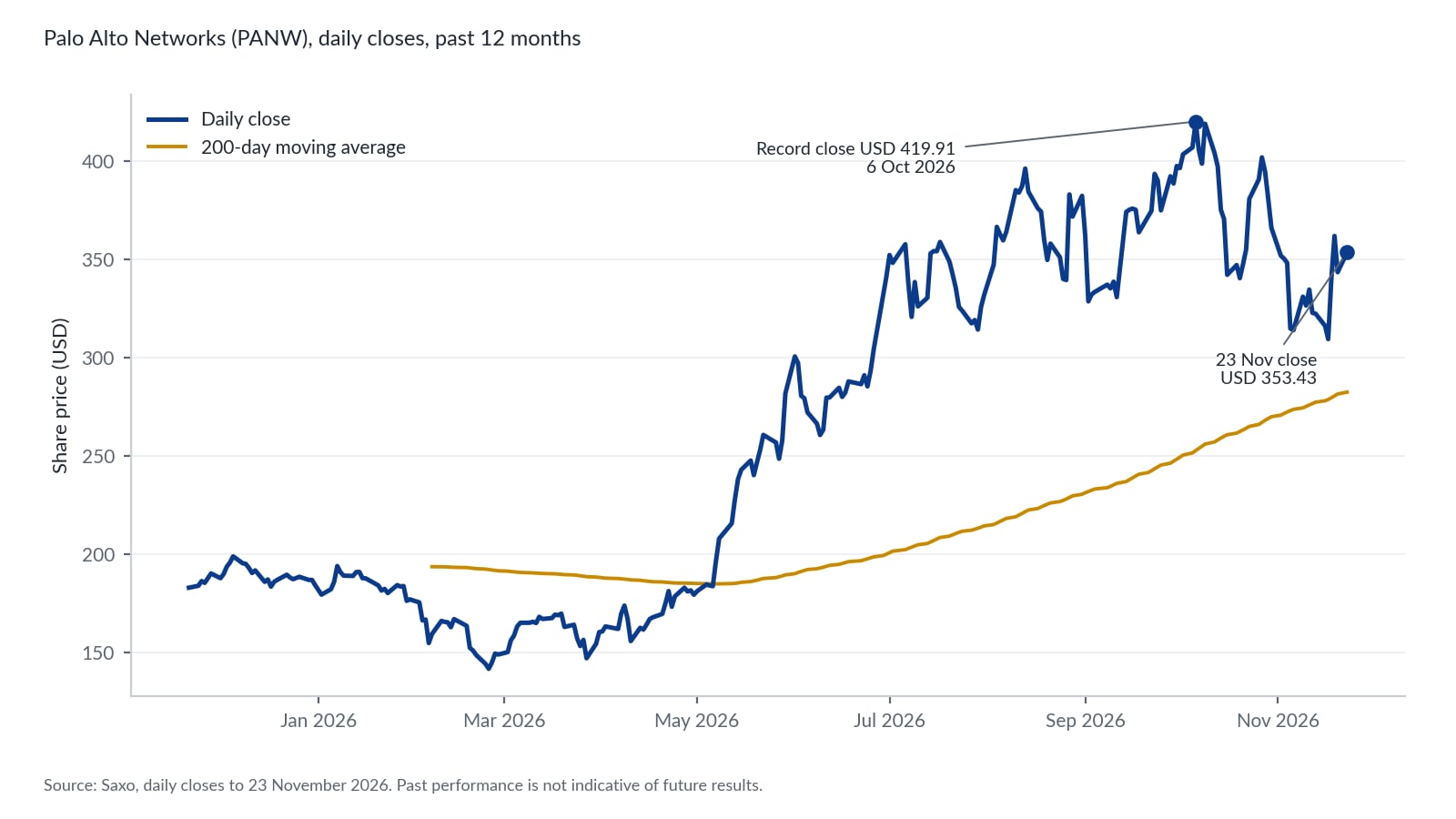 Palo Alto Networks daily closes with the 200-day moving average. Source: Saxo. Past performance is not indicative of future results. This chart is illustrative and for educational purposes only; it is not predictive.
What a LEAPS call is
LEAPS (long-term equity anticipation securities) are options with more than a year left to run. A LEAPS call gives the right, but not the obligation, to buy 100 shares at a fixed price, the strike, until expiry. The buyer pays for that right up front and can lose all of it, but never more.
The price of such a call has two parts. Take a call with a strike of USD 260 while the shares trade near USD 353. The first part is what the call is already worth today, the gap of about USD 93 per share, and it rises and falls with the shares. The second part is the price of time: what the buyer pays to keep the upside open until expiry. That part shrinks to zero by expiry, so if the shares go nowhere, it is lost.
How much time costs depends on how much the market expects the shares to swing. Options on Palo Alto Networks expiring in January 2028 currently assume larger swings than the shares delivered over most of the past year (Source: Saxo, as of the 23 November 2026 close). In our view, time therefore appears relatively expensive on this stock right now, which matters for everything below.
Important note: The strategies and examples provided in this article are purely for educational purposes. They are intended to assist in shaping your thought process and should not be replicated or implemented without careful consideration. Every investor or trader must conduct their own due diligence and take into account their unique financial situation, risk tolerance, and investment objectives before making any decisions. Remember, investing in the stock market carries risk, and it’s crucial to make informed decisions.
The worked example: a call that behaves like shares
The following example is hypothetical and for educational use only; it is not advice or a trade recommendation.
Example structure (illustrative only - not a trade recommendation)
- Buy 1 PANW 21 Jan 2028 260 call (mid about USD 140.90 per share; bid 137.85, ask 144.00)
- Cost: about USD 14,090 per contract, against about USD 35,300 for 100 shares
- Maximum risk: the full cost, about USD 14,090 per contract, if Palo Alto Networks closes at or below 260 at expiry
- Maximum profit: not capped
- Break-even at expiry: about USD 400.90, about 13% above the 23 November close
- (Source: Saxo, indicative mid prices as of the 23 November 2026 close; author calculation. The mid is the midpoint between the best bid, what buyers offer, and the best ask, what sellers want. All figures are hypothetical and for education only.)
Because the strike sits far below the share price, the call follows the shares closely, though not one for one: for every USD 1 the shares move, it moves by roughly USD 0.80, because there is still some chance the shares end below the strike. The call costs about USD 140.90 per share. Using it today would mean buying at USD 260 shares that trade near USD 353, so it already holds about USD 93 of value (353 minus 260). The remaining USD 48 or so (140.90 minus 93) is the price of time, paid to keep the upside open for the 14 months until 21 January 2028. That is why the break-even sits at about USD 400.90, the strike plus the full price paid, well above today’s price. The full cost of about USD 14,090 per contract can be lost if the shares close at or below USD 260 at expiry. Costs and charges apply to each leg and vary by account and venue; check the applicable rates before entering any position.
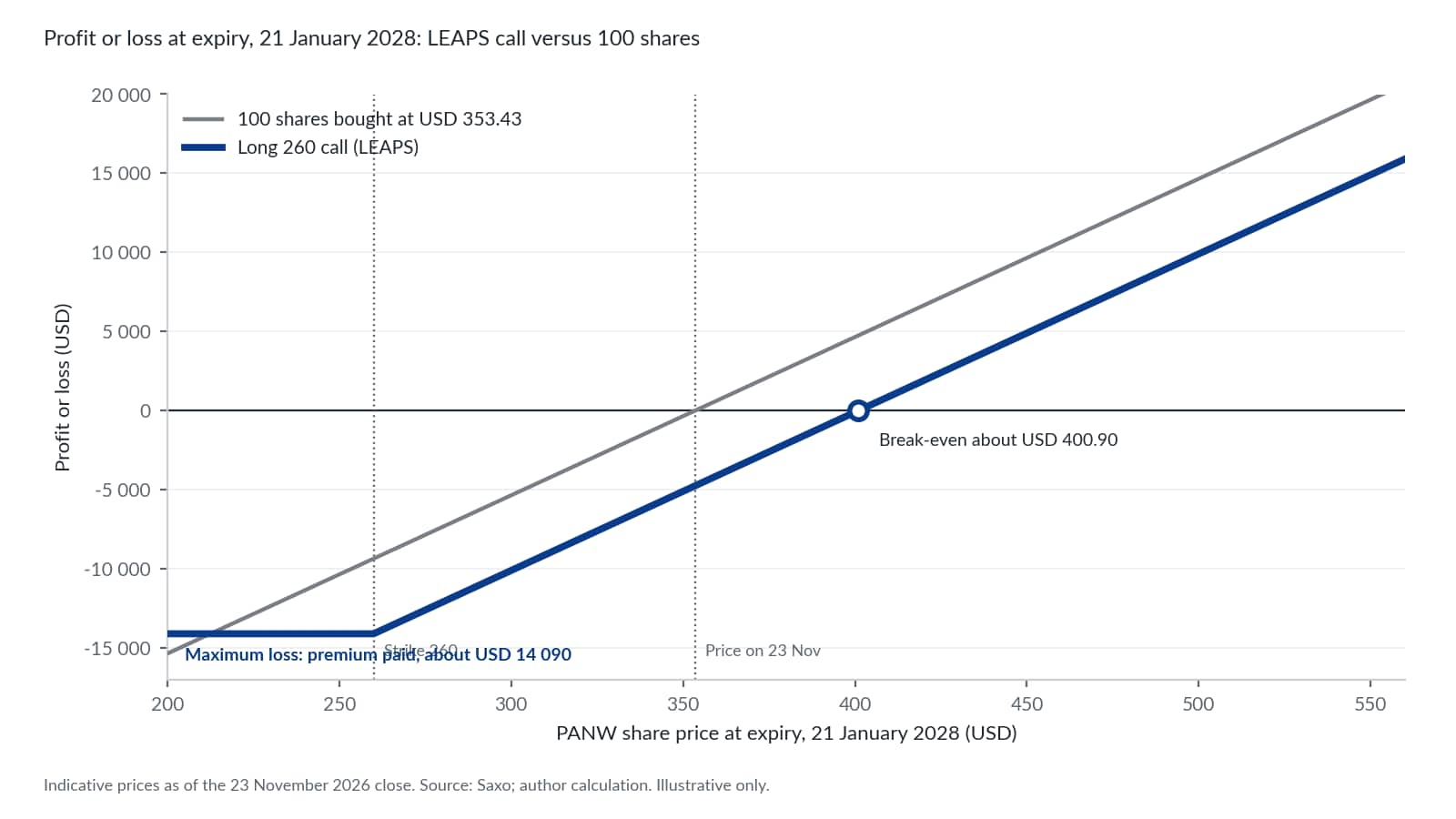 Profit or loss at expiry, long PANW 21 January 2028 260 call versus 100 shares. Indicative prices as of 23 November 2026. Source: Saxo; author calculation. Past performance is not indicative of future results; figures are illustrative and not predictive.
Shares or call: what happens in a fall, a flat year and a rise
Comparing the two at expiry, on 21 January 2028, as a percentage of the money put in, shows the trade-off.
- If the shares fall to about USD 300: the shares lose about 15%, the call about 72%. In dollars the call loses less, because less was invested, but measured against what was paid it loses far more.
- If the shares end flat, near USD 353: the shares are unchanged; the call loses about a third, because the price of time has run out.
- If the shares return to the October record, near USD 420: the shares gain about 19%, the call only about 14%. Even a solid rise can leave the call behind the shares, because it first has to earn back the price of time.
- If the shares reach USD 500: the shares gain about 41%, the call about 70%. Only a large rise rewards the call more than the shares.
A LEAPS call therefore trades a smaller amount at risk and a fixed maximum loss for a higher hurdle: the shares have to rise meaningfully before the call does better than owning them. Options carry a high risk of rapid loss and are not suitable for every investor.
A variation: capping the upside to lower the cost
Some investors pair a long-dated call with a second call that they sell at a higher strike, a structure called a call spread. Selling a call means taking money today in exchange for a promise: any gain above that higher strike goes to the buyer of the call.
The following example is hypothetical and for educational use only; it is not advice or a trade recommendation.
Example structure (illustrative only - not a trade recommendation)
- Buy 1 PANW 21 Jan 2028 300 call (mid about USD 118.50 per share; bid 114.00, ask 123.00)
- Sell 1 PANW 21 Jan 2028 450 call (mid about USD 58.50 per share; bid 55.00, ask 62.10)
- Net cost: about USD 60 per share (USD 118.50 paid minus USD 58.50 received), or about USD 6,000 per contract
- Maximum risk: about USD 6,000 per contract, if Palo Alto Networks closes at or below 300 at expiry
- Maximum profit: about USD 9,000 per contract, if Palo Alto Networks closes at or above 450 at expiry
- Break-even at expiry: about USD 360
- (Source: Saxo, indicative mid prices as of the 23 November 2026 close; author calculation. All figures are hypothetical and for education only.)
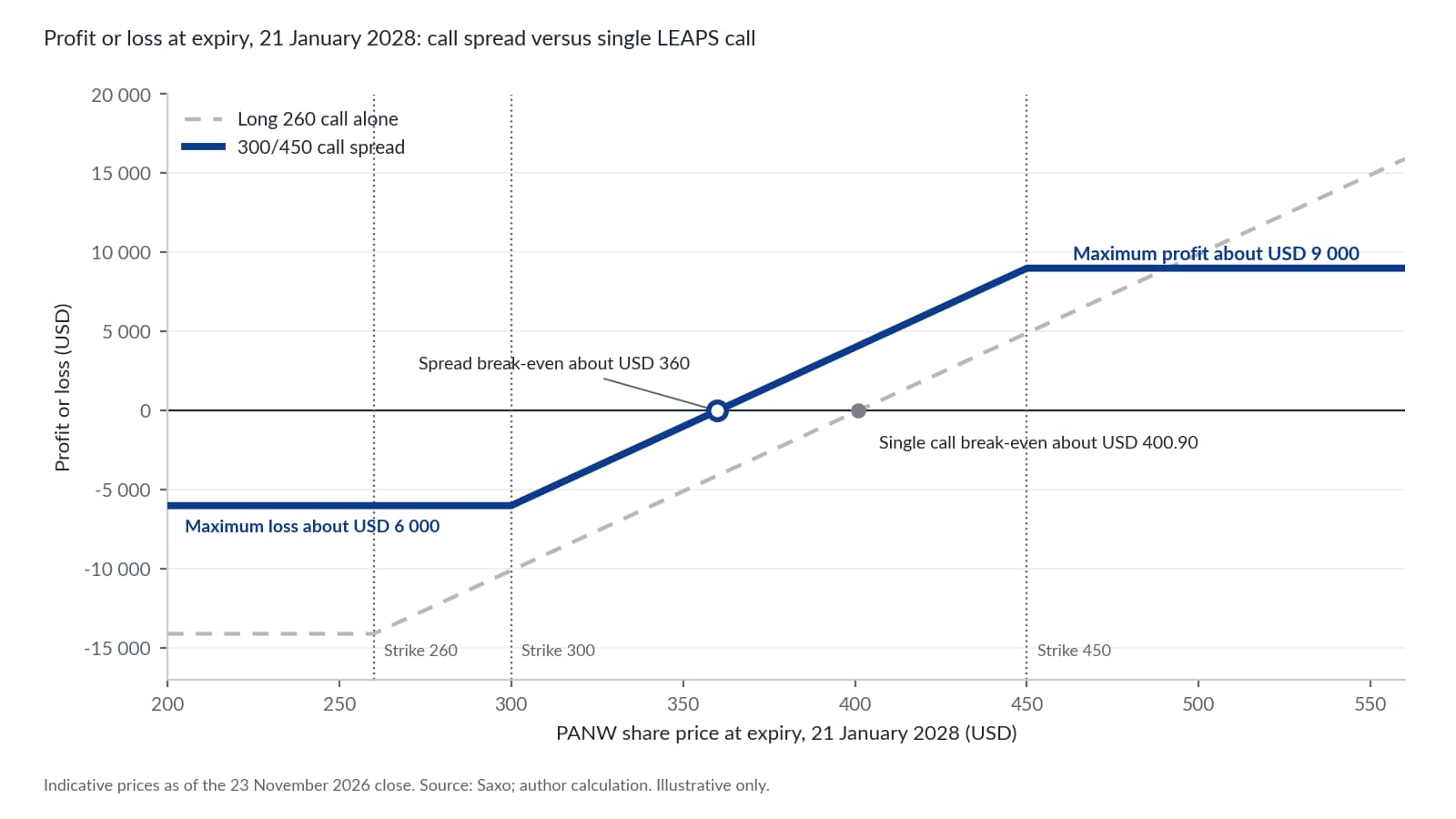 Profit or loss at expiry, PANW 21 January 2028 300/450 call spread versus the single 260 call. Indicative prices as of 23 November 2026. Source: Saxo; author calculation. Past performance is not indicative of future results; figures are illustrative and not predictive.
The spread swaps one set of risks for another. It costs less and breaks even closer to today’s price, but it gives up everything above USD 450, and it is more fragile on the way down: if the shares close at or below USD 300 at expiry, the full cost is lost, a fall of only about 15% from the 23 November close. It also responds far less to day-to-day moves in the shares, so it can feel slow even when the shares rise. Options carry a high risk of rapid loss and are not suitable for every investor. Costs and charges apply to each leg and vary by account and venue; check the applicable rates before entering any position.
When a LEAPS call may not fit
- When losing the full amount paid would be hard to accept, even if that amount is smaller than the cost of the shares.
- When the expected rise is modest: as the scenarios show, the shares can do better than the call even in a good year.
- When options are expensive, as they appear to be on this stock today, because the price of time is higher and the hurdle is taller.
- When the plan is to hold for many years: the call expires, while shares can be held indefinitely.
Buying fewer shares, waiting, or doing nothing at all are equally reasonable alternatives.
Before any position:
- The gap between bid and ask: on long-dated options it can be several dollars wide, which matters at entry and at exit
- Trading volume and open interest (the number of contracts outstanding) at the chosen strikes and expiry
- 21 January 2028 is a standard monthly expiry; around four more quarterly reports fall before it, and each one can move the shares sharply
- Early exercise on any sold call: Palo Alto Networks options can be exercised before expiry, so if the shares surge, the buyer of a sold call could claim the shares early. The buyer of a call never faces this
- An exit plan: positions can often be closed early or swapped for a later expiry
Final thoughts
A LEAPS call lets an investor stay exposed to a stock like Palo Alto Networks with less money at stake and a loss that cannot exceed the price paid. The trade-off for that capped loss is the price of time, which raises the bar the shares must clear, and which is currently high on this stock after weeks of large swings.
Whether that trade-off makes sense depends on how far and how fast an investor expects the shares to move, and on how much of a possible loss they can live with. The scenarios above are a way to test that view before acting on it, and for many investors the answer may simply be the shares, or nothing at all. Options carry a high risk of rapid loss and are not suitable for every investor.
The author does not hold positions in any of the instruments mentioned in this article and is permitted to wait at least 24 hours from the time of the publication before trading the instruments themselves.
| Related articles/content |
|---|
| What is a cash-secured put Using Oracles post-earnings pullback as an example | 12 Jun 2026 What investors misunderstand about covered calls | 10 Jun 2026 Covered call or cash-secured put | 2 Jun 2026 From shareholder to options user | 26 May 2026 |
| More from the author |
|---|