
You can access both of our platforms from a single Saxo account.

Selling cash-secured puts on QQQ: why the premium is smaller than the headlines suggest

Summary: Selling puts is supposed to pay more when investors are nervous. On Monday the market fell, the VIX rose about 8%, and QQQ implied volatility still sat around a quarter of the way up its one-year range. The gap between the headlines and the option chain is the part worth understanding.
A falling market and a richly priced option are not the same thing.
Monday was an uncomfortable session for anyone long the Nasdaq. QQQ, the Invesco QQQ Trust that tracks the Nasdaq 100, closed at USD 709.18, down 0.80%. Crude oil settled at USD 104.01, up 3.96%. Anthropic’s chief executive published an essay urging the industry to slow frontier AI development, which weighed on Nvidia, AMD and SanDisk. And the Federal Reserve meets on Wednesday 16 September, with futures pricing an 85.6% probability of a quarter-point hike (Source: Saxo, CME FedWatch, Bloomberg, as of 14 September 2026). Past performance is not indicative of future results.
An investor holding cash and waiting for a cheaper entry into the Nasdaq 100 might expect option premiums to have turned generous. Selling puts is supposed to pay more when investors are nervous. The chain says something more modest, and the reason matters before choosing any strike. Options carry a high risk of rapid loss and are not suitable for every investor.
What the premium is made of
A cash-secured put is one trade. Sell a put, set aside the cash to buy 100 shares at the strike if assigned, keep the premium. How much premium arrives depends on implied volatility, the market’s estimate of how far the underlying may move before expiry.
QQQ implied volatility was 18.26% (Source: Saxo, as of 15 September 2026 pre-open). On its own that means little. Implied volatility rank places it on a 0 to 100 scale between the highest and lowest implied volatility QQQ has seen over the past year. At 26, it sits roughly a quarter of the way up from the twelve-month low toward the twelve-month high. The VIX closed at 17.10, up about 8% (Source: Saxo, CBOE, as of 14 September 2026). In our view that looks more like repricing than panic.
That headline is also an average. Each strike carries its own implied volatility, and on QQQ the puts further below the market are priced at higher implied volatility than those close to it. On the 16 October 2026 expiry the 690 put priced at 21.45% and the 660 put at 25.29%, both above the 18.26% headline (Source: Saxo, as of 14 September 2026 close). This tilt across the chain is what practitioners mean by volatility skew, usually measured by comparing a put and a call the same distance from the money. For an investor choosing where to sell, the practical point is that the headline figure and the strike being traded can price very differently.
Important note: The strategies and examples provided in this article are purely for educational purposes. They are intended to assist in shaping your thought process and should not be replicated or implemented without careful consideration. Every investor or trader must conduct their own due diligence and take into account their unique financial situation, risk tolerance, and investment objectives before making any decisions. Remember, investing in the stock market carries risk, and it’s crucial to make informed decisions.
Selling a put on an index you would be willing to own
The starting point is cash rather than shares, plus a view that the Nasdaq 100 is worth owning below Monday’s close. Setting that cash aside is what makes the position cash-secured rather than leveraged. Theta, the value the option loses each day, works in the seller’s favour as expiry approaches.
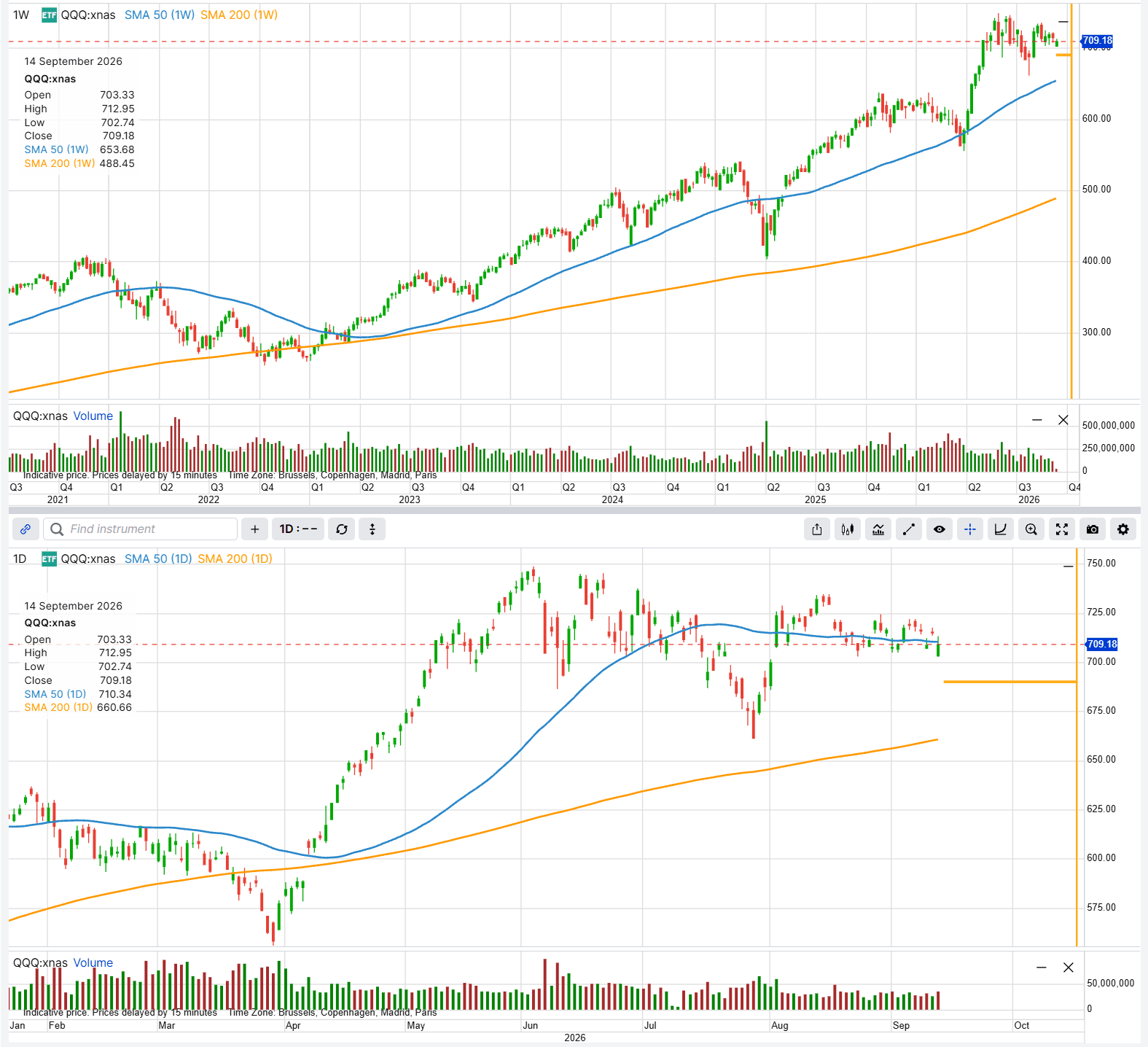 QQQ weekly and daily to the 14 September 2026 close, with the 690 strike marked. Source: SaxoTrader. Illustrative and educational only; not predictive. Past performance is not indicative of future results.
The following example is hypothetical and for educational use only; it is not advice or a trade recommendation.
Example structure (illustrative only – not a trade recommendation)
- Sell 1 QQQ put, strike 690, expiry 16 October 2026 (standard monthly, 32 days)
- Premium: USD 8.89 bid, USD 9.02 offered, a mid of USD 895 per contract
- Delta approximately -0.30, implied volatility 21.45%
- Cash set aside: USD 69,000
- Break-even at expiry: USD 681.05
- Maximum profit USD 895; maximum risk USD 68,105
If the option expires worthless the premium works out at about 1.30% on the cash set aside over 32 days. The risk sits on the other side of the same trade: assignment obliges buying 100 shares at 690 whatever the market price, and losses below 681.05 grow with every further point of decline. The -0.30 delta is the market’s rough implied estimate of the chance of finishing in the money. All figures are hypothetical and for education only. Costs and charges apply; see Saxo pricing for costs and applicable charges at home.saxo/rates-and-conditions/pricing-overview.
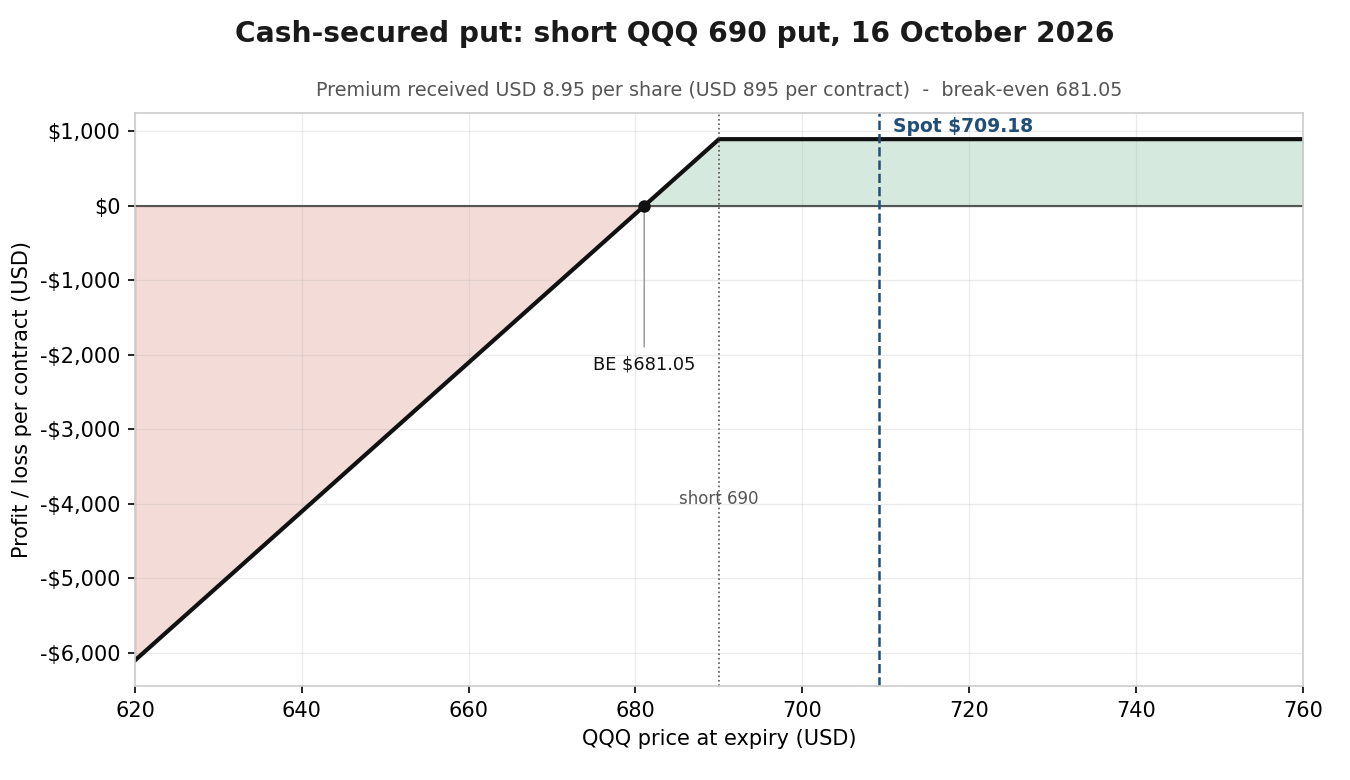 Profit and loss at expiry for the illustrative cash-secured put. Source: Saxo. Illustrative and educational only; not predictive. Past performance is not indicative of future results.
Moving the strike down changes the trade. The 660 put on the same expiry was quoted at a mid of USD 421, delta near -0.15 (Source: Saxo, as of 14 September 2026 close). It sits 6.9% below Monday’s close rather than 2.7%, close to the ETF’s 200-day moving average at 660.66, and returns about 0.64% on the USD 66,000 set aside against 1.30% at 690. Half the delta, half the income, same open-ended downside below 655.79. Costs and charges apply to each leg; see Saxo pricing.
Strategy insight – the premium is priced, not free. A larger premium and a strike closer to the market are the same fact from two directions. The 690 put pays more because the market considers a move to 690 more likely. Neither strike is better in the abstract; they express different willingness to be assigned, at different prices. Illustrative only. Not a trade recommendation.
What this looks like in practice
- QQQ well below 690: the investor buys 100 shares at 690, above the market, the premium offsetting part of the gap.
- QQQ near 709: the put expires worthless, USD 895 kept, and the cash no longer needs to be set aside.
- QQQ rallies hard: same outcome, but the month was spent in cash rather than the shares.
The case for, and the case against
The case for is straightforward. An investor who already wants Nasdaq 100 exposure, and would rather buy it lower, has two ways to wait. A limit order at 690 pays nothing. Selling the 690 put pays USD 895 for the same commitment over a defined period. If QQQ holds above the strike the premium is kept and the cash is free again; if not, the shares arrive at a price picked in advance. The higher implied volatility on downside strikes works in that investor’s favour.
The case against is equally clear. The 32-day expiry covers the Fed decision and the start of Q3 earnings, so the premium is certain while the outcomes behind it are not, and the position cannot be abandoned without cost once the market moves. An investor who believes the AI capital expenditure cycle is turning should not be structuring an entry at any strike; the right position for that view is no position. Options carry a high risk of rapid loss and are not suitable for every investor.
Between the two sits the investor who wants the exposure eventually and holds no strong view on the next month.
Before placing the trade, check
- Bid/ask spreads, volume and open interest at the chosen strike, since a wide spread erodes the premium at entry
- Implied volatility at that specific strike, not only the headline figure for the underlying, and how it compares with the movement QQQ has actually been delivering
- That the cash set aside is genuinely idle for the next 32 days
- An exit plan defined before entry, and that the FOMC decision on 16 September 2026 falls inside the holding period
Assignment risk note: QQQ options are American-style, so a short put can be assigned before expiry if it moves in the money, particularly close to expiration or around the ETF’s ex-dividend date. As the buyer of a put or a call you face no assignment risk. Only the seller does.
Final thoughts
The lesson from Monday is that price and volatility do not have to move together. QQQ fell, the VIX rose about 8%, and implied volatility still sat about a quarter of the way up its one-year range. Headlines and option pricing are separate readings of the same market, and they often disagree.
A cash-secured put does not change the risk of owning the Nasdaq 100. It attaches a price and a deadline to a decision already being weighed, pays for that commitment, and can usually be closed early if circumstances change. Whether it suits an investor depends less on the size of the premium than on whether the strike is a price worth owning the shares at. Options carry a high risk of rapid loss and are not suitable for every investor. Past performance is not indicative of future results.
Sources: Saxo platform options chain, CBOE, CME FedWatch and Bloomberg, as of 14 September 2026 close and 15 September 2026 pre-open.
The author holds positions in a derived product of QQQ, the size of which represents less than 0.5% of QQQ. The Author is permitted to wait at least 24 hours from the time of the publication before they trade the instruments themselves.
This content will not be changed or subject to review after publication.
| Related articles/content |
|---|
| Silver ETF SLV what a long-dated call buys you instead of the shares | 13 Aug 2026 Adyen earnings an investors options playbook | 6 Aug 2026 Rheinmetall how to use options on a share that costs EUR 1139 | 31 Jul 2026 Shell into second-quarter earnings two ways to use options for income | 24 Jul 2026 LVMH through results season what mini options change for a smaller portfolio | 22 Jul 2026 Options on leveraged ETFs how investors actually use them | 7 Jul 2026 Adding options to your portfolio what actually changes | 26 Jun 2026 What investors misunderstand about covered calls | 10 Jun 2026 Covered call or cash-secured put | 2 Jun 2026 From shareholder to options user | 26 May 2026 |
| More from the author |
|---|