
Access all our platforms from a single account.

Q2 Outlook for Investors: AI mania meets geopolitical mayhem
Quarterly Outlook 10 minutes to read

Summary: Our Q2 outlook argues that investors should stop thinking in binaries. AI remains a powerful long-term theme, but geopolitics, energy disruption, and supply-chain stress are making markets more selective and less forgiving. The key message is to stay exposed to structural growth while reducing concentration risk and building resilience through broader diversification, real assets, quality income, and sectors tied to energy, infrastructure, and security.
Markets are entering Q2 with two forces pulling at once. The Iran conflict is the macro shock dominating headlines, while AI remains the structural trend shaping capital spending, policy priorities, and long-term market leadership. For investors, the challenge is not choosing one over the other, but understanding how to position for both.
The geopolitical shock matters beyond oil as a sustained energy disruption can feed into inflation expectations, bond yields, rate-cut assumptions, and broader risk appetite. The bigger picture is that AI is still one of the most important investment cycles of this decade, but conviction around it is no longer unconditional. It remains policy-backed, capex-driven, and tied to national competitiveness, but a sustained energy shock would make the path more uneven by raising power costs, tightening financial conditions, and forcing investors to ask harder questions about monetisation, balance-sheet strength, and how much capex can still be defended if growth slows.
In other words, the geopolitical shock may not end the AI buildout, but it can make it more energy-sensitive, more selective, and less forgiving for the parts of the theme that rely most on cheap capital and distant promises.
That is the real task for investors in Q2. Staying exposed to structural growth, but reducing dependence on a single macro outcome.
When diversification stops diversifying
For long-term investors, the first rule is still not to panic. Geopolitical shocks are rarely a good reason to abandon a long-term plan, and the cost of stepping out can be high. However, understanding whether the portfolio has drifted into hidden concentration is key.
That matters now because many portfolios look diversified on paper but are less diversified in practice, with heavy exposure to a narrow cluster of AI winners, too much dependence on one region, and too much reliance on bonds as the only line of defence.
For safety and income in a world of volatile inflation and rates, bonds still matter but they may not be enough on their own. Therefore, it becomes necessary to make sure the portfolio is not relying on one type of defence.
For investors, the most useful response is not to trade every twist in the conflict. It is to ask whether diversification still works. A simple long-term investor checklist is:
- are you too concentrated in a handful of AI winners or one market
- do you own anything that can help if inflation or energy shocks persist
- is all your safety coming from bonds or cash
- do you have exposure to structural growth beyond just mega-cap technology
If the answer to most of those questions is no, that probably means the portfolio deserves a rebalance.
The investor takeaway
- Panic-selling is costly, but so is ignoring concentration.
- Rebalance if the portfolio has drifted too far into mega-cap tech, one region, or one type of safety.
- Build resilience through a mix of growth, quality fixed income, real assets, and some cash optionality.
- Revisit safety and income through a mix of quality bonds, real assets, defensive cash-flow exposure, and some cash optionality.
Iran is not just an oil shock
The shock is now moving through supply chains
The Iran conflict matters to markets first through energy, but the investment impact no longer stops at the oil price. Disruption to shipping lanes, insurance costs, freight routes, and intermediate inputs means the shock increasingly looks like a supply-chain and cost shock as well, and can start to hit margins, delivery times, and inflation more broadly.
For investors, this changes the way the shock should be read.
- It is not only an oil story.
- It is also an inflation and rates story.
- And increasingly, it is a supply-chain resilience story.
That broadening matters for portfolio strategy.
How to position if the shock fades, lingers, or worsens
The most useful way to think about the Iran conflict for investors is using three scenarios as different tests of portfolio resilience.
If tensions ease
A de-escalation outcome would allow markets to move away from pure defensiveness and back toward breadth. If the oil risk premium fades, growth fears ease, inflation pressure softens, and supply disruptions start to clear, broader equities can recover.
Positioning in that setting should favour:
- quality growth, including selective AI exposure
- broader cyclical participation where earnings breadth improves
- areas that have lagged but still retain healthy earnings support
If disruption lingers
A prolonged disruption is more uncomfortable because it keeps oil, freight, and input costs elevated at the same time. That leaves markets dealing with slower growth, stickier inflation, and more volatile bond pricing.
Positioning in that setting should lean toward balance:
- keep structural growth exposure, including AI
- pair it with quality equities, infrastructure, and selected real assets
- favour businesses with pricing power and stronger earnings visibility
If energy infrastructure is hit
The tail-risk scenario is the one that most clearly shifts the market from positioning for opportunity to positioning for resilience. In that case, oil would likely move into the danger zone for both growth and inflation, and stagflation fears could come to the forefront. Bloomberg Intelligence analysis has shown that oil above $100 has historically been the danger zone for equities, with S&P 500 profitability slipping as energy costs bite into margins.
Positioning there should focus on:
- real assets and gold
- defensive equities and durable cash-flow businesses
- reducing reliance on duration alone for protection
- preserving optionality to redeploy when volatility creates better opportunities
The investor takeaway
- Do not treat the Iran conflict as an oil call; it is also a supply-chain, inflation, and rates shock.
- In the base case, favour balance: structural growth on one side, resilience and pricing power on the other.
- In the tail risk, shift from chasing upside to protecting real returns and preserving optionality.
AI is not dead, but blind conviction is
AI disruption fears are creating the next layer of winners and losers
If Iran is the macro shock, AI remains the structural trend, but that no longer means the market has the same conviction in every part of the story.
What changed in Q1 is not the existence of the theme, but the willingness of investors to fund it unquestioningly. The easy phase of the trade is over. Investors are asking harder questions about valuations, earnings conversion, competitive moats, energy intensity, and whether AI makes some software businesses stronger while making others more vulnerable. They are also asking a harder macro question: if energy costs stay high and financial conditions remain tight, which parts of the AI buildout still get funded and which parts begin to look easier to delay, shrink, or question?
That is why the more useful distinction now is not between AI winners and losers in one broad sense, but between:
- businesses enabling the buildout where spending is harder to postpone
- businesses using AI to deepen productivity and client retention
- businesses whose existing advantages become easier to challenge
- businesses whose AI case still depends too heavily on aggressive capex, weak cash flow, or distant monetisation
How to position when AI shifts from hype to scrutiny
For long-term investors, the stronger strategy may be to move away from narrow concentration and toward broader exposure across the AI value chain, while recognising that not all parts of that chain deserve the same level of conviction.
That means looking beyond the headline winners to areas such as:
- semiconductors and semiconductor equipment
- power, grid infrastructure, and cooling
- industrial automation and electrification
- cybersecurity and secure digital infrastructure
- selective software with clearer productivity and retention benefits
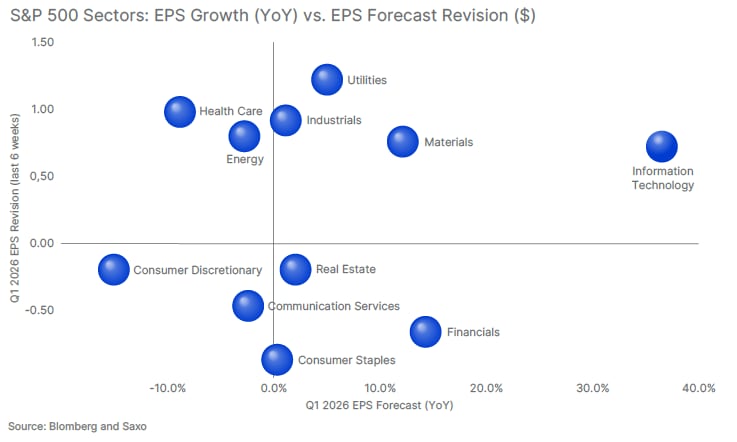
Earnings expectations still support the structural AI case. S&P 500 EPS growth is still expected to improve into Q2, and technology remains one of the strongest earnings engines in the market. Earnings revisions have also held up better in technology. But strong sector-level earnings expectations also do not remove the risk that parts of the AI theme are over-owned, over-promised, or more exposed to an energy and funding shock than the market had priced a quarter ago. That tells investors two things at once: the earnings engine behind AI has not disappeared, but leadership remains narrow enough, and conviction fragile enough, that concentration risk is still real.
The investor takeaway
- Broaden along the value chain: look beyond the headline winners toward semiconductors, power, grid infrastructure, automation, and secure digital infrastructure.
- Look for AI with earnings support: favour businesses with clearer cash-flow delivery, healthier balance sheets, and more credible monetisation.
- Reduce concentration risk: keep AI exposure, but avoid letting the whole growth case rest on a narrow cluster of mega-cap names or on the assumption that all AI capex remains untouchable.
The next opportunity set sits where AI meets geopolitics
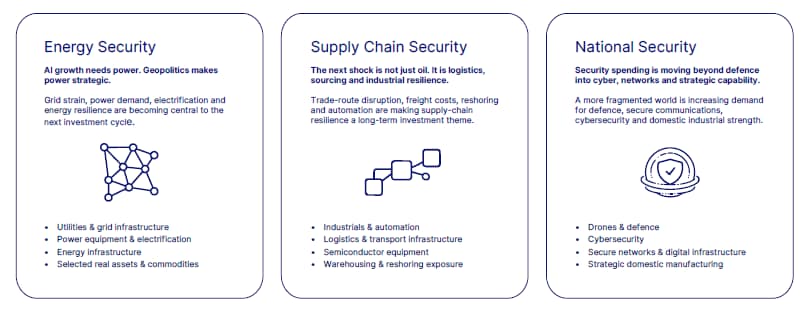
The overlap between AI and geopolitics is where the most interesting long-term investment implications are starting to emerge. AI is increasing demand for power, chips, data centres, grids, and secure digital infrastructure. Geopolitics is increasing the premium on energy resilience, trusted supply chains, and domestic strategic capability. Put together, they are creating a market shaped less by convenience and more by security.
Energy security
AI is energy-hungry, and geopolitics is making energy more strategic.
This theme maps most clearly to:
- utilities and grid infrastructure
- power equipment and electrification
- energy infrastructure
- selected commodities and real assets
Positioning here is about owning the physical buildout that supports both AI demand and a more security-conscious world.
Supply-chain security
The Iran shock is a reminder that logistics, shipping, sourcing, and intermediate inputs can quickly become market issues. At the same time, AI and industrial policy are pushing countries and companies to shorten, diversify, or harden supply chains.
This theme maps most clearly to:
- industrials and automation
- logistics and transport infrastructure
- semiconductor equipment and reshoring beneficiaries
- selected real estate and warehousing exposure
Positioning here is about favouring businesses tied to resilience, localisation, and operational efficiency rather than just global volume growth.
National security
Geopolitics is not only raising demand for military spending. It is also lifting demand for cybersecurity, secure communications, strategic technology, and domestic industrial capability.
This theme maps most clearly to:
- defence
- cybersecurity
- secure networks and digital infrastructure
- domestic manufacturing and strategic technology champions
Positioning here is about recognising that national security spending is broadening beyond traditional defence and increasingly overlaps with technology and infrastructure.
Why real assets are moving from hedge to core allocation
This is also why real assets deserve more attention in investor portfolios. They are not only a hedge against geopolitical shocks. They are part of the structural response to a more energy-hungry, supply-constrained, and security-conscious world.
From an investment strategy perspective, real assets can do two jobs at once:
- provide resilience if the macro shock deepens
- participate in the long-term buildout linked to AI, electrification, and national resilience
The investor takeaway
- Energy security points to utilities, grid infrastructure, electrification, and selected real assets.
- Supply-chain security favours industrials, automation, logistics infrastructure, and reshoring beneficiaries.
- National security increasingly spans defence, cybersecurity, secure networks, and strategic domestic capability.
This content is marketing material and should not be considered investment advice. Trading financial instruments carries risks and historic performance is not a guarantee for future performance.
The instrument(s) mentioned in this content may be issued by a partner, from which Saxo receives promotion, payment or retrocessions. While Saxo receives compensation from these partnerships, all content is conducted with the intention of providing clients with valuable options and information.
The instrument(s) mentioned in this content may be issued by a partner, from which Saxo receives promotion, payment or retrocessions. While Saxo receives compensation from these partnerships, all content is conducted with the intention of providing clients with valuable options and information.