
Access all our platforms from a single account.

Rheinmetall: how to use options on a share that costs EUR 1,139

Summary: One Rheinmetall option contract controls more than EUR 113,000 of stock, which rules the usual strategies out for most portfolios. There is a smaller contract that does the same job, and it is not the one you would expect to quote tighter.
The strategies are simple. The contract size is where most investors get stuck.
Rheinmetall (RHM), the German defence and automotive supplier, closed at EUR 1,139.60 on 30 July 2026, roughly 43% below its 52-week high of EUR 1,988.50 and about 20% above its 52-week low of EUR 946.60 (Source: Saxo price history, 31 July 2026). The company released preliminary second-quarter figures on 29 July 2026, reporting sales of EUR 3.29 billion and an operating result of EUR 562 million (Source: company announcement, 29 July 2026). Full half-year detail, including cash flow and order intake, is scheduled for 6 August 2026 (Source: Rheinmetall investor relations financial calendar). Past performance is not indicative of future results.
The headline figures are therefore public while the cash flow detail and any guidance update are not. For an investor who owns the shares, or who has been waiting for a lower entry, options can add structure to a view they already hold. On this share, though, a more basic question comes first.
The contract comes before the strategy
Rheinmetall options trade on two venues, and the difference matters more than the choice of strategy.
- Standard contract, Eurex (RHM:xeur): 100 shares per contract, worth approximately EUR 113,960 at the 30 July close.
- Mini contract, Euronext Amsterdam (RHQM:xams): 10 shares per contract, worth approximately EUR 11,396.
Source: Saxo instrument reference and options chain, 31 July 2026.
A covered call has to be backed by the shares it may oblige the seller to deliver. On the standard contract that means 100 shares, close to EUR 113,960 at the 30 July close, which in our view may put it beyond many private portfolios. The mini contract covers 10 shares, so the same strategy needs roughly EUR 11,396. See Saxo pricing for costs and applicable charges.
Two further points are easy to miss. Saxo lists no weekly expiries on either series, so the nearest is Friday 21 August 2026, the standard monthly: a position opened now runs through the 6 August release and two further weeks, and cannot isolate it. Multi-leg orders are available on the Amsterdam mini but not on the Eurex contract (Source: Saxo instrument reference, 31 July 2026), which does not restrict either single-leg strategy below.
One cost is easy to overlook. Every option is quoted with a bid, the price a seller receives, and an ask, the price a buyer pays. A seller who accepts the bid rather than the middle of the two gives up part of the premium the moment the trade is done, and that loss is repeated on the way out. The wider the gap, the more of the premium disappears into it.
It would be reasonable to expect the smaller Amsterdam contract to show the wider gap. In quotes taken before the open on 31 July, at the out-of-the-money strikes these strategies use, it did not. The figures below show the bid-to-ask gap as a percentage of the option’s mid price, for calls expiring 21 August 2026.
- 1180 strike: Eurex 19.0% of mid, mini 18.1%.
- 1200 strike: Eurex 27.9%, mini 18.1%.
- 1220 strike: Eurex 34.9%, mini 19.1%.
- 1260 strike: Eurex 47.6%, mini 30.3%.
Source: Saxo options chain, 31 July 2026. Quotes taken before the market open are indicative and change once trading begins.
At the 1220 strike that difference mattered: selling the Eurex call at the bid meant accepting about 17% below the mid price, against about 10% on the mini. Across the whole 21 August expiry, 70% of mini contracts carried a two-sided quote against 11% on Eurex.
Important note: The strategies and examples provided in this article are purely for educational purposes. They are intended to assist in shaping your thought process and should not be replicated or implemented without careful consideration. Every investor or trader must conduct their own due diligence and take into account their unique financial situation, risk tolerance, and investment objectives before making any decisions. Remember, investing in the stock market carries risk, and it’s crucial to make informed decisions.
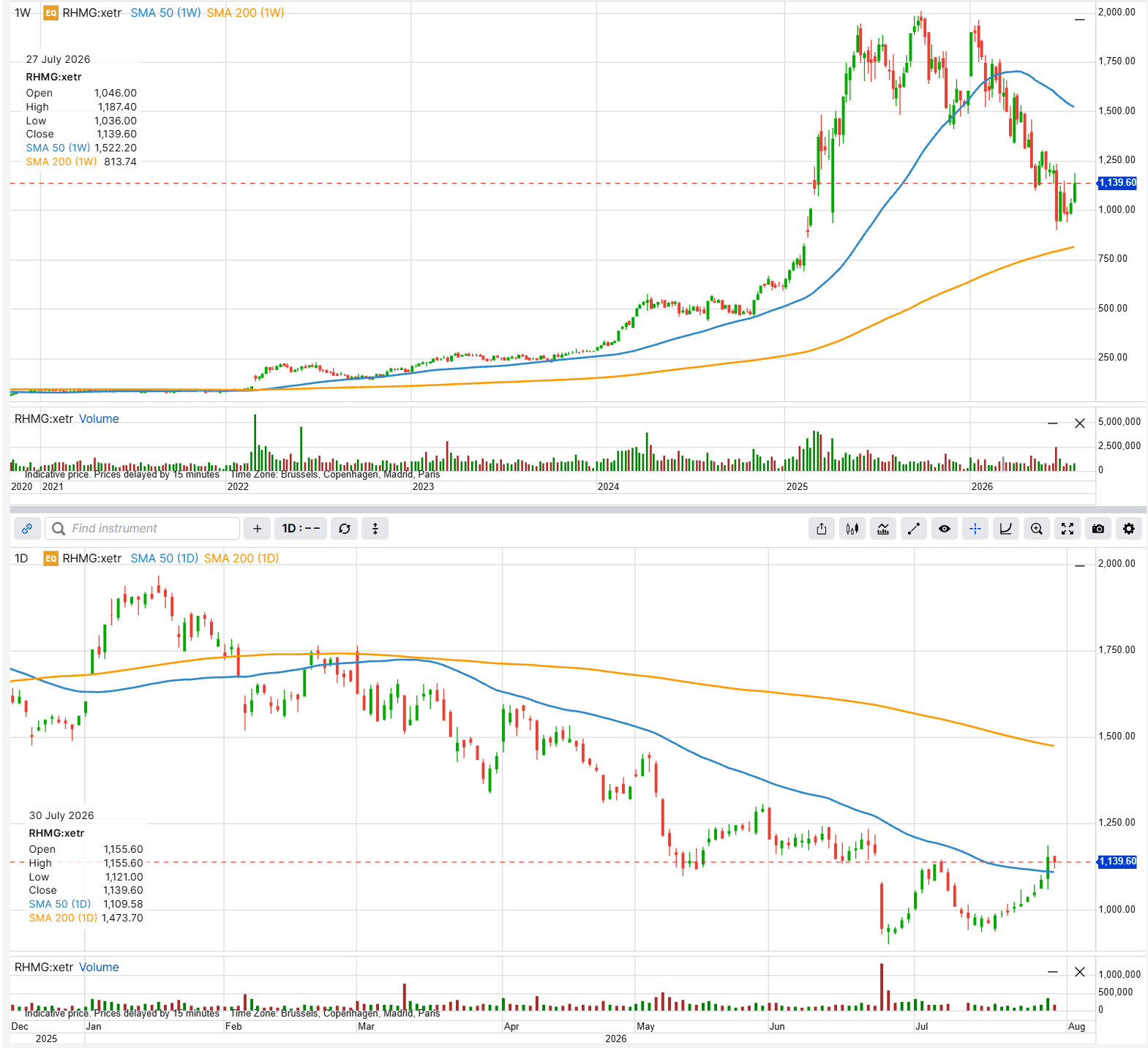 Rheinmetall weekly and daily, showing the drawdown from EUR 1,988.50 and the recent move back above the 50-day average at 1,109.58. Past performance is not indicative of future results; figures are illustrative and not predictive. Source: SaxoTrader
What the volatility is actually saying
Implied volatility on the 21 August expiry sits near 46%, with an implied volatility rank around 52 (Source: Saxo options chain, 31 July 2026). Read alone that suggests an expensive options market. Measured against how far the shares have actually travelled, it reads differently: realised volatility has run near 75% over 30 days, 59% over 90 days and 49% over the past year (Source: Saxo price history, 31 July 2026).
Bloomberg puts the move implied for 6 August at about 5.2%, against an average absolute move of 4.9% across the last 20 reports (Source: Bloomberg, 30 July 2026). On Saxo closing prices, Rheinmetall’s reaction on its last six reporting days averaged roughly 6.1% in absolute terms, three of them above 7%. Past performance is not indicative of future results.
In our view that combination may argue against treating either structure below as a way of harvesting rich premium. The better reason to use them is a standing wish to own the shares lower, or to sell them higher. Options carry a high risk of rapid loss and are not suitable for every investor. See Saxo pricing for costs and applicable charges.
Income on shares you already own: the covered call
Thesis. An investor holds Rheinmetall, thinks the recovery could continue, and would be content to sell into strength well below the old highs.
Mechanics. Selling a call means agreeing to sell the shares at the strike if the stock is above that level at expiry, and the premium is kept either way. The investor retains the full downside risk of holding the shares: the premium received provides a partial offset, but it does not protect against a significant decline in the stock price. Upside above the strike is given up.
The following examples are hypothetical and for educational use only; they are not advice or trade recommendations.
Example structure (illustrative only - not a trade recommendation)
- Hold 10 Rheinmetall shares, worth approximately EUR 11,396
- Sell 1 mini call, 21 August 2026, 1240 strike, at approximately EUR 16.70 per share
- Premium received: approximately EUR 167, against a maximum loss on the shares of approximately EUR 11,229 were Rheinmetall to fall to zero
- Break-even at expiry: approximately EUR 1,122.90
- Maximum profit: approximately EUR 1,171, reached only at or above 1240
Risk: the maximum loss is the full value of the shares less the premium received, and the short call carries early-assignment risk. All figures are hypothetical and for education only. Prices are indicative and pre-open; verify in the live chain before use. Costs and charges apply to each leg; see Saxo pricing for full details.
The same trade on the standard contract needs 100 shares and would have collected about EUR 2,162 at the 1220 strike: a better yield, roughly 1.90% against 1.47% over 21 days, for a position ten times the size and a wider gap.
Theta measures time decay: the option loses a little value each day, which favours the seller, though a sharp fall in the shares would outweigh it.
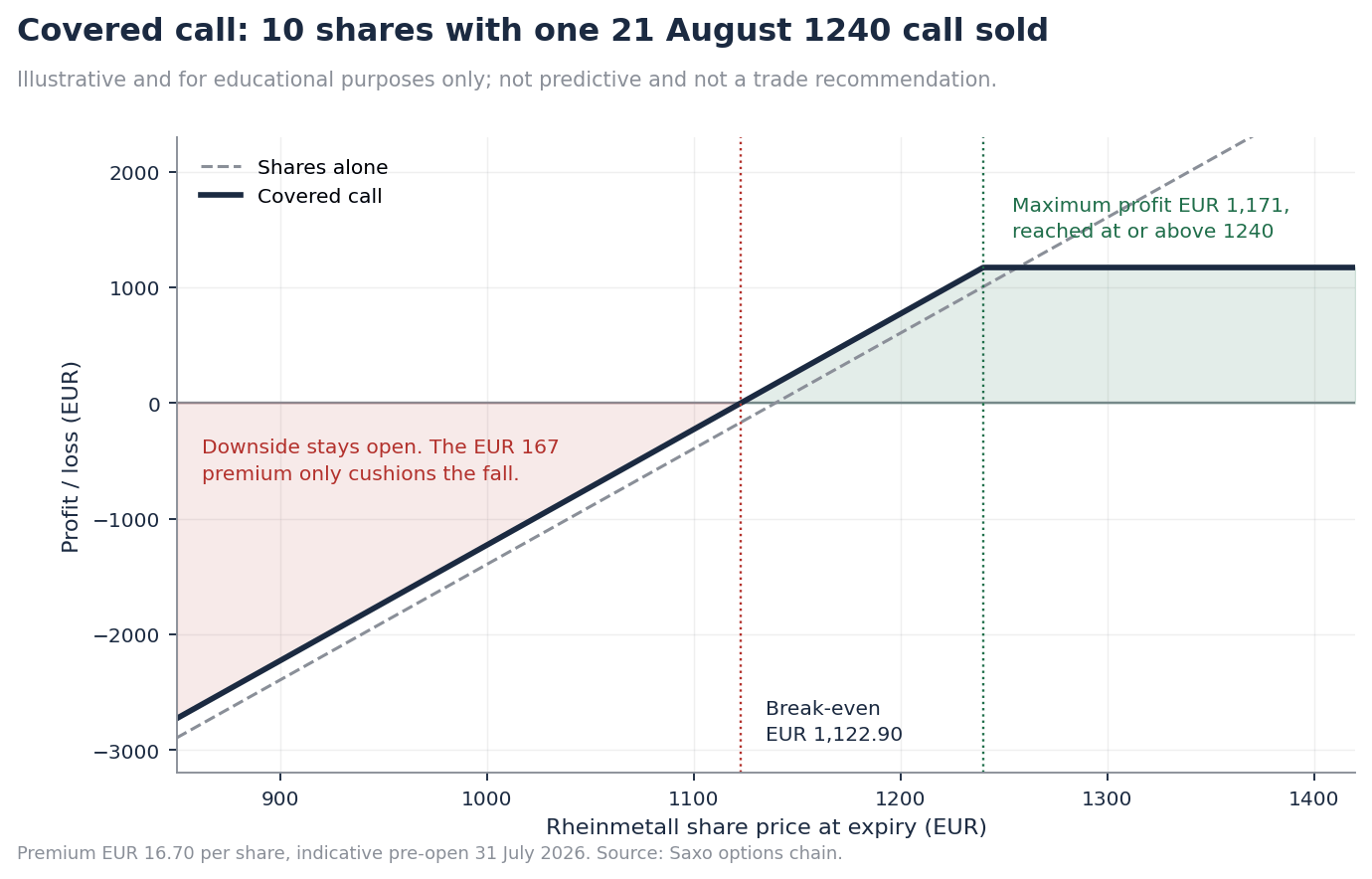 Payoff at expiry for the illustrative covered call, 10 shares against one 21 August 1240 call. Past performance is not indicative of future results; figures are illustrative and not predictive. Source: Saxo options chain data
Getting paid to wait: the cash-secured put
Thesis. An investor does not own the shares, finds EUR 1,140 too high, but would buy nearer EUR 1,020.
Mechanics. Selling a cash-secured put means agreeing to buy the shares at the strike if the stock falls there by expiry, with the cash set aside to do so, in exchange for a premium collected today. The risk is owning the stock at that price while it keeps falling, and below the break-even the loss is the same as any shareholder’s.
The following examples are hypothetical and for educational use only; they are not advice or trade recommendations.
Example structure (illustrative only - not a trade recommendation)
- Sell 1 mini put, 21 August 2026, 1040 strike, at approximately EUR 18.40 per share
- Cash set aside: approximately EUR 10,400
- Premium received: approximately EUR 184, which is also the maximum profit, against a maximum loss of approximately EUR 10,216 were Rheinmetall to fall to zero
- Break-even at expiry: approximately EUR 1,021.60, around 10.4% below the 30 July close
Risk: the maximum loss is the strike less the premium received, multiplied by the contract size, and the short put carries early-assignment risk. All figures are hypothetical and for education only. Prices are indicative and pre-open; verify in the live chain before use. Costs and charges apply to each leg; see Saxo pricing for full details.
On the standard contract the 1100 strike was quoted near EUR 38.55 per share, about EUR 3,855 against EUR 110,000 of cash. It paid more, but the break-even sits only 6.9% below the close, committing the investor much closer to the current price with a maximum loss near EUR 106,145.
Puts struck well below the market carry higher implied volatility than options at the money: on 21 August the 940 put was marked near 57.3% against 48.5% on the 1140 call (Source: Saxo options chain, 31 July 2026). In our view that shape may favour put sellers, but it exists because the market is pricing real downside risk.
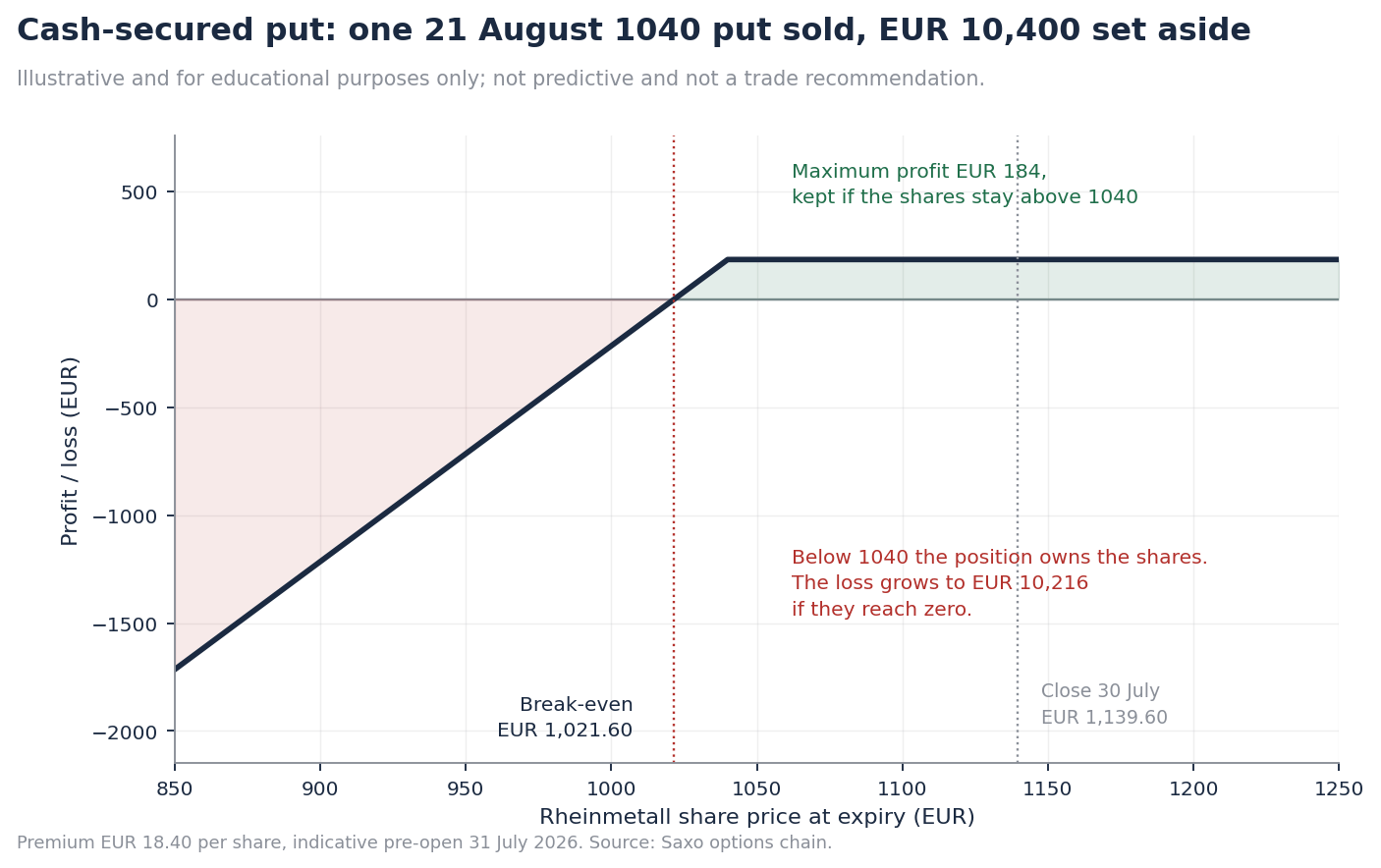 Payoff at expiry for the illustrative cash-secured put, one 21 August 1040 put. Past performance is not indicative of future results; figures are illustrative and not predictive. Source: Saxo options chain data
Before placing the trade, check
- Bid/ask gaps, which on both Rheinmetall series are wide enough to remove much of the theoretical edge at entry
- Volume and open interest at the specific strike and expiry
- That the expiry is the 21 August standard monthly, since no weekly is listed at Saxo on either series
- That 6 August falls inside the life of the position, and that the release is scheduled during the trading day rather than before the open
- Implied volatility against realised volatility, as set out above
- An exit plan, defined before entry
- Assignment risk on the short leg
Assignment risk note: Rheinmetall options on both Eurex and Euronext Amsterdam are American-style and settle by physical delivery (Source: Saxo instrument reference, 31 July 2026). A short leg can be assigned before expiry if it moves in the money, particularly close to expiration or around an ex-dividend date. Short options need monitoring, and the platform’s assignment process is worth understanding before any position is opened. The buyer of an option carries no assignment risk; only the seller does.
Final thoughts
Options give an investor more ways to act on a view they already hold, not a shortcut to a quick return. On Rheinmetall the premium available over three weeks is small next to the moves this share has produced on reporting days. Both structures can be closed or adjusted before expiry. Options carry a high risk of rapid loss and are not suitable for every investor, and future outcomes are uncertain and may result in losses. Past performance is not indicative of future results.
The wider lesson has little to do with strategy. On a share priced above EUR 1,000, the contract specification decides what is possible long before the strike does. Contract size, venue, available expiries and the bid-to-ask gap are the first things to check, not the last.
This content is marketing material and should not be regarded as investment advice. Trading financial instruments carries risks and historic performance is not a guarantee of future results.
The author does not hold positions in any of the instruments mentioned in this article.
The Author is permitted to wait at least 24 hours from the time of the publication before they trade the instruments themselves.
The instrument(s) referenced in this content may be issued by a partner, from whom Saxo receives promotional fees, payment or retrocessions. While Saxo may receive compensation from these partnerships, all content is created with the aim of providing clients with valuable information and options.
This content will not be changed or subject to review after publication.
| Related articles/content |
|---|
| Shell into second-quarter earnings two ways to use options for income | 24 Jul 2026 LVMH through results season what mini options change for a smaller portfolio | 22 Jul 2026 Options on leveraged ETFs how investors actually use them | 7 Jul 2026 Adding options to your portfolio what actually changes | 26 Jun 2026 Protecting your gains without selling how to hedge a tech portfolio with options | 19 Jun 2026 What investors misunderstand about covered calls | 10 Jun 2026 Covered call or cash-secured put | 2 Jun 2026 From shareholder to options user | 26 May 2026 |
| More from the author |
|---|