
Access all our platforms from a single account.

Asia Market Quick Take – 09 October, 2026

Key points:
- Macro: OpenAI revenue run-rate ~$50B, below prior estimates
- Equities: Nasdaq 100 fell 1.4%, worst decline in 7 weeks; SOX fell 3.4%
- FX: CHF and oil‑supported CAD led G10 gains, each rising against USD
- Commodities: Brent crude surged ~5%; gold rebounded from a two-month low
- Fixed income: US Treasuries bull-flatten; long end leads rally
------------------------------------------------------------------
Disclaimer: Past performance does not indicate future performance.
Macro:
- OpenAI Revenue: Reports indicated OpenAI's annualized revenue run rate is reportedly around $50 billion, below previously circulated estimates of nearly $70 billion, reigniting concerns about the sustainability of AI-related capital spending.
- US Jobless Claims: Initial claims fell 2,000 to 197,000 in the week ended 3 October, the lowest since July and the fourth consecutive week below 200,000, beating the consensus estimate of 200,000. Continuing claims rose 17,000 to 1.716 million.
- Fed's Waller: Fed Governor Christopher Waller said further rate hikes will likely be needed to return inflation to the 2% target in a timely manner, though officials have flexibility on timing and do not need to tighten at consecutive meetings.
- Hurricane Isaias: The Category 2 storm, with winds reaching 100 mph, is disrupting US offshore oil production and is forecast to hit the Alabama coast or Florida Panhandle, adding further uncertainty to energy supply.
- CBO Fiscal Warning: Congressional Budget Office Director Phillip Swagel warned that economic growth alone is unlikely to stabilise the US federal debt trajectory, pushing back on Treasury Secretary Scott Bessent's growth-led fiscal strategy.
Equities:
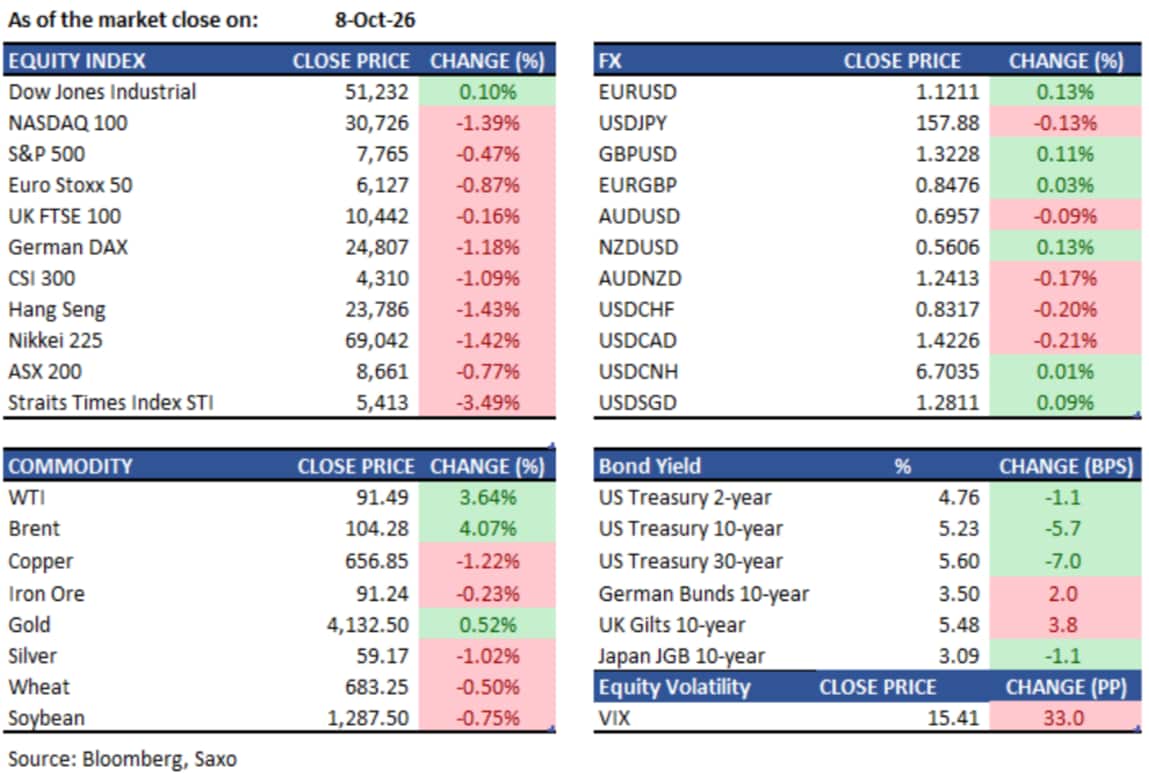
- US: US equities closed mixed as a chipmaker selloff driven by OpenAI revenue concerns weighed on tech. S&P 500 fell 0.5% to 7,765.36 and the Nasdaq 100 dropped 1.4% — its worst single-day decline in seven weeks — while the Dow Jones Industrial Average edged up 0.1% to 51,231.64. The Philadelphia Semiconductor Index plunged 3.4%, with Nvidia down 2.9% and Coherent Corp. falling 9.6%. Oracle closed 5.6% lower in its worst session since 16 July. In after-hours trading, AT&T, T-Mobile and Verizon each fell more than 6% after Elon Musk's SpaceX reportedly acquired low-band spectrum.
- EU: European equities fell for a second consecutive day as a bank selloff deepened amid growing concerns over France's fiscal situation and elevated oil prices. The Stoxx Europe 600 declined 0.8% to 625.51, its lowest close since 11 June. The DAX fell 1.2% to 24,806.97, with Volkswagen the largest decliner at -4.5%. The SMI dropped 1.2%. The FTSE 100 outperformed, slipping just 0.2% to 10,441.60, with HSBC the largest drag at -2.0%. Argenx was the biggest mover in the Stoxx 600, falling 15.9%. The Euro Stoxx Banks index posted its largest two-day decline since March, with Societe Generale down 26% from its August peak and Deutsche Bank off 18%.
- Asia: Asian equities fell sharply, with the MSCI Asia Pacific Index dropping as much as 1.8%, its largest decline since mid-August. The Hang Seng Index fell 1.4% to 23,785.79, its lowest close since 7 July, with HSBC down 4.9% and Hua Hong Semiconductor falling 9.2%. The Hang Seng Tech Index dropped 2.9%. The Nikkei 225 declined 1.4% to 69,042.11, dragged by banks and electronics; Topix fell 1.5% to 4,091.46. The Kospi dropped 2.6% to 6,625.93, pressured by memory names SK Hynix and Samsung. The STI was the worst performer in the region, tumbling 3.5% to 5,412.96 — its largest single-day drop since April 2025 — as Singapore banks DBS (-4.7%), OCBC (-4.3%) and UOB (-5.2%) sold off sharply following a JPMorgan warning that surging long bond yields will hurt Southeast Asian lender earnings. China's CSI 300 fell 1.1% on its return from Golden Week, with the chip-heavy STAR 50 Index losing 4.8%. Looking ahead to Friday's open, Nikkei futures point to further losses as markets digest the overnight US chip selloff with Softbank down 4.5% and Fast Retailing reported strong earnings in western markets but is down 2%.
Earnings this week:
- Friday: Delta Air Lines
FX:
- CHF and CAD were the strongest G10 performers vs. the USD, each gaining ~0.20%, with CAD supported by elevated oil prices benefiting Canada as an energy exporter.
- EURUSD held above 1.12 despite widening US-Europe rate differentials. Options traders flipped bearish on EUR vs. GBP for the first time since 2024, driven by French political and fiscal risks.
- GBPUSD was essentially unchanged at 1.3228. AUDUSD edged up +0.01% to 0.6958, with AUD outperforming GBP — GBPAUD slipped -0.02% to 1.9011.
- JPY was the standout underperformer across the board. USDJPY rose +0.13% to 158.08, while EURJPY gained +0.14% to 177.26 and GBPJPY added +0.13% to 209.11. AUDJPY also climbed +0.13% to 109.99.
Commodities:
- Brent crude surged nearly 5% to above $104–$105/bbl on reports of potential US strikes on Iran and fresh tanker attacks in the Strait of Hormuz, before paring gains after Trump's comments. Hurricane Isaias is adding a further supply disruption risk to US Gulf output. Brent settled above $104/bbl.
- Gold rebounded from a two-month low, climbing as much as 0.9% to near $4,146/oz after Trump's Iran remarks eased some geopolitical risk premium. India separately scrapped a key tax exemption on gold imports, subjecting shipments to a 3% levy, raising costs for one of the world's largest bullion markets.
Fixed income:
- Treasuries rallied, led by the long end, after a solid $22 billion 30-year bond auction drew strong demand (bid-to-cover 2.54x vs 1-year average of 2.42x). The 30-year yield fell ~7bps to 5.606%, pulling back from its highest level since 2002 (intraday high 5.73%). The 10-year yield fell ~5bps to 5.231%.
- French bond yields continued to rise sharply amid fiscal uncertainty and political risk, with UK 30-year gilt yields back near 6%. Widening sovereign spreads are compounding pressure on European equities, particularly banks with large domestic sovereign holdings.
- The junk bond rally lost momentum amid elevated oil prices and revived inflation fears. Four deals totalling over $3 billion priced this week, with month-to-date supply at a modest $4 billion after a heavy $51 billion September. Spreads remain tight, supported by resilient fundamentals and a strong labour market.
For a global look at markets – go to Inspiration.
This content is marketing content and should not be considered investment advice. Trading financial instruments carries risks and historic performance is not a guarantee for future performance.
The instrument(s) mentioned in this content may be issued by a partner, from which Saxo receives promotion, payment or retrocessions. While Saxo receives compensation from these partnerships, all content is conducted with the intention of providing clients with valuable options and information.