
Access all our platforms from a single account.

Asia Market Quick Take – 08 October, 2026

Key points:
- Macro: All 19 Fed officials backed Sept rate hike, citing inflation risks
- Equities: Broadcom to raise ~$30B to fund OpenAI’s purchase of their co-developed chip
- FX: Most G-10 currencies weaken vs dollar; euro leads losses
- Commodities: Precious metal recovers after gold breaks $4,100 while silver below $60
- Fixed income: 10-year yield hits 5.365%, highest since April 2002
------------------------------------------------------------------
Disclaimer: Past performance does not indicate future performance.
Macro:
- Fed Minutes (Hawkish): All 19 Federal Reserve officials backed the September rate hike, with many citing the need to guard against intensifying inflation. The minutes reinforced market expectations that the Fed's hiking cycle is not over, keeping pressure on the front end of the curve.
- US Mortgage Rates: The 30-year fixed mortgage rate jumped 19bps to 7.49% for the week ended Oct. 2 — the highest since November 2023 and the seventh consecutive weekly increase. MBA mortgage applications fell 4.2%, with purchases down 2.1% and refinancings down 7.5%.
- RBI Rate Hike: India's Reserve Bank raised its benchmark repurchase rate by 25bps to 5.50% — the first hike since Governor Sanjay Malhotra took over — and signalled further increases may follow as inflation intensifies and the rupee weakens.
Equities:
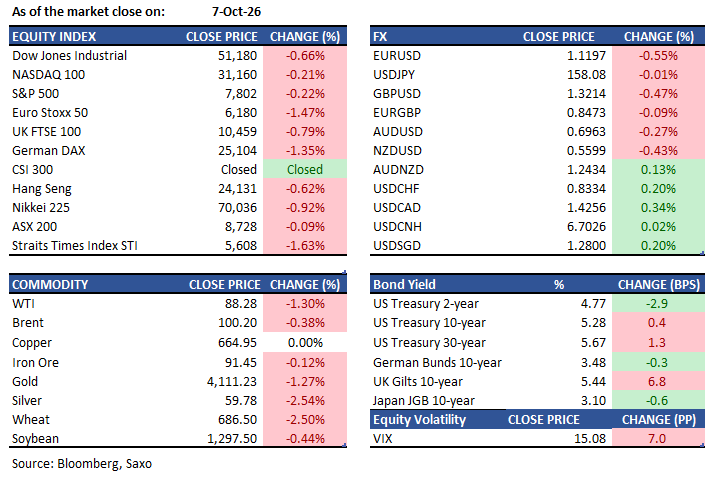
- US: The S&P 500 fell 0.2% to 7,801.77 on Wednesday, snapping a four-day winning streak, while the Nasdaq 100 also declined 0.2% and the Dow Jones Industrial Average dropped 0.7% to 51,179.87. Industrials led losses, with Caterpillar falling 5.8% as the largest single-stock drag. Nvidia slipped 0.7%. Broadcom is arranging for a $50b in financing for a chip it’s developing with OpenAI. In after-hours trading, Wolfspeed surged 27% after securing a $1.5bn conditional loan commitment, while Levi Strauss fell 1.5% after reporting its slowest direct-to-consumer growth since late 2022.
- EU: European equities sold off sharply on Wednesday, driven by banking sector weakness and French fiscal concerns. The Euro Stoxx 50 fell 1.5% to 6,180.29, its largest single-day decline since October 1. The Stoxx Europe 600 dropped 1%, led lower by banks, with the Euro Stoxx Banks index falling 3.4%. HSBC declined 4.4% and Prudential fell 4.7% on the FTSE 100, which lost 0.8% to 10,458.50. Societe Generale and Deutsche Bank tumbled more than 5%. Pennon Group had the largest individual drop in the Stoxx 600, falling 20.1% to a 52-week low. The Swiss SMI bucked the trend, edging up 0.1% with Roche gaining 2.9%.
- Asia: Asian equities are declining this morning, tracking Wall Street lower, as elevated oil prices and renewed tech weakness weigh on sentiment. The MSCI Asia Pacific index is down 0.3%. Japan's Nikkei 225 closed down 0.9% on Wednesday as AI and semiconductor stocks retreated. The Kospi is edging lower after Samsung Electronics forecasts Q3 preliminary record profit but missed estimates — shares fluctuated between gains and losses. Mainland China markets return from Golden Week holiday today. The Hang Seng fell 0.6% to 24,130.50 on Wednesday, dragged by Alibaba (-2.6%) and Hua Hong Semiconductor (-2.7%), with the Hang Seng Tech Index down 1.5% and the Hang Seng Biotech Index declining 2.8%. Japan Exchange Group also announced the biggest-ever Topix reshuffle, earmarking 683 companies for removal and 35 additions under tightened inclusion rules.
Earnings this week:
- Thursday: PepsiCo, Seven & i Holdings, Fast Retailing
- Friday: Delta Air Lines
FX:
- USD regained broad strength during Asian hours on October 7 as risk appetite deteriorated, oil prices rose and hawkish Fed minutes reinforced a higher‑for‑longer rates narrative.
- USDJPY broke above 158 last night, pushing deeper into potential intervention territory and lifting short‑dated implied volatility, while analysts warned that Japan’s fiscal plans could add further pressure on the yen.
- GBP remained the G10 outperformer overall after its recent rally, having traded up to 1.3269, though GBPUSD finished the day roughly unchanged (-0.03%) as renewed dollar strength offset gains.
- EUR underperformed on persistent French fiscal concerns and wider OAT‑Bund spreads, with EURUSD ending marginally lower. AUDEUR rose to its highest since November 2024 at 0.6231, reflecting relative eurozone weakness.
- AUDUSD slipped to around 0.6972, staying in a bearish channel below its 200‑DMA, while NZDUSD was flat on the day.
- In Asia, USDKRW dipped 0.15% to 1,339.28, consolidating after a three‑session, ~1.5% decline; USDCNH edged 0.02% lower as China’s FX reserves fell to $3.400 trillion.
Commodities:
- Brent crude settled around $100–$101/bbl on Wednesday, supported by the pickup in Iranian attacks on tankers in the Strait of Hormuz. Shell raised its Q3 refining margin outlook, pointing to a record $42/barrel margin driven by Middle East supply disruptions. US commercial crude inventories fell 3.2 million barrels last week, versus expectations for a build.
- Gold futures fell 1.2% to $4,135.10/troy oz on Wednesday, retreating alongside a stronger dollar and rising real yields. The US 10-year real yield rose to 2.94%, up 102bps year-to-date, acting as a headwind for the precious metal.
Fixed income:
- The 10-year yield hit an intraday high of 5.365% — the highest since April 2002 — before pulling back to around 5.28% after a strong $39bn 10-year auction cleared at 5.30%, stopping through the WI by 1.7bps. The 30-year yield touched 5.73%, also a 24-year high, before paring gains. The curve ended in a twist-steepening pattern, with the front end richer by ~3bps and the long end marginally cheaper.
- The global bond selloff spread to Europe, with UK 30-year gilt yields returning to 6.0%. French OAT yields rose as much as 14bps on the day, with the OAT-Bund spread widening materially as French budget concerns intensified. German Bunds partially recovered on haven demand and trimmed ECB rate-hike bets, with the 2-year Bund yield sliding 6bps to 3.05%.
- Traders extended short bets against US government bonds following the hawkish FOMC minutes, with open interest in long-dated futures rising — signalling the selloff has room to continue. Wall Street strategists remain divided on whether yields have peaked, with Goldman Sachs calling for a year-end decline while others see further upside risk.
For a global look at markets – go to Inspiration.
This content is marketing content and should not be considered investment advice. Trading financial instruments carries risks and historic performance is not a guarantee for future performance.
The instrument(s) mentioned in this content may be issued by a partner, from which Saxo receives promotion, payment or retrocessions. While Saxo receives compensation from these partnerships, all content is conducted with the intention of providing clients with valuable options and information.