
You can access both of our platforms from a single Saxo account.

IBIT: two ways to take part in bitcoin’s recovery without buying the shares

Summary: Bitcoin has recovered roughly 37% since mid-August, and IBIT’s options market is pricing calmer conditions than the last five weeks actually delivered. Two defined-risk structures show what an investor without a position can do about that, and what each one costs.
Options do not make bitcoin less volatile. They let an investor choose which slice of that volatility to take, and how much capital to put behind it.
Bitcoin has risen about 37% since the middle of August, yet it remains below where it started 2026, a move backed by disclosed fund flows rather than sentiment alone: IBIT (the iShares Bitcoin Trust ETF) took in roughly USD 3.76bn from 15 August (Source: Bloomberg, 22 September 2026). The legislative picture is less settled, with the CLARITY Act cloture vote failing 49 to 50 on 15 September 2026.
That leaves a particular reader in an awkward spot: someone who thinks the recovery may have further to run, does not own IBIT, and is wary of committing full capital to a fund that has moved more than 15% in five sessions on three separate occasions this year (Source: Saxo, computed from daily closes, as of 22 September 2026). Buying shares answers the view but not the wariness. The listed options market offers two other answers, at different prices.
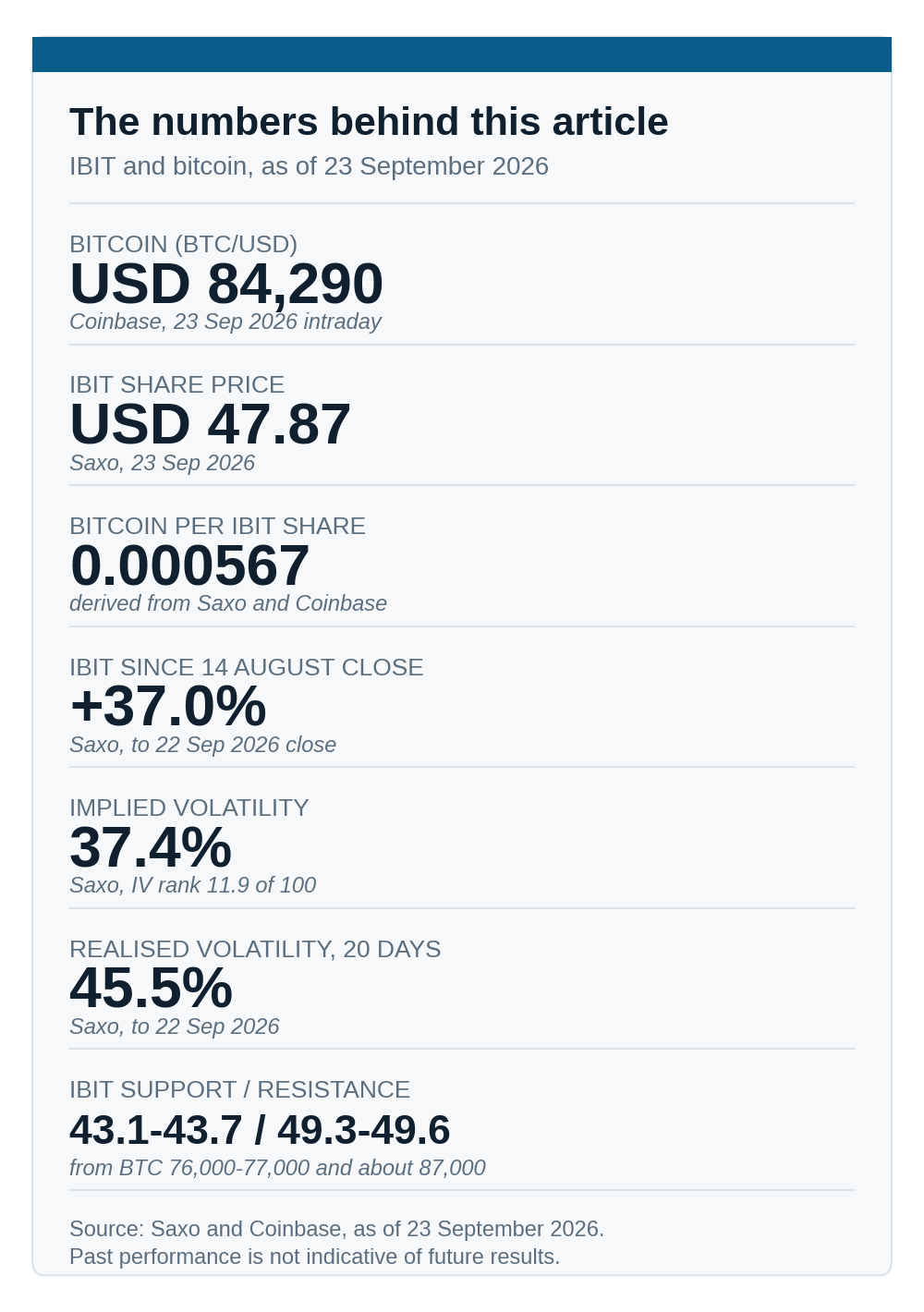 The numbers behind this article: bitcoin and IBIT prices, the bitcoin-per-share ratio, the move since 14 August, implied against realised volatility, and the support and resistance bands. Source: Saxo and Coinbase, as of 23 September 2026.
Past performance is not indicative of future results; figures are illustrative and not predictive.
Translating bitcoin into IBIT
At 0.000567 bitcoin per share, the BTC 76,000 to 77,000 support zone becomes about IBIT 43.1 to 43.7, and the roughly 87,000 level that capped the move on 21 September becomes about IBIT 49.3 to 49.6, only 1% to 3% above where IBIT traded on 23 September (Source: Saxo and Coinbase, as of 23 September 2026). In our view that resistance sits too close to serve as an upside target.
Implied volatility was 37.4% against 45.5% realised over the 20 sessions to 22 September, with an IV rank of 11.9 near the bottom of its 12-month range (Source: Saxo, as of 23 September 2026). In our view the options market appears to be pricing calmer conditions than the recent past produced, which may help a buyer of premium and works against a seller. Options carry a high risk of rapid loss and are not suitable for every investor.
Important note: The strategies and examples provided in this article are purely for educational purposes. They are intended to assist in shaping your thought process and should not be replicated or implemented without careful consideration. Every investor or trader must conduct their own due diligence and take into account their unique financial situation, risk tolerance, and investment objectives before making any decisions. Remember, investing in the stock market carries risk, and it’s crucial to make informed decisions.
Bullish continuation: the bull call spread
An investor who thinks the recovery may run past the January 2026 high needs a structure that pays for a move well above the current price. A bull call spread buys a call at one strike and sells a higher one in the same expiry, capping the gain in order to cut the cost.
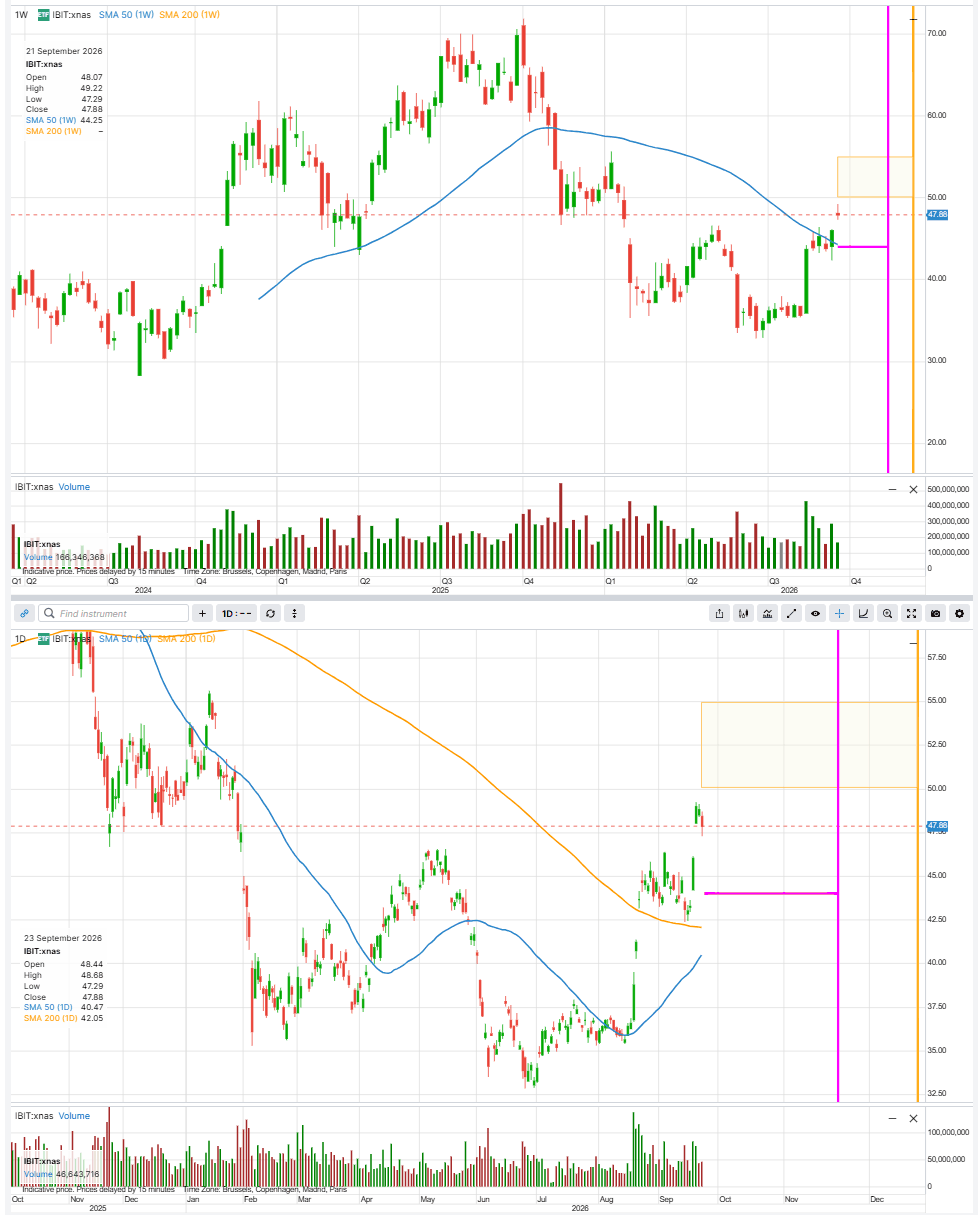 IBIT weekly since launch and daily over the past year, with the 50 to 55 zone and the level near 43 marked. Price history covers the fund’s whole trading life; IBIT began trading on 11 January 2024. Source: TradingView, as of 23 September 2026.
Past performance is not indicative of future results; figures are illustrative and not predictive.
Example structure (illustrative only – not a trade recommendation)
- Buy 1 IBIT 18 December 2026 50 call at approximately USD 3.10
- Sell 1 IBIT 18 December 2026 55 call at approximately USD 1.64
- Net debit: approximately USD 146 per contract, or about USD 153 paying the offer and hitting the bid, plus USD 0.58 in trade fees
- Maximum loss: approximately USD 146, if IBIT is at or below 50 on 18 December 2026
- Maximum profit: approximately USD 354, if IBIT is at or above 55 on 18 December 2026
- Break-even at expiry: approximately USD 51.46, about 7.5% above the 23 September price
- All figures are hypothetical and for education only (Source: Saxo, as of 23 September 2026)
IBIT began 2026 at USD 49.65, so the long 50 call pays only if the fund climbs back to roughly flat on the year, while the short 55 call sits just under the USD 55.44 close of 14 January 2026. Delta gives the spread its directional tilt, 0.47 on the long leg against 0.29 on the short (Source: Saxo, as of 23 September 2026).
Strategy insight – what the cap buys. The position risks approximately USD 146 against the roughly USD 4,787 that 100 shares would have cost, and low implied volatility makes the long leg cheaper than it would be in a fearful market. The ceiling is hard: the gain stops at approximately USD 354 however far bitcoin runs, and the whole USD 146 is lost if IBIT sits at or below 50 on 18 December 2026. Options carry a high risk of rapid loss and are not suitable for every investor. See Saxo pricing for costs and applicable charges.
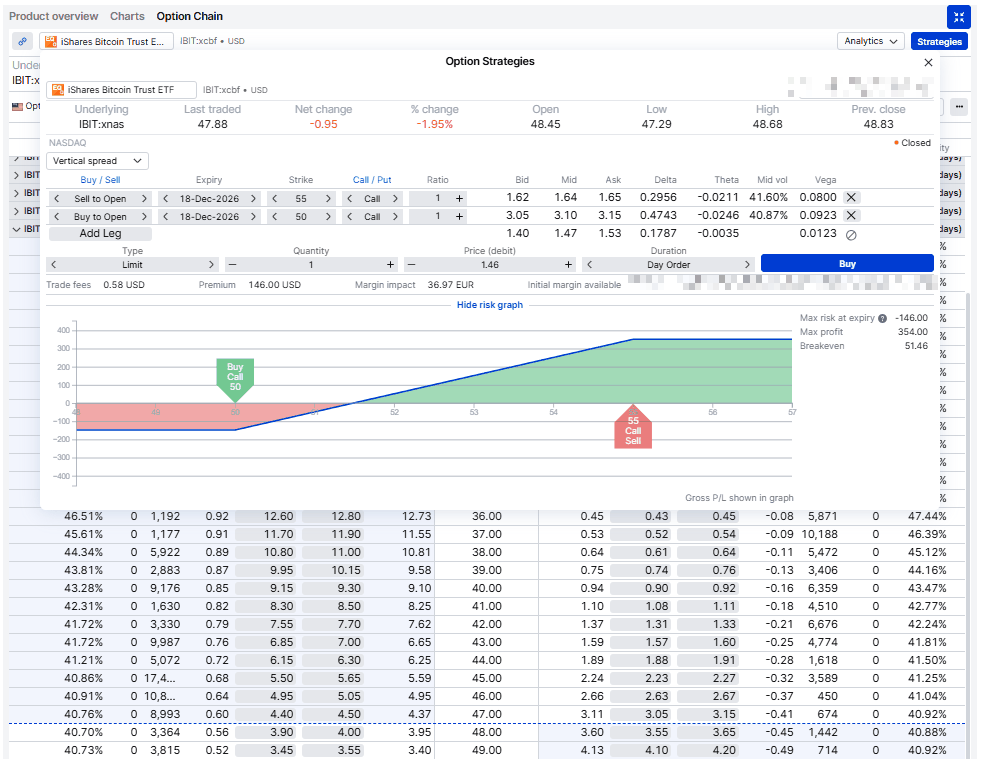 The 50/55 December call spread built in the option strategies ticket, with the platform’s own risk graph and the maximum risk, maximum profit and break-even it reports. Hypothetical, for education only. Source: SaxoTraderGo, as of 23 September 2026.
Past performance is not indicative of future results; figures are illustrative and not predictive.
Consolidation, then ownership: the cash-secured put
A different investor reads the same chart and concludes the move has come too far too quickly, while still wanting to own IBIT lower down. Selling a cash-secured put is an agreement to buy 100 shares at the strike if IBIT falls there by expiry, in exchange for a premium collected today.
Example structure (illustrative only – not a trade recommendation)
- Sell 1 IBIT 20 November 2026 44 put at approximately USD 1.32
- Premium received: approximately USD 132 per contract
- Cash reserved: USD 4,400 per contract
- Effective purchase price if assigned: approximately USD 42.68, about 10.8% below the 23 September price
- Maximum profit: approximately USD 132, if IBIT is above 44 on 20 November 2026
- Maximum loss: approximately USD 4,268 per contract, in the theoretical case IBIT falls to zero
- All figures are hypothetical and for education only (Source: Saxo, as of 23 September 2026)
Theta measures time decay, and it works for the seller: the option sheds a little value each day IBIT does not fall. The USD 42.68 effective purchase price lands near the floor of the support zone (Source: Saxo and Coinbase, as of 23 September 2026).
Strategy insight – what the premium does not do. The approximately USD 132 collected is about 3.0% of the USD 4,400 reserved over 58 days, and it is the whole of the upside, so a run to 55 leaves the seller holding the premium and none of the rally. It does not reduce the capital committed, and it removes very little of the downside: below USD 42.68 losses grow dollar for dollar as they would for a shareholder, up to approximately USD 4,268. Options carry a high risk of rapid loss and are not suitable for every investor. See Saxo pricing for costs and applicable charges.
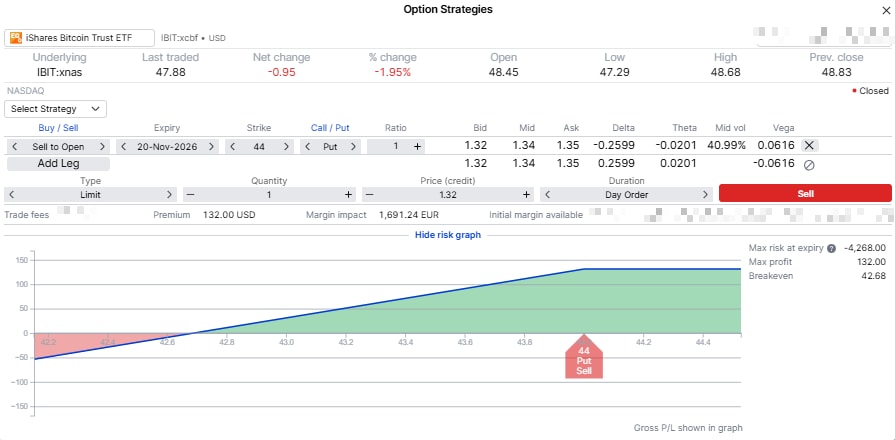 The 44 November put built in the option strategies ticket, with the platform’s own risk graph and the maximum risk, maximum profit and break-even it reports. Hypothetical, for education only. Source: SaxoTraderGo, as of 23 September 2026.
Past performance is not indicative of future results; figures are illustrative and not predictive.
Testing the premise
Both structures lean on the idea that the recovery is real, and that premise deserves testing. The debasement trade that carried bitcoin through August rests on expectations of easier policy, so firmer inflation, a more hawkish Federal Reserve or a renewed rise in long-end yields could each remove the support. The regulatory catalyst has stalled once already and may not return before the midterms. Leverage appears to have been rebuilding in perpetual futures, which tends to make declines faster than the rallies preceding them, and the chart is stretched after a near-vertical five-week move.
An investor who finds that case persuasive should, in our view, do nothing. No position is a legitimate position, and expressing a bearish view through options on a fund already 13.7% below its January close is how defined risk turns into a run of small, repeated losses (Source: Saxo, as of 23 September 2026). The neutral case sits between: an investor expecting IBIT to hold between the bands is describing the cash-secured put’s natural home, since it pays something for waiting and only becomes an ownership decision if the lower band gives way. The spread needs the opposite, a continued move arriving before 18 December 2026.
Before placing the trade, check:
- Bid and ask spreads, since wide spreads can remove the theoretical edge at entry
- Volume and open interest, to confirm liquidity at the chosen strike and expiry
- Expiry type: both 20 November 2026 and 18 December 2026 are standard monthly expiries, falling on the third Friday
- Implied volatility against realised volatility, which on 23 September favoured the buyer rather than the seller (Source: Saxo, as of 23 September 2026)
- Who is reserving the cash. A platform margins a short put the same way whether or not the cash is set aside, so the ticket above shows a margin impact near EUR 1,691 against the USD 4,400 an assignment would call for. “Cash-secured” is a discipline the investor applies, not something the platform enforces
- An exit plan, defined before entering, particularly for the two-leg spread
Assignment risk note: Because IBIT options are American-style, short legs can be assigned before expiry if they move in the money, and that risk rises closer to expiration. It applies to the 44 put and to the short 55 call. Monitor short options and understand the platform’s assignment process before entering. As the buyer of a put or call you face no assignment risk; only the seller does.
Final thoughts
Neither structure makes bitcoin calmer. The spread takes a capped and relatively inexpensive slice of a continued recovery, risking approximately USD 146 to make at most approximately USD 354. The put is paid approximately USD 132 to wait, keeps nearly all the downside below USD 42.68, and ties up approximately USD 4,400 meanwhile. The choice is about which risk an investor is willing to carry, not which looks cheaper.
Both can usually be closed before expiry if the view changes, and in our view that flexibility matters more to a newer options user than the headline numbers do. Options carry a high risk of rapid loss and are not suitable for every investor. See Saxo pricing for costs and applicable charges.
| Educational Resources |
|---|
| More from the author |
|---|