
Access both platforms from your single Saxo account.

Asia Market Quick Take – 06 April, 2026
Asia Market Quick Take – 6 April, 2026
Key points:
- Macro: Trump threatens to strike Iran if Straits not opened by Tuesday
- Equities: Stocks ended slightly higher in a short session on Friday.
- FX: USDJPY hovers just below 160 as strong US data offsets haven demand
- Commodities: Oil surges on severe Middle East supply risks; gold falls amid rate fears
- Fixed income: Yields rose after Trump threatens to hit Iran
------------------------------------------------------------------
Disclaimer: Past performance does not indicate future performance.
Macro:
- Trump threatened to target Iran’s power plants and bridges if the Strait of Hormuz is not reopened by Tuesday, further intensifying tensions in a Middle East conflict now in its second month.
- OPEC+ authorized a modest increase in production quotas for next month but warned that damage to Middle East energy infrastructure will continue to constrain oil supply well beyond the end of the war.
- US nonfarm payrolls rose by 178,000 in March—almost triple economists’ expectations of 60,000 and unemployment rate fell to 4.3%—prompting traders to wipe out remaining bets on Fed rate cuts this year.
Equities:
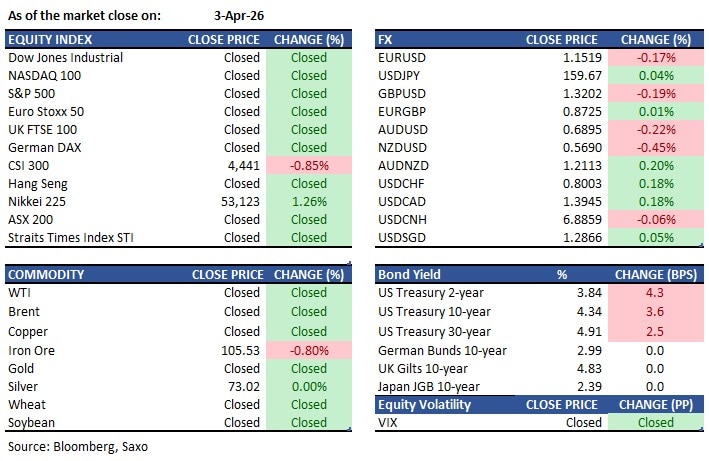
- US: US equity index futures fell 0.2% to 0.4% in Sunday evening trading after President Trump signaled sharp escalation in the Iran war, heightening risks of an energy shock already weighing on the global economic outlook. Brent crude rose 2% to trade above $111 per barrel as trading started. On Friday, the S&P 500 gained 0.1% in a shortened Good Friday session, led by real estate and information technology sectors. Last week's notable losers included Nike, which decreased 14.29% after reporting Q3 results and issuing fourth-quarter sales guidance below estimates. VinFast Auto jumped 42.77% to lead gainers for the week.
- EU: European stocks posted their best week in almost a year, with the Stoxx Europe 600 Index up 3.7% for the week ending April 2, the most since April 18, 2025. The index closed 0.2% lower on Thursday after erasing earlier declines of as much as 1.6% following a report that Iran is drafting a protocol with Oman to monitor traffic through the Strait of Hormuz. The FTSE 100 rose 4.70% for the week to 10,436.29, marking the largest one-week point gain since November 2008 and the largest percentage gain since January 2021. The CAC 40 Index gained 3.38% for the week to 7,962.39. Energy stocks including Shell and Total were among the strongest performers as oil prices soared. Airlines slumped as Morgan Stanley cut price targets across the sector and downgraded Lufthansa due to risks from higher fuel costs. Rolls-Royce Holdings gained as much as 10% after Wells Fargo initiated coverage with an overweight rating.
- Asia: South Korea's Kospi advanced as much as 2.2% in early Monday trading, extending Friday's gain, as shares of chipmakers climbed with Samsung Electronics rising as much as 4% and SK Hynix up 2.4%. The small-cap Kosdaq Index gained 1.2%. For the week ending April 3, the Kospi fell 1.1% despite closing Friday nearly 3% higher at 5,377.3. Japan's Nikkei climbed more than 3% in early Wednesday trading after President Trump indicated the war with Iran may be over in around two weeks. Mainland investors extended their buying spree of Hong Kong stocks in March, purchasing HK$61.4 billion through the cross-border exchange link program, marking a third consecutive month of net inflows. Poongsan jumped 23% after a report that Hanwha may buy its ammunition unit. Daikyonishikawa shares rose 4.2% after Takateru Murakami disclosed a stake.
Earnings this week:
- Monday: Samsung Electronics
- Wednesday: Delta
FX:
- In early Asian trade Monday, FX markets are cautious amid escalating US–Iran tensions.Dollar strengthened with DXY rose 0.2% to 100.26.USDJPY is steady near the key 160 level at 159.65, with Nomura expecting USDJPY to stay elevated and having raised its year-end forecast.
- The dollar is softer against AUD and NZD, with AUDUSD up 0.22% to 0.6911 and NZDUSD up 0.21% to 0.5702.
- EURUSD dips toward 1.15 as strong US jobs, Middle East tensions boost USD, while ECB signals policy to stay restrictive until inflation hits 2%.
Commodities:
- Oil prices are surging Monday morning as Middle East tensions escalate and traders price in heightened supply risks. WTI crude is up around 2% to roughly $113.7 per barrel, while Brent crude is also gaining about 2% to the $110. The move is driven by fears over disrupted Gulf exports and President Trump’s threats to destroy Iran’s power infrastructure if the Strait of Hormuz is not reopened, with Goldman Sachs calling it “the worst oil crisis in history.”
- Gold is under pressure despite the geopolitical backdrop. Spot gold is down 1.3% to about $4,617 per ounce, weighed by dollar strength and concerns that surging oil prices could fuel inflation and prompt interest-rate hikes, reducing the appeal of non-yielding assets like gold.
Fixed income:
- US Treasury yields rose 3 to 4 basis points across maturities on Friday after better-than-expected March employment data, with the 10-year yield climbing to 4.351% and traders erasing remaining wagers on Fed easing this year.
- Treasury 10-year note futures dipped 2/32 to 110 22/32 in early Monday trading after President Trump's threat to destroy Iran's power plants pushed up oil prices and fanned concern over quicker inflation.
For a global look at markets – go to Inspiration.
This content is marketing content and should not be considered investment advice. Trading financial instruments carries risks and historic performance is not a guarantee for future performance. The instrument(s) mentioned in this content may be issued by a partner, from which Saxo receives promotion, payment or retrocessions. While Saxo receives compensation from these partnerships, all content is conducted with the intention of providing clients with valuable options and information.