
1024x768 M 4

Multi-asset investing: How to give your portfolio a better chance at winning?

Charu Chanana 400x400
Charu Chanana

Chief Investment Strategist

Key points:

  • Over the last five years, Saxo’s client data shows investors who used more than one product type have tended to be more profitable than those using only one.
  • A broader toolkit may help by reducing hidden concentration, improving decision-making in drawdowns, and providing more than one way for a portfolio to perform across market regimes.
  • Getting started doesn’t require a portfolio overhaul. One small step beyond stocks (ETF, bonds, commodities, or simple collateralised options) can be a practical first move.

An interesting insight

Markets don’t reward the same exposures every quarter. Multi-asset investing is less about chasing returns and more about building a portfolio that can behave through different regimes, especially when drawdowns test decision-making.

Looking at aggregated Saxo client activity over the past five years, clients who used more than one product type were more likely to have higher profitability outcomes than clients who only used one (for example, stocks only).
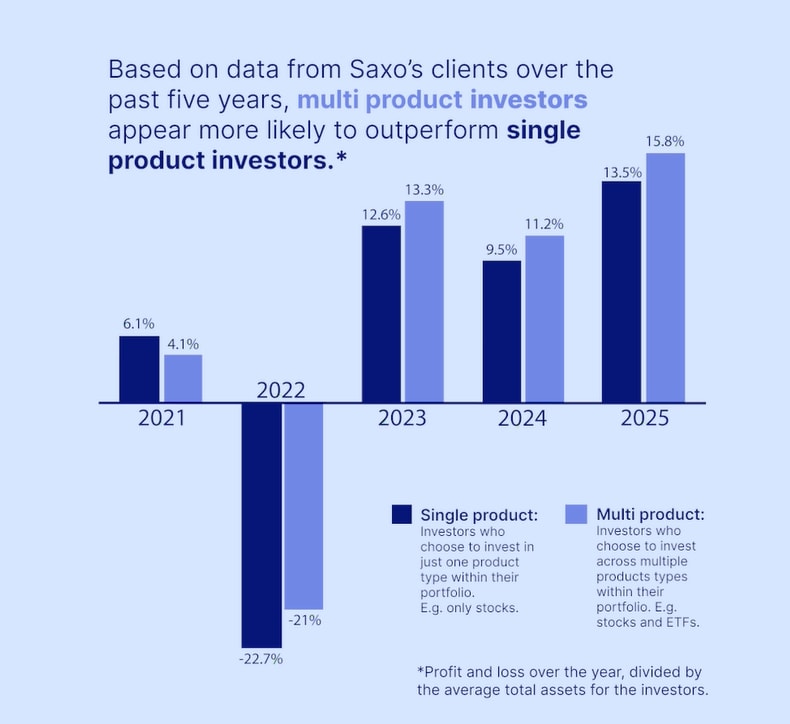
9_CHCA_Multi asset

Note: Past performance is not indicative of future results.
Source: Saxo client data

This is an association, not proof that using multiple products causes better results. Clients who use more instruments may differ in experience, risk management, time horizon, trading frequency, and costs—each of which can influence outcomes.

The practical takeaway is simpler: having more than one tool can give investors more ways to respond to changing market regimes—and may reduce the odds that one “single story” dominates results.


Why this may be happening

1) A smoother ride can improve behaviour
When outcomes are less dominated by one market move, investors are often less likely to panic-sell, overreact, or abandon a plan after a drawdown.

2) Different environments reward different exposures
Stocks don’t lead every quarter. Adding other building blocks (like bonds or commodities) can help when leadership rotates.

3) Less hidden concentration
“Stocks-only” portfolios often drift into concentrated bets (a few mega-caps, one sector, one region). Adding another product type can reduce single-story risk.

4) More consistent habits
ETFs and recurring contributions can encourage steadier investing behaviour. These are often more important than perfect timing.


Myths that keep investors stuck

Myth 1: “Diversification means lower returns.”
Diversification can reduce extremes, both on the highs and lows. For many investors, the bigger benefit is avoiding deep drawdowns and the bad timing decisions they often trigger.

Myth 2: “ETFs are just beginner products.”
ETFs are simply a wrapper. They can express broad markets, quality, dividends, sectors, regions, or themes – all without relying on single-stock outcomes.

Myth 3: “Bonds don’t matter anymore.”
Bonds are less about excitement and more about ballast. They may help cushion equity volatility and provide liquidity when markets are stressed.

Myth 4: “Commodities are only for traders.”
Commodities can be volatile, but they can also diversify portfolios in certain regimes (inflation surprises, supply shocks) when stocks and bonds become correlated.

Myth 5: “Options are leverage.”
Some options strategies are highly leveraged. But collateralised strategies like covered calls and cash-secured puts are often used by long-term investors as portfolio tools (still risky, but not the same as naked options).


If you’re stocks-only: common starting points investors consider

A broader toolkit doesn’t have to mean a full rebuild. The examples below are educational illustrations of how investors sometimes introduce a second return driver or a shock absorber. They’re not investment advice and may not be suitable for everyone.

1) ETFs (spreading single-name risk)

What it does: ETFs can reduce reliance on a handful of stocks by spreading exposure across more companies, sectors, or regions—while still keeping equity exposure.

Simple ways to start (illustrative):

  • Broad-market exposure to reduce single-stock concentration
  • Quality/dividend tilts to change the risk profile (with different sector/factor exposures)

Reality check: ETFs still carry market risk and can fall materially in a broad selloff.


2) Bonds (potential shock absorber / liquidity sleeve)

What it does: Bonds are often used as ballast and liquidity—particularly when equity volatility rises.

Simple ways to start (illustrative):

  • Higher-quality bonds as ballast
  • Shorter-duration exposure to reduce rate sensitivity (still not “risk-free”)

Reality check: Bonds can lose money (especially longer duration) and may not hedge equities in every regime.

3) Commodities (real assets for diversification in some regimes)

What it does: Commodities can diversify portfolios in certain macro environments, such as inflation surprises or supply shocks.

Simple ways to start (illustrative):

  • Broad commodities exposure for diversification
  • A modest allocation to precious metals as a stress diversifier in some regimes

Reality check: Commodities can be highly volatile and may not provide protection when you most want it.

4) Equity Trading Options (ETO) in collateralised structures

Some investors use collateralised option structures to introduce rules—often around income discipline or entry discipline. These strategies still carry meaningful risk and are not suitable for all investors.

Two examples (for information only):

A) Covered call (income-focused)

  • What it is: you own the shares and sell a call option against them.
  • Why investors use it: to earn option premium; trade-off is capped upside if the stock rises above the strike.

B) Cash-secured put (entry-focused)

  • What it is: you sell a put option while setting aside enough cash to buy shares if assigned.
  • Why investors use it: to earn premium while waiting to potentially buy at a lower effective price; trade-off is the obligation to buy if the stock falls.

Reality check: Options involve risk and are not suitable for all investors. Covered calls and cash-secured puts can still result in losses, missed upside, early assignment, and outcomes comparable to holding (or being obligated to buy) the underlying shares.


Risks and reality checks

  • Not causation: Multi-product clients tended to be more profitable; that doesn’t prove the product mix alone caused it.
  • ETFs can fall: Diversification reduces single-name risk, not market risk.
  • Bonds can lose money: Especially with rising yields or longer duration.
  • Commodities can be very volatile: They can draw down sharply and may not hedge in every environment.
  • Options carry significant risk: Covered calls and cash-secured puts can still lead to losses, missed upside, early assignment, and losses comparable to owning the underlying shares (or being obligated to buy them). Options may not be suitable for all investors.
  • Behaviour risk is real: Overtrading, panic-selling, or abandoning a plan can overwhelm diversification benefits.


Bottom line

The big takeaway from Saxo’s own client data is simple: portfolios with more than one way to work may be more resilient, and resilience often supports better outcomes.

If you’re stocks-only, you don’t need a complicated overhaul. Common examples investors sometimes explore include: start with an ETF, consider bonds, include a small real-asset diversifier, or use ETO in a simple collateralised way to add structure.


Outrageous Predictions 2026

01 /

  • Switzerland's Green Revolution: CHF 30 Billion Initiative by 2050

    Outrageous Predictions

    Switzerland's Green Revolution: CHF 30 Billion Initiative by 2050

    Katrin Wagner

    Head of Investment Content Switzerland

    Switzerland launches a CHF 30 billion energy revolution by 2050, rivaling Lindt & Sprüngli's market ...
  • The Swiss Fortress – 2026

    Outrageous Predictions

    The Swiss Fortress – 2026

    Erik Schafhauser

    Senior Relationship Manager

    Swiss voters reject EU ties, boosting the Swiss Franc and sparking Switzerland's "Souveränität Zuers...
  • Executive Summary: Outrageous Predictions 2026

    Outrageous Predictions

    Executive Summary: Outrageous Predictions 2026

    Saxo Group

    Read Saxo's Outrageous Predictions for 2026, our latest batch of low probability, but high impact ev...
  • A Fortune 500 company names an AI model as CEO

    Outrageous Predictions

    A Fortune 500 company names an AI model as CEO

    Charu Chanana

    Chief Investment Strategist

    Can AI be trusted to take over in the boardroom? With the right algorithms and balanced human oversi...
  • Dollar dominance challenged by Beijing’s golden yuan

    Outrageous Predictions

    Dollar dominance challenged by Beijing’s golden yuan

    Charu Chanana

    Chief Investment Strategist

    Beijing does an end-run around the US dollar, setting up a framework for settling trade in a neutral...
  • Dumb AI triggers trillion-dollar clean-up

    Outrageous Predictions

    Dumb AI triggers trillion-dollar clean-up

    Jacob Falkencrone

    Global Head of Investment Strategy

    Agentic AI systems are deployed across all sectors, and after a solid start, mistakes trigger a tril...
  • Quantum leap Q-Day arrives early, crashing crypto and destabilizing world finance

    Outrageous Predictions

    Quantum leap Q-Day arrives early, crashing crypto and destabilizing world finance

    Neil Wilson

    Investor Content Strategist

    A quantum computer cracks today’s digital security, bringing enough chaos with it that Bitcoin crash...
  • SpaceX announces an IPO, supercharging extraterrestrial markets

    Outrageous Predictions

    SpaceX announces an IPO, supercharging extraterrestrial markets

    John J. Hardy

    Global Head of Macro Strategy

    Financial markets go into orbit, to the moon and beyond as SpaceX expands rocket launches by orders-...
  • Taylor Swift-Kelce wedding spikes global growth

    Outrageous Predictions

    Taylor Swift-Kelce wedding spikes global growth

    John J. Hardy

    Global Head of Macro Strategy

    Next year’s most anticipated wedding inspires Gen Z to drop the doomscrolling and dial up the real w...
  • Despite concerns, U.S. 2026 mid-term elections proceed smoothly

    Outrageous Predictions

    Despite concerns, U.S. 2026 mid-term elections proceed smoothly

    John J. Hardy

    Global Head of Macro Strategy

    In spite of outstanding threats to the American democratic process, the US midterms come and go cord...

This content is marketing material.

None of the information provided on this website constitutes an offer, solicitation, or endorsement to buy or sell any financial instrument, nor is it financial, investment, or trading advice. Saxo Bank Switzerland and its entities within the Saxo Bank Group provide execution-only services, with all trades and investments based on self-directed decisions. Analysis, research, and educational content is for informational purposes only and should not be considered advice nor a recommendation.

Saxo Bank Switzerland’s content may reflect the personal views of the author, which are subject to change without notice. Mentions of specific financial products are for illustrative purposes only and may serve to clarify financial literacy topics. Content classified as investment research is marketing material and does not meet legal requirements for independent research.

Saxo Bank Switzerland partners with companies that provide compensation for promotional activities conduced on its platform. Additionally, Saxo Bank Switzerland has agreements with certain partners who provide retrocession contingent upon clients purchasing specific products offered by these partners.

While Saxo Bank Switzerland receives compensation from these partnerships, all educational and research content remains focused on providing information to clients.  

Before making any investment decisions, you should assess your own financial situation, needs, and objectives, and consider seeking independent professional advice. Saxo Bank Switzerland does not guarantee the accuracy or completeness of any information provided and assumes no liability for any errors, omissions, losses, or damages resulting from the use of this information.

The content of this website represents marketing material and is not the result of financial analysis or research. It has therefore not been prepared in accordance with directives of the Swiss Bankers Association designed to promote the independence of financial research and is not subject to any prohibition on dealing ahead of the dissemination of the marketing material.

Saxo Bank (Schweiz) AG
The Circle 38
CH-8058
Zürich-Flughafen
Switzerland

Contact Saxo

Switzerland
Switzerland

All trading carries risk. Losses can exceed deposits on margin products. You should consider whether you understand how our products work and whether you can afford to take the high risk of losing your money. To help you understand the risks involved we have put together a general Risk Warning series of Key Information Documents (KIDs) highlighting the risks and rewards related to each product. The KIDs can be accessed within the trading platform. Please note that the full prospectus can be obtained free of charge from Saxo Bank (Switzerland) Ltd. or the issuer.

This website can be accessed worldwide however the information on the website is related to Saxo Bank (Switzerland) Ltd. All clients will directly engage with Saxo Bank (Switzerland) Ltd. and all client agreements will be entered into with Saxo Bank (Switzerland) Ltd. and thus governed by Swiss Law. 

The content of this website represents marketing material and has not been notified or submitted to any supervisory authority.

If you contact Saxo Bank (Switzerland) Ltd. or visit this website, you acknowledge and agree that any data that you transmit to Saxo Bank (Switzerland) Ltd., either through this website, by telephone or by any other means of communication (e.g. e-mail), may be collected or recorded and transferred to other Saxo Bank Group companies or third parties in Switzerland or abroad and may be stored or otherwise processed by them or Saxo Bank (Switzerland) Ltd. You release Saxo Bank (Switzerland) Ltd. from its obligations under Swiss banking and securities dealer secrecies and, to the extent permitted by law, data protection laws as well as other laws and obligations to protect privacy. Saxo Bank (Switzerland) Ltd. has implemented appropriate technical and organizational measures to protect data from unauthorized processing and disclosure and applies appropriate safeguards to guarantee adequate protection of such data.

Apple, iPad and iPhone are trademarks of Apple Inc., registered in the U.S. and other countries. App Store is a service mark of Apple Inc.