
You can access both of our platforms from a single Saxo account.

Bitcoin breaks its summer floor, then bounces: relief or turn?

Summary: Bitcoin has fallen for seven weeks and broke below its 200-day average on 12 November. What drove the slide, what the options market is pricing after the weekend plunge, and three calm ways investors can approach it.
Seven weeks of losses, one violent weekend and a bounce: what has really changed for bitcoin investors?
For anyone holding bitcoin, the past seven weeks have been a slow grind rather than a single shock. Each week closed lower than the one before. What changed on the weekend of 21 and 22 November was the speed: a market-wide sell-off on Friday 20 November turned a steady decline into a sharp flush, before buyers pulled the price back above USD 60,000 (Source: Saxo, Deribit, as of 23 November 2026). Past performance is not indicative of future results.
The question for investors is less about the weekend and more about the trend. What pushed bitcoin lower for so long, and has any of that changed?
How we got here
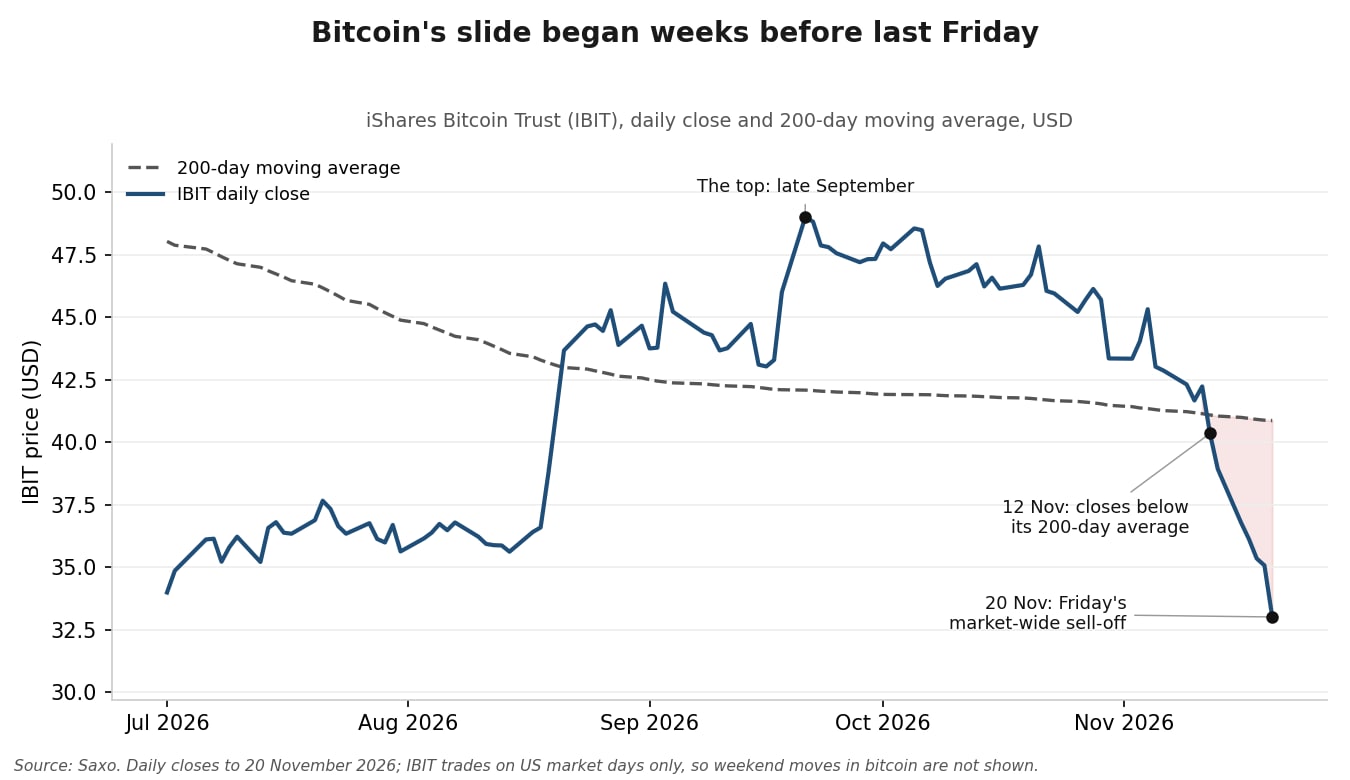 iShares Bitcoin Trust (IBIT) daily closes with the 200-day moving average, to 20 November 2026. IBIT tracks the bitcoin price and trades on US market days only, so weekend moves are not shown. Source: Saxo. Past performance is not indicative of future results. This chart is illustrative and for educational purposes only; it is not predictive.
October: the momentum faded. Bitcoin topped out in late September and could not get back there in early October. Inflation figures came in hotter than expected, and traders started to price in further US rate increases. Money that had been flowing into US bitcoin funds over the summer turned into outflows. October ended with bitcoin lower, giving back all of September’s gain.
Mid-November: the trend broke. The 200-day moving average is the average closing price over roughly the past ten months. Long-term investors watch it because it smooths out the daily noise: a price above it suggests an uptrend, a price below it suggests the trend has turned. Bitcoin had stayed above that line all autumn. Then a hot US inflation report on 10 November pushed Federal Reserve officials into a more hawkish tone, and two days later Nvidia, the bellwether of the AI trade, said its chief executive was leaving. Technology shares fell, the US ten-year yield climbed back above 5%, and bitcoin closed below its 200-day average on 12 November. It has not been back above it since.
Late November: the pressure built. New US curbs on access to advanced AI chips dragged technology shares lower again, and minutes from the Federal Reserve’s October meeting showed nearly all officials expected further rate rises. Markets now price at least two more hikes by mid-2027. Higher rates make cash and bonds more attractive, and reduce the appeal of assets that pay no income, bitcoin among them. At the same time, money kept leaving US bitcoin funds (Source: Farside Investors), and index provider MSCI announced it will drop Strategy, the largest corporate holder of bitcoin, from its global indexes after the 30 November close (Source: MSCI).
The weekend of 21 November: the flush. On Friday 20 November, stocks fell across the board, with chipmakers hit hardest, and bitcoin went with them. In thin weekend trading on Saturday, traders who had borrowed to bet on higher prices were forced out, and that selling pushed bitcoin to about USD 55,000. Then the same mechanism ran in reverse, as traders who had bet on further falls bought back their positions, and the price recovered above USD 60,000 within hours (Source: Deribit).
Why this is not only a crypto story
The striking part of the week to 20 November was not that bitcoin fell. It was that almost everything fell with it. Stocks, gold and silver all lost ground at the same time. Normally, when investors sell one asset, they move the money somewhere else. That week, they mostly moved it into cash.
That points to the cause. When rates are rising and inflation refuses to cool, money gets tighter across the whole system, and the most speculative assets feel it first. Bitcoin sits near the front of that queue. Friday’s sell-off was the whole market moving; the weeks before it were bitcoin leading the way down.
For investors, the takeaway in our view is that bitcoin’s next big move may depend less on crypto news and more on inflation data and central bank language. In our view, bounces inside that backdrop may stay short-lived until the backdrop itself changes.
Monday 23 November: the first test
Weekend bounces in crypto happen with stock markets closed, so Monday morning is the first time the rebound meets the rest of the market. The early signs are calmer. US stock futures rose about 2% overnight, recovering part of Friday’s slide, after Treasury Secretary Bessent warned that the Fed risks raising rates too far. Governments in South Korea, Taiwan and China stepped up support for their stock markets over the weekend, although Korean chipmakers still fell sharply (Source: Saxo, as of 23 November 2026, 05:00 CET).
Bitcoin is holding a little above USD 61,000. That still left it with a seventh weekly decline in a row when the week closed on Sunday 22 November (Source: Deribit, as of 23 November 2026).
The level to watch is USD 60,000. It is a round number, but it matters because so many traders use it as a reference. Holding above it once US stocks trade again would suggest the weekend low may stand for now. Falling back below it would put the Saturday low near USD 55,000 back in focus. A one-night rebound in futures is not yet a change in trend: the 200-day average still sits far above, close to USD 72,000. Future outcomes are uncertain and may result in losses.
What the options market is pricing
Options prices tell us how nervous traders are, and about what. Comparing the weekend peak with Monday morning shows the panic fading, but not gone (Source: Deribit, as of 23 November 2026, 07:00 CET).
How big a move traders expect. Implied volatility is the market’s estimate of how much bitcoin will swing. Deribit’s bitcoin volatility index jumped to its highest level in weeks during Saturday’s drop. By Monday morning it had fallen back by about a quarter, though it is still above where it stood before the slide in mid-November.
When they expect it. Normally, options that run for months price in more uncertainty than options that expire this week. Over the weekend it was clearly the other way round: the shortest-dated options carried by far the highest volatility, a typical sign of stress. That gap has narrowed sharply since Sunday. This week’s options are still the most expensive, but from one month out the curve is now almost flat.
Which direction worries them. Put options, which pay out if the price falls, still cost noticeably more than call options the same distance away on the upside. That gap has barely moved since the weekend, and it is widest for December and January expiries. In plain terms: traders appear calmer about the next few days, but they are still paying up to insure against another leg down over the coming months.
One nuance is worth keeping in mind. Compared with how much bitcoin has actually moved recently, options appear, if anything, slightly cheap overall. The extra cost sits almost entirely in the downside protection. In our view, that shapes which approaches may make more sense below.
Important note: The strategies and examples provided in this article are purely for educational purposes. They are intended to assist in shaping your thought process and should not be replicated or implemented without careful consideration. Every investor or trader must conduct their own due diligence and take into account their unique financial situation, risk tolerance, and investment objectives before making any decisions. Remember, investing in the stock market carries risk, and it’s crucial to make informed decisions.
Three ways investors can approach this
There is no single right answer after a fall like this. What fits depends on whether an investor already owns bitcoin exposure, and how much further decline they can accept. Investors can express these ideas with listed options on the iShares Bitcoin Trust (IBIT), a US exchange-traded fund that tracks the bitcoin price; one IBIT option covers 100 shares of the fund. IBIT closed at USD 33.02 on 20 November 2026 (Source: Saxo). Costs and charges apply to each option leg; see Saxo pricing for full details.
The following examples are hypothetical and for educational use only; they are not advice or trade recommendations.
1. Wait for the backdrop to change. Staying on the sidelines is a valid choice. If the sell-off is driven by tight money rather than crypto itself, waiting for the US inflation data on 25 November and a turn in fund flows costs nothing but a possible missed rebound.
2. Get paid to buy lower. An investor who would be comfortable owning IBIT at a lower price can sell a cash-secured put at that level, keeping enough cash aside to buy the 100 shares if needed. They collect a premium upfront. If IBIT stays above the chosen strike at expiry, they keep the premium. If it falls below, they buy at the strike, and the premium already received lowers the effective purchase price. Because puts are expensive right now, that premium is larger than usual. The risk is real: in a fast fall, the investor still buys at the agreed price, even if the market is far lower.
3. Protect what you hold, without overpaying. Buying a put on its own works like insurance, but at today’s prices the insurance is costly. A collar spreads that cost: the investor holding IBIT buys a put for protection and sells a call above the current price to help pay for it. The trade-off is that gains above the call strike are given up, and the protection only starts below the put strike. A put spread, buying one put and selling a lower one, is a cheaper alternative that covers a defined slice of the downside, but it stops protecting below the lower strike.
Options carry a high risk of rapid loss and are not suitable for all investors. Selling options can lead to losses that exceed the premium received.
Before any position:
- Bid and ask spreads at the chosen strikes; wide spreads can eat into the premium at entry and exit
- Volume and open interest at the chosen strike and expiry
- Whether the expiry is a weekly or a standard monthly; the December standard monthly expiry is 18 December 2026
- Implied versus realised volatility: is the market charging more than bitcoin has been moving?
- An exit plan, defined before entering; positions can often be closed or rolled before expiry
- Early-assignment risk on any option sold: IBIT options are American-style, so a short put or call that moves in the money can be assigned before expiry. The buyer of an option faces no assignment risk
The week ahead
- Wednesday 25 November: US inflation (PCE) for October and a second estimate of third-quarter growth. This is the release most likely to move rate expectations, and with them bitcoin.
- Thursday 26 November: US markets closed for Thanksgiving, with a shortened session on Friday 27 November. Thinner trading can exaggerate moves, as the weekend of 21 November showed.
- Friday 27 November: a large batch of bitcoin options expires on Deribit. Big expiries can pull prices around in the final hours.
- 9 December: the next US Federal Reserve decision.
Final thoughts
Until inflation data gives central banks room to ease, rebounds in bitcoin may, in our view, stay fragile. The options market gives an early read: if short-dated volatility falls back below longer-dated volatility, and put prices cool, the market may be signalling that the panic has passed.
Options do not change the direction of bitcoin. They give investors more ways to act on a view they already hold: waiting with a plan, setting a lower price at which they would buy, or limiting the damage on a position they want to keep. Each of these can be adjusted or closed long before expiry if the picture changes. Options carry a high risk of rapid loss and are not suitable for every investor.
The author does not hold positions in any of the instruments mentioned in this article and is permitted to wait at least 24 hours from the time of the publication before trading the instruments themselves.
| Educational Resources |
|---|
| Related articles/content |
|---|
| Cryptos late-summer run where bitcoin and ethereum stand and what comes next | 23 Sep 2026 -- Market Quick Take - Sentiment bounces after Friday mayhem - 23 November 2026 |
| More from the author |
|---|