ChatGPT Image Jan 8 2026 125934 PM

Why Defense is creeping into “core portfolio” conversations

Actions 5 minutes to read
Charu Chanana 400x400
Charu Chanana

Chief Investment Strategist

Key points:

  • The big shift: Defense is no longer a “headline trade”. Early 2026 is showing it is becoming a standing line item when tensions flare in more than one region from US-Venezuela, to Greenland to China-Japan and others at the same time.
  • Spending is rising, but the rules are tightening: Europe is trying to lock in a multi-year plan, while the US is signalling “deliver first” — which can create winners and losers within defense, not just lift the whole sector.
  • AI is changing what ‘defense’ means: Budgets are moving from only big platforms to information advantage (drones, sensors, networks, software).


Why defense is being discussed as “part of all portfolios”

Defense sits at the intersection of three forces that matter for long-term investing:

  1. Geopolitics has reset the baseline. Early 2026 has already delivered multiple pressure points at once — US action in Venezuela, renewed focus on Greenland and the Arctic, and sharper Japan–China tensions.
  2. Europe is trying to turn urgency into a multi-year plan. NATO’s new spending commitment matters because it pushes defense from “reaction” toward “roadmap,” even if progress will differ by country.
  3. AI is changing what defense looks like. The story is no longer only jets and ships. Increasingly, it is also sensors, secure networks, drones, and software that helps decisions happen faster.

Geopolitics is setting the tone early in 2026

The year has started with a reminder that national security issues are no longer “somewhere else” or “some other time.”

  • In the US, the aftermath of the Venezuela operation has reinforced a mood of hard-power politics returning to the agenda.
  • In Europe, leaders have publicly stressed that Greenland’s future is for Greenland and Denmark to decide, reflecting unease about Arctic strategy and sovereignty.
  • In Asia, Japan–China tensions have sharpened, with China restricting exports of some dual-use items to Japan and Japan approving a record military budget (Reuters reported 9 trillion yen for the coming fiscal year).

This matters for investors because defense spending is often one of the first places governments try to “do something visible”—even when other parts of the budget are under strain.


NATO has raised the bar on European defense spending

For years, the shorthand was “2% of GDP.” Now the direction is clearer.

NATO’s Hague Summit commitments point to 5% of GDP by 2035, with at least 3.5% aimed at core defense and up to 1.5% toward security-related areas like protecting infrastructure, networks, and resilience.

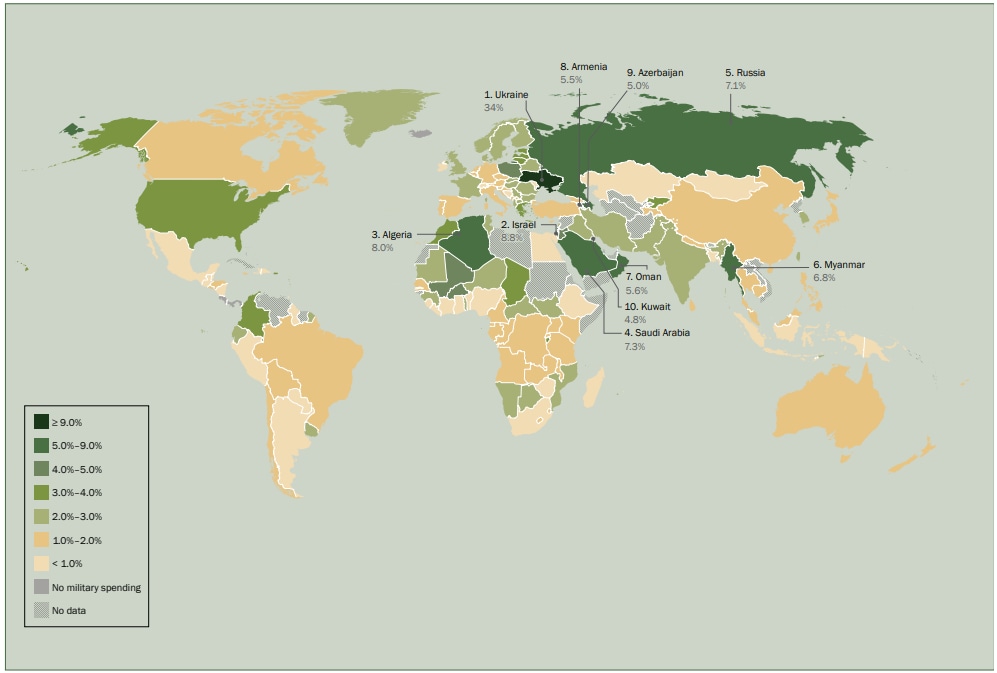
Chart 1: Military spending as a share of gross doemtic product, by country, 2024 
8_CHCA_Military spending by countrySource:  SIPRI Military Expenditure Database, April 2025

What that signals for Europe

  • Spending pressure is rising, even if the pace is uneven across countries.
  • The definition is broader than “weapons only.” It includes security-related areas like infrastructure resilience and network protection.
  • Europe will care more about local supply chains. That means not only buying equipment, but also building production capacity at home.

The US twist: bigger ambition, tougher rules

President Trump has called for a $1.5 trillion US military budget for 2027 (up from $901 billion for 2026), but he has also signalled tougher expectations for contractors, pushing them to prioritise delivery and production over shareholder payouts in cases of underperformance.

This means demand can rise, but the sector may face more political scrutiny. That can create more headline-driven swings, especially in companies tied to programs that are delayed or over budget.


AI is changing defense faster than most people think

AI’s impact is practical and near-term:

  • More unmanned systems. Drones in the air and at sea can scale faster than traditional platforms.
  • More sensing and tracking. Countries are spending more on satellites, radar, and detection.
  • More secure connectivity. Communications and electronic systems must keep working under stress.
  • More software. Tools that turn data into usable action are becoming more important.

But the risks are real: AI in security can become controversial quickly after accidents, misuse, or public backlash. That can slow projects, change rules, or redirect spending.


Mapping out the defense sector

1) Air and missile defense

This area is focused on protecting cities, bases, and critical infrastructure. It often includes sensors, air defense electronics, and command systems.

US: RTX, Lockheed Martin

Europe: Thales,  Saab

What to watch: new orders, delivery timelines, and whether replenishment becomes a priority.

2) Weapon and ammunition manufacturing

This area matters when governments want to rebuild stockpiles and shorten delivery times.

Europe: Rheinmetall, BAE Systems

US (more indirect, but still relevant): General Dynamics

What to watch: production capacity expansion, availability of key components, and political pressure on pricing.

3) Space, surveillance, and secure communications

This is where the “AI and data” angle often shows up most clearly. It is about seeing, connecting, and coordinating faster.

US: Northrop Grumman (space and strategic systems exposure), L3Harris (communications and defense electronics), Palantir (software and data tools linked to defense use cases; often more volatile)

Europe: Leonardo (defense electronics and platforms), Thales (sensors, electronics, and security systems)

What to watch: government contracts that move from pilots to real deployment, and any sudden political pushback around surveillance or AI.

4) Shipbuilding and naval (“protect trade routes”)

This area supports maritime security, but projects can take longer and face delivery risk.

US: Huntington Ingalls (naval shipbuilding exposure), General Dynamics (submarine exposure via Electric Boat)

Europe: Rolls-Royce (defense propulsion exposure; not a pure-play defense company)

Risk note: capacity constraints and program delays are common here. The work can be large, but the timelines can be messy.

5) Japan

Japan has been on a path of higher security spending, and the investable names tend to reflect different parts of the ecosystem.

  • Mitsubishi Heavy Industries — aerospace and defense programs, plus broader industrial capacity.
  • IHI Corporation — defense and aerospace-related industrial exposure (including engines and heavy industry capabilities).
  • NEC — communications, networks, and defense-related electronics and systems.


Risks investors should watch

  • Fiscal pressure: higher defense ambitions collide with debt, interest costs, and competing domestic priorities. This can slow the pace or change what gets funded first.
  • Policy risk: the US push to prioritise production over payouts can create sudden volatility in individual names.
  • Execution risk: late delivery and cost overruns can hurt sentiment even when spending is rising.
  • AI controversy risk: regulation and political scrutiny can arrive quickly after incidents.


This material is marketing content and should not be regarded as investment advice. Trading financial instruments carries risks and historic performance is not a guarantee of future results.
The instrument(s) referenced in this content may be issued by a partner, from whom Saxo receives promotional fees, payment or retrocessions. While Saxo may receive compensation from these partnerships, all content is created with the aim of providing clients with valuable information and options..

Prévisions "chocs" 2026

01 /

  • Révolution Verte en Suisse : un projet de CHF 30 milliards d’ici 2050

    Outrageous Predictions

    Révolution Verte en Suisse : un projet de CHF 30 milliards d’ici 2050

    Katrin Wagner

    Head of Investment Content Switzerland

    la Suisse se lance dans une révolution énergétique de CHF 30 milliards d'ici 2050, rivalisant avec l...

  • « La Forteresse Suisse – 2026 »

    Outrageous Predictions

    « La Forteresse Suisse – 2026 »

    Erik Schafhauser

    Senior Relationship Manager

    les électeurs suisses rejettent les liens avec l'UE, renforçant le franc suisse et déclenchant la d...
  • Une entreprise du classement Fortune 500 nomme un modèle d’intelligence artificielle comme directeur général.

    Outrageous Predictions

    Une entreprise du classement Fortune 500 nomme un modèle d’intelligence artificielle comme directeur général.

    Charu Chanana

    Chief Investment Strategist

  • Prévisions "chocs" 2026

    Outrageous Predictions

    Prévisions "chocs" 2026

    Saxo Group

  • Malgré certaines inquiétudes, les élections américaines de mi-mandat de 2026 se déroulent sans heurts

    Outrageous Predictions

    Malgré certaines inquiétudes, les élections américaines de mi-mandat de 2026 se déroulent sans heurts

    John J. Hardy

    Global Head of Macro Strategy

  • La domination du dollar remise en cause par le « yuan doré » de Pékin

    Outrageous Predictions

    La domination du dollar remise en cause par le « yuan doré » de Pékin

    Charu Chanana

    Chief Investment Strategist

  • Des médicaments contre l’obésité pour tous – même pour les animaux de compagnie

    Outrageous Predictions

    Des médicaments contre l’obésité pour tous – même pour les animaux de compagnie

    Jacob Falkencrone

    Global Head of Investment Strategy

  • Le grand bug de l’IA : un reset à mille milliards de dollars

    Outrageous Predictions

    Le grand bug de l’IA : un reset à mille milliards de dollars

    Jacob Falkencrone

    Global Head of Investment Strategy

  • Le grand saut quantique arrive plus tôt que prévu : le « Q-Day » fait s’effondrer les cryptomonnaies et déstabilise la finance mondiale.

    Outrageous Predictions

    Le grand saut quantique arrive plus tôt que prévu : le « Q-Day » fait s’effondrer les cryptomonnaies et déstabilise la finance mondiale.

    Neil Wilson

    Investor Content Strategist

  • SpaceX annonce son introduction en Bourse, dopant les marchés liés à l’exploration spatiale.

    Outrageous Predictions

    SpaceX annonce son introduction en Bourse, dopant les marchés liés à l’exploration spatiale.

    John J. Hardy

    Global Head of Macro Strategy

Ce contenu est un document à caractère marketing.

Aucune des informations fournies sur ce site ne constitue une offre, une sollicitation ou une recommandation d'acheter ou de vendre un instrument financier, ni un conseil financier, d'investissement ou de trading. Saxo Bank Suisse et ses entités au sein du groupe Saxo Bank fournissent des services d'exécution uniquement, avec toutes les transactions et investissements basés sur des décisions autonomes. Les analyses, les travaux de recherche et le contenu éducatif sont fournis à des fins d'information uniquement et ne doivent pas être considérés comme des conseils ou des recommandations.

Le contenu de Saxo Bank Suisse peut refléter les opinions personnelles de l’auteur, susceptibles d’être modifiées sans préavis. Les mentions de produits financiers spécifiques sont données à titre purement illustratif et peuvent servir à clarifier des notions liées à la culture financière. Les contenus classés comme recherches en investissement sont considérés comme du matériel marketing et ne répondent pas aux exigences légales en matière de recherche indépendante.

Saxo Bank Suisse entretient des partenariats avec des entreprises qui la rémunèrent pour les activités promotionnelles menées sur sa plateforme. De plus, Saxo Bank Suisse a des accords avec certains partenaires qui fournissent des rétrocessions conditionnées à l'achat par les clients de produits spécifiques proposés par ces partenaires.

Bien que Saxo Bank Suisse reçoive une compensation de ces partenariats, tous les contenus éducatifs et inspirants sont réalisés dans l'intention de fournir aux clients des options et des informations pertinentes.

Avant de prendre des décisions d'investissement, vous devez évaluer votre propre situation financière, vos besoins et vos objectifs, et envisager de demander des conseils professionnels indépendants. Saxo Bank Suisse ne garantit ni l'exactitude ni l'exhaustivité des informations fournies et décline toute responsabilité en cas d’erreurs, d’omissions, de pertes ou de dommages résultant de l’utilisation de ces informations.

Le contenu de ce site Web représente du matériel de marketing et n'est pas le résultat d'une analyse ou d'une recherche financière. Il n'a donc pas été préparé conformément aux directives de l'association suisse des banquiers visant à promouvoir l'indépendance de la recherche financière et n'est soumis à aucune interdiction de négociation avant la diffusion du matériel de marketing. 

Saxo Bank (Suisse) SA
The Circle 38
CH-8058
Zürich-Flughafen
Suisse

Nous contacter

Select region

Suisse
Suisse

Le trading d’instruments financiers comporte des risques. Les pertes peuvent dépasser les dépôts sur les produits de marge. Vous devez comprendre comment fonctionnent nos produits et quels types de risques ils comportent. De plus, vous devez savoir si vous pouvez vous permettre de prendre un risque élevé de perdre votre argent. Pour vous aider à comprendre les risques impliqués, nous avons compilé une divulgation des risques ainsi qu'un ensemble de documents d'informations clés (Key Information Documents ou KID) qui décrivent les risques et opportunités associés à chaque produit. Les KID sont accessibles sur la plateforme de trading. Veuillez noter que le prospectus complet est disponible gratuitement auprès de Saxo Bank (Suisse) SA ou directement auprès de l'émetteur.

Ce site web est accessible dans le monde entier. Cependant, les informations sur le site web se réfèrent à Saxo Bank (Suisse) SA. Tous les clients traitent directement avec Saxo Bank (Suisse) SA. et tous les accords clients sont conclus avec Saxo Bank (Suisse) SA et sont donc soumis au droit suisse.

Le contenu de ce site web constitue du matériel de marketing et n'a été signalé ou transmis à aucune autorité réglementaire.

Si vous contactez Saxo Bank (Suisse) SA ou visitez ce site web, vous reconnaissez et acceptez que toutes les données que vous transmettez, recueillez ou enregistrez via ce site web, par téléphone ou par tout autre moyen de communication (par ex. e-mail), à Saxo Bank (Suisse) SA peuvent être transmises à d'autres sociétés ou tiers du groupe Saxo Bank en Suisse et à l'étranger et peuvent être enregistrées ou autrement traitées par eux ou Saxo Bank (Suisse) SA. Vous libérez Saxo Bank (Suisse) SA de ses obligations au titre du secret bancaire suisse et du secret des négociants en valeurs mobilières et, dans la mesure permise par la loi, des autres lois et obligations concernant la confidentialité dans le cadre des divulgations de données du client. Saxo Bank (Suisse) SA a pris des mesures techniques et organisationnelles de pointe pour protéger lesdites données contre tout traitement ou transmission non autorisés et appliquera des mesures de sécurité appropriées pour garantir une protection adéquate desdites données.

Apple, iPad et iPhone sont des marques déposées d'Apple Inc., enregistrées aux États-Unis et dans d'autres pays. App Store est une marque de service d'Apple Inc.