ChatGPT Image Jan 8 2026 125934 PM

Why Defense is creeping into “core portfolio” conversations

Equities 5 minutes to read
Charu Chanana 400x400
Charu Chanana

Chief Investment Strategist

Key points:

  • The big shift: Defense is no longer a “headline trade”. Early 2026 is showing it is becoming a standing line item when tensions flare in more than one region from US-Venezuela, to Greenland to China-Japan and others at the same time.
  • Spending is rising, but the rules are tightening: Europe is trying to lock in a multi-year plan, while the US is signalling “deliver first” — which can create winners and losers within defense, not just lift the whole sector.
  • AI is changing what ‘defense’ means: Budgets are moving from only big platforms to information advantage (drones, sensors, networks, software).


Why defense is being discussed as “part of all portfolios”

Defense sits at the intersection of three forces that matter for long-term investing:

  1. Geopolitics has reset the baseline. Early 2026 has already delivered multiple pressure points at once — US action in Venezuela, renewed focus on Greenland and the Arctic, and sharper Japan–China tensions.
  2. Europe is trying to turn urgency into a multi-year plan. NATO’s new spending commitment matters because it pushes defense from “reaction” toward “roadmap,” even if progress will differ by country.
  3. AI is changing what defense looks like. The story is no longer only jets and ships. Increasingly, it is also sensors, secure networks, drones, and software that helps decisions happen faster.

Geopolitics is setting the tone early in 2026

The year has started with a reminder that national security issues are no longer “somewhere else” or “some other time.”

  • In the US, the aftermath of the Venezuela operation has reinforced a mood of hard-power politics returning to the agenda.
  • In Europe, leaders have publicly stressed that Greenland’s future is for Greenland and Denmark to decide, reflecting unease about Arctic strategy and sovereignty.
  • In Asia, Japan–China tensions have sharpened, with China restricting exports of some dual-use items to Japan and Japan approving a record military budget (Reuters reported 9 trillion yen for the coming fiscal year).

This matters for investors because defense spending is often one of the first places governments try to “do something visible”—even when other parts of the budget are under strain.


NATO has raised the bar on European defense spending

For years, the shorthand was “2% of GDP.” Now the direction is clearer.

NATO’s Hague Summit commitments point to 5% of GDP by 2035, with at least 3.5% aimed at core defense and up to 1.5% toward security-related areas like protecting infrastructure, networks, and resilience.

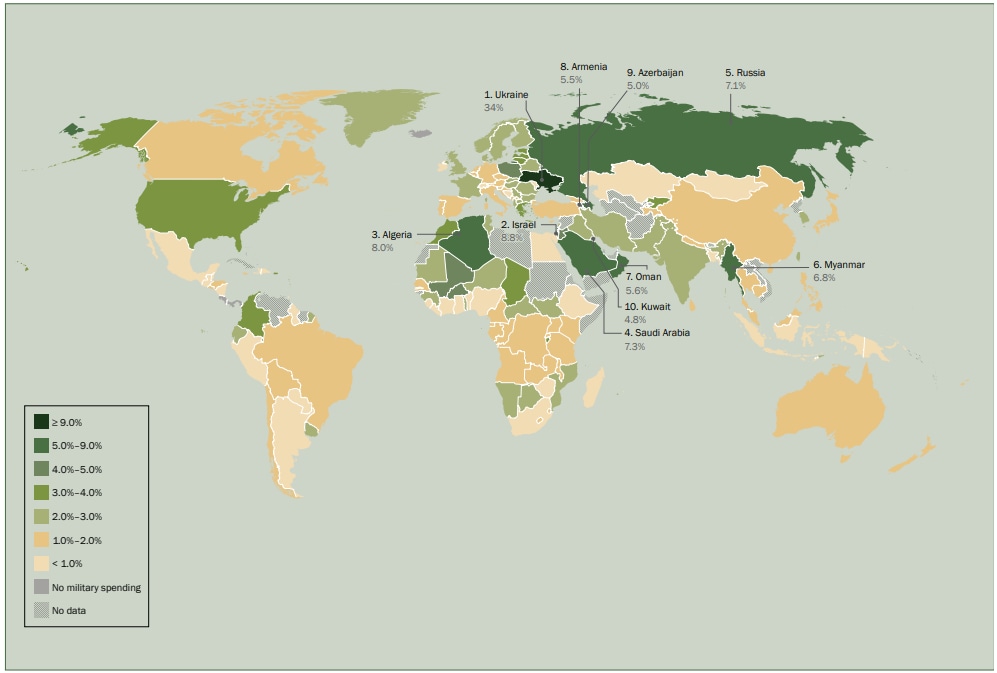
Chart 1: Military spending as a share of gross doemtic product, by country, 2024 
8_CHCA_Military spending by countrySource:  SIPRI Military Expenditure Database, April 2025

What that signals for Europe

  • Spending pressure is rising, even if the pace is uneven across countries.
  • The definition is broader than “weapons only.” It includes security-related areas like infrastructure resilience and network protection.
  • Europe will care more about local supply chains. That means not only buying equipment, but also building production capacity at home.

The US twist: bigger ambition, tougher rules

President Trump has called for a $1.5 trillion US military budget for 2027 (up from $901 billion for 2026), but he has also signalled tougher expectations for contractors, pushing them to prioritise delivery and production over shareholder payouts in cases of underperformance.

This means demand can rise, but the sector may face more political scrutiny. That can create more headline-driven swings, especially in companies tied to programs that are delayed or over budget.


AI is changing defense faster than most people think

AI’s impact is practical and near-term:

  • More unmanned systems. Drones in the air and at sea can scale faster than traditional platforms.
  • More sensing and tracking. Countries are spending more on satellites, radar, and detection.
  • More secure connectivity. Communications and electronic systems must keep working under stress.
  • More software. Tools that turn data into usable action are becoming more important.

But the risks are real: AI in security can become controversial quickly after accidents, misuse, or public backlash. That can slow projects, change rules, or redirect spending.


Mapping out the defense sector

1) Air and missile defense

This area is focused on protecting cities, bases, and critical infrastructure. It often includes sensors, air defense electronics, and command systems.

US: RTX, Lockheed Martin

Europe: Thales,  Saab

What to watch: new orders, delivery timelines, and whether replenishment becomes a priority.

2) Weapon and ammunition manufacturing

This area matters when governments want to rebuild stockpiles and shorten delivery times.

Europe: Rheinmetall, BAE Systems

US (more indirect, but still relevant): General Dynamics

What to watch: production capacity expansion, availability of key components, and political pressure on pricing.

3) Space, surveillance, and secure communications

This is where the “AI and data” angle often shows up most clearly. It is about seeing, connecting, and coordinating faster.

US: Northrop Grumman (space and strategic systems exposure), L3Harris (communications and defense electronics), Palantir (software and data tools linked to defense use cases; often more volatile)

Europe: Leonardo (defense electronics and platforms), Thales (sensors, electronics, and security systems)

What to watch: government contracts that move from pilots to real deployment, and any sudden political pushback around surveillance or AI.

4) Shipbuilding and naval (“protect trade routes”)

This area supports maritime security, but projects can take longer and face delivery risk.

US: Huntington Ingalls (naval shipbuilding exposure), General Dynamics (submarine exposure via Electric Boat)

Europe: Rolls-Royce (defense propulsion exposure; not a pure-play defense company)

Risk note: capacity constraints and program delays are common here. The work can be large, but the timelines can be messy.

5) Japan

Japan has been on a path of higher security spending, and the investable names tend to reflect different parts of the ecosystem.

  • Mitsubishi Heavy Industries — aerospace and defense programs, plus broader industrial capacity.
  • IHI Corporation — defense and aerospace-related industrial exposure (including engines and heavy industry capabilities).
  • NEC — communications, networks, and defense-related electronics and systems.


Risks investors should watch

  • Fiscal pressure: higher defense ambitions collide with debt, interest costs, and competing domestic priorities. This can slow the pace or change what gets funded first.
  • Policy risk: the US push to prioritise production over payouts can create sudden volatility in individual names.
  • Execution risk: late delivery and cost overruns can hurt sentiment even when spending is rising.
  • AI controversy risk: regulation and political scrutiny can arrive quickly after incidents.


This material is marketing content and should not be regarded as investment advice. Trading financial instruments carries risks and historic performance is not a guarantee of future results.
The instrument(s) referenced in this content may be issued by a partner, from whom Saxo receives promotional fees, payment or retrocessions. While Saxo may receive compensation from these partnerships, all content is created with the aim of providing clients with valuable information and options..

Outrageous Predictions 2026

01 /

  • Switzerland's Green Revolution: CHF 30 Billion Initiative by 2050

    Outrageous Predictions

    Switzerland's Green Revolution: CHF 30 Billion Initiative by 2050

    Katrin Wagner

    Head of Investment Content Switzerland

    Switzerland launches a CHF 30 billion energy revolution by 2050, rivaling Lindt & Sprüngli's market ...

  • The Swiss Fortress – 2026

    Outrageous Predictions

    The Swiss Fortress – 2026

    Erik Schafhauser

    Senior Relationship Manager

    Swiss voters reject EU ties, boosting the Swiss Franc and sparking Switzerland's "Souveränität Zuers...
  • A Fortune 500 company names an AI model as CEO

    Outrageous Predictions

    A Fortune 500 company names an AI model as CEO

    Charu Chanana

    Chief Investment Strategist

    Can AI be trusted to take over in the boardroom? With the right algorithms and balanced human oversi...
  • Dollar dominance challenged by Beijing’s golden yuan

    Outrageous Predictions

    Dollar dominance challenged by Beijing’s golden yuan

    Charu Chanana

    Chief Investment Strategist

    Beijing does an end-run around the US dollar, setting up a framework for settling trade in a neutral...
  • Dumb AI triggers trillion-dollar clean-up

    Outrageous Predictions

    Dumb AI triggers trillion-dollar clean-up

    Jacob Falkencrone

    Global Head of Investment Strategy

    Agentic AI systems are deployed across all sectors, and after a solid start, mistakes trigger a tril...
  • Quantum leap Q-Day arrives early, crashing crypto and destabilizing world finance

    Outrageous Predictions

    Quantum leap Q-Day arrives early, crashing crypto and destabilizing world finance

    Neil Wilson

    Investor Content Strategist

    A quantum computer cracks today’s digital security, bringing enough chaos with it that Bitcoin crash...
  • SpaceX announces an IPO, supercharging extraterrestrial markets

    Outrageous Predictions

    SpaceX announces an IPO, supercharging extraterrestrial markets

    John J. Hardy

    Global Head of Macro Strategy

    Financial markets go into orbit, to the moon and beyond as SpaceX expands rocket launches by orders-...
  • Taylor Swift-Kelce wedding spikes global growth

    Outrageous Predictions

    Taylor Swift-Kelce wedding spikes global growth

    John J. Hardy

    Global Head of Macro Strategy

    Next year’s most anticipated wedding inspires Gen Z to drop the doomscrolling and dial up the real w...
  • Despite concerns, U.S. 2026 mid-term elections proceed smoothly

    Outrageous Predictions

    Despite concerns, U.S. 2026 mid-term elections proceed smoothly

    John J. Hardy

    Global Head of Macro Strategy

    In spite of outstanding threats to the American democratic process, the US midterms come and go cord...
  • Obesity drugs for everyone – even for pets

    Outrageous Predictions

    Obesity drugs for everyone – even for pets

    Jacob Falkencrone

    Global Head of Investment Strategy

    The availability of GLP-1 drugs in pill form makes them ubiquitous, shrinking waistlines, even for p...

This content is marketing material.

None of the information provided on this website constitutes an offer, solicitation, or endorsement to buy or sell any financial instrument, nor is it financial, investment, or trading advice. Saxo Bank Switzerland and its entities within the Saxo Bank Group provide execution-only services, with all trades and investments based on self-directed decisions. Analysis, research, and educational content is for informational purposes only and should not be considered advice nor a recommendation.

Saxo Bank Switzerland’s content may reflect the personal views of the author, which are subject to change without notice. Mentions of specific financial products are for illustrative purposes only and may serve to clarify financial literacy topics. Content classified as investment research is marketing material and does not meet legal requirements for independent research.

Saxo Bank Switzerland partners with companies that provide compensation for promotional activities conduced on its platform. Additionally, Saxo Bank Switzerland has agreements with certain partners who provide retrocession contingent upon clients purchasing specific products offered by these partners.

While Saxo Bank Switzerland receives compensation from these partnerships, all educational and research content remains focused on providing information to clients.  

Before making any investment decisions, you should assess your own financial situation, needs, and objectives, and consider seeking independent professional advice. Saxo Bank Switzerland does not guarantee the accuracy or completeness of any information provided and assumes no liability for any errors, omissions, losses, or damages resulting from the use of this information.

The content of this website represents marketing material and is not the result of financial analysis or research. It has therefore not been prepared in accordance with directives of the Swiss Bankers Association designed to promote the independence of financial research and is not subject to any prohibition on dealing ahead of the dissemination of the marketing material.

Saxo Bank (Schweiz) AG
The Circle 38
CH-8058
Zürich-Flughafen
Switzerland

Contact Saxo

Select region

Switzerland
Switzerland

All trading carries risk. Losses can exceed deposits on margin products. You should consider whether you understand how our products work and whether you can afford to take the high risk of losing your money. To help you understand the risks involved we have put together a general Risk Warning series of Key Information Documents (KIDs) highlighting the risks and rewards related to each product. The KIDs can be accessed within the trading platform. Please note that the full prospectus can be obtained free of charge from Saxo Bank (Switzerland) Ltd. or the issuer.

This website can be accessed worldwide however the information on the website is related to Saxo Bank (Switzerland) Ltd. All clients will directly engage with Saxo Bank (Switzerland) Ltd. and all client agreements will be entered into with Saxo Bank (Switzerland) Ltd. and thus governed by Swiss Law. 

The content of this website represents marketing material and has not been notified or submitted to any supervisory authority.

If you contact Saxo Bank (Switzerland) Ltd. or visit this website, you acknowledge and agree that any data that you transmit to Saxo Bank (Switzerland) Ltd., either through this website, by telephone or by any other means of communication (e.g. e-mail), may be collected or recorded and transferred to other Saxo Bank Group companies or third parties in Switzerland or abroad and may be stored or otherwise processed by them or Saxo Bank (Switzerland) Ltd. You release Saxo Bank (Switzerland) Ltd. from its obligations under Swiss banking and securities dealer secrecies and, to the extent permitted by law, data protection laws as well as other laws and obligations to protect privacy. Saxo Bank (Switzerland) Ltd. has implemented appropriate technical and organizational measures to protect data from unauthorized processing and disclosure and applies appropriate safeguards to guarantee adequate protection of such data.

Apple, iPad and iPhone are trademarks of Apple Inc., registered in the U.S. and other countries. App Store is a service mark of Apple Inc.