ChatGPT Image Jan 8 2026 125934 PM

Why Defense is creeping into “core portfolio” conversations

Equities 5 minutes to read
Charu Chanana 400x400
Charu Chanana

Chief Investment Strategist

Key points:

  • The big shift: Defense is no longer a “headline trade”. Early 2026 is showing it is becoming a standing line item when tensions flare in more than one region from US-Venezuela, to Greenland to China-Japan and others at the same time.
  • Spending is rising, but the rules are tightening: Europe is trying to lock in a multi-year plan, while the US is signalling “deliver first” — which can create winners and losers within defense, not just lift the whole sector.
  • AI is changing what ‘defense’ means: Budgets are moving from only big platforms to information advantage (drones, sensors, networks, software).


Why defense is being discussed as “part of all portfolios”

Defense sits at the intersection of three forces that matter for long-term investing:

  1. Geopolitics has reset the baseline. Early 2026 has already delivered multiple pressure points at once — US action in Venezuela, renewed focus on Greenland and the Arctic, and sharper Japan–China tensions.
  2. Europe is trying to turn urgency into a multi-year plan. NATO’s new spending commitment matters because it pushes defense from “reaction” toward “roadmap,” even if progress will differ by country.
  3. AI is changing what defense looks like. The story is no longer only jets and ships. Increasingly, it is also sensors, secure networks, drones, and software that helps decisions happen faster.

Geopolitics is setting the tone early in 2026

The year has started with a reminder that national security issues are no longer “somewhere else” or “some other time.”

  • In the US, the aftermath of the Venezuela operation has reinforced a mood of hard-power politics returning to the agenda.
  • In Europe, leaders have publicly stressed that Greenland’s future is for Greenland and Denmark to decide, reflecting unease about Arctic strategy and sovereignty.
  • In Asia, Japan–China tensions have sharpened, with China restricting exports of some dual-use items to Japan and Japan approving a record military budget (Reuters reported 9 trillion yen for the coming fiscal year).

This matters for investors because defense spending is often one of the first places governments try to “do something visible”—even when other parts of the budget are under strain.


NATO has raised the bar on European defense spending

For years, the shorthand was “2% of GDP.” Now the direction is clearer.

NATO’s Hague Summit commitments point to 5% of GDP by 2035, with at least 3.5% aimed at core defense and up to 1.5% toward security-related areas like protecting infrastructure, networks, and resilience.

Chart 1: Military spending as a share of gross doemtic product, by country, 2024 
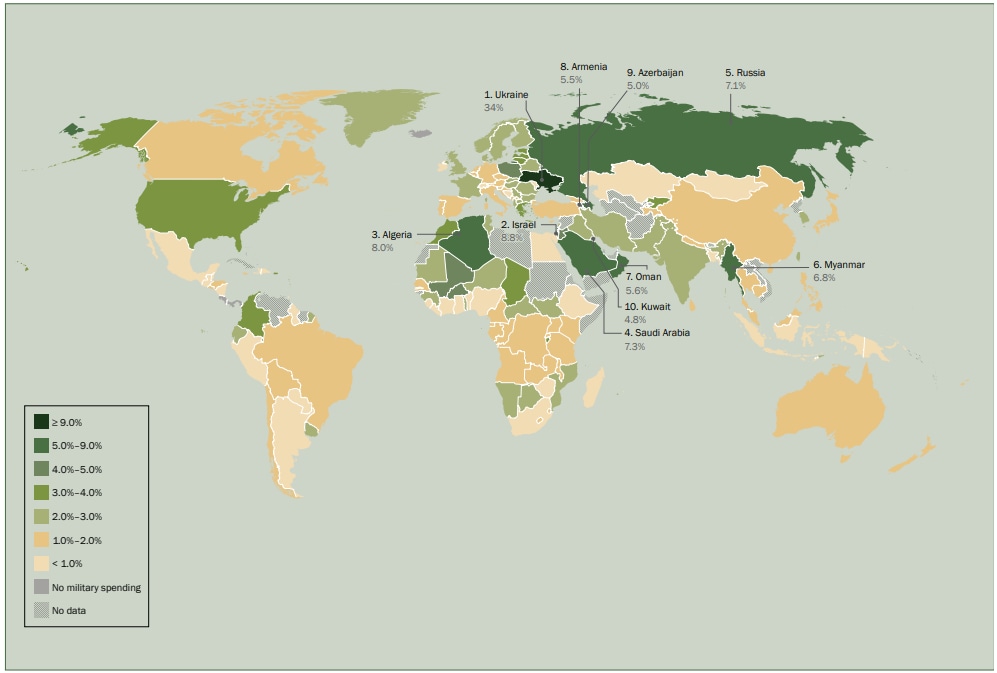
8_CHCA_Military spending by countrySource:  SIPRI Military Expenditure Database, April 2025

What that signals for Europe

  • Spending pressure is rising, even if the pace is uneven across countries.
  • The definition is broader than “weapons only.” It includes security-related areas like infrastructure resilience and network protection.
  • Europe will care more about local supply chains. That means not only buying equipment, but also building production capacity at home.

The US twist: bigger ambition, tougher rules

President Trump has called for a $1.5 trillion US military budget for 2027 (up from $901 billion for 2026), but he has also signalled tougher expectations for contractors, pushing them to prioritise delivery and production over shareholder payouts in cases of underperformance.

This means demand can rise, but the sector may face more political scrutiny. That can create more headline-driven swings, especially in companies tied to programs that are delayed or over budget.


AI is changing defense faster than most people think

AI’s impact is practical and near-term:

  • More unmanned systems. Drones in the air and at sea can scale faster than traditional platforms.
  • More sensing and tracking. Countries are spending more on satellites, radar, and detection.
  • More secure connectivity. Communications and electronic systems must keep working under stress.
  • More software. Tools that turn data into usable action are becoming more important.

But the risks are real: AI in security can become controversial quickly after accidents, misuse, or public backlash. That can slow projects, change rules, or redirect spending.


Mapping out the defense sector

1) Air and missile defense

This area is focused on protecting cities, bases, and critical infrastructure. It often includes sensors, air defense electronics, and command systems.

US: RTX, Lockheed Martin

Europe: Thales,  Saab

What to watch: new orders, delivery timelines, and whether replenishment becomes a priority.

2) Weapon and ammunition manufacturing

This area matters when governments want to rebuild stockpiles and shorten delivery times.

Europe: Rheinmetall, BAE Systems

US (more indirect, but still relevant): General Dynamics

What to watch: production capacity expansion, availability of key components, and political pressure on pricing.

3) Space, surveillance, and secure communications

This is where the “AI and data” angle often shows up most clearly. It is about seeing, connecting, and coordinating faster.

US: Northrop Grumman (space and strategic systems exposure), L3Harris (communications and defense electronics), Palantir (software and data tools linked to defense use cases; often more volatile)

Europe: Leonardo (defense electronics and platforms), Thales (sensors, electronics, and security systems)

What to watch: government contracts that move from pilots to real deployment, and any sudden political pushback around surveillance or AI.

4) Shipbuilding and naval (“protect trade routes”)

This area supports maritime security, but projects can take longer and face delivery risk.

US: Huntington Ingalls (naval shipbuilding exposure), General Dynamics (submarine exposure via Electric Boat)

Europe: Rolls-Royce (defense propulsion exposure; not a pure-play defense company)

Risk note: capacity constraints and program delays are common here. The work can be large, but the timelines can be messy.

5) Japan

Japan has been on a path of higher security spending, and the investable names tend to reflect different parts of the ecosystem.

  • Mitsubishi Heavy Industries — aerospace and defense programs, plus broader industrial capacity.
  • IHI Corporation — defense and aerospace-related industrial exposure (including engines and heavy industry capabilities).
  • NEC — communications, networks, and defense-related electronics and systems.


Risks investors should watch

  • Fiscal pressure: higher defense ambitions collide with debt, interest costs, and competing domestic priorities. This can slow the pace or change what gets funded first.
  • Policy risk: the US push to prioritise production over payouts can create sudden volatility in individual names.
  • Execution risk: late delivery and cost overruns can hurt sentiment even when spending is rising.
  • AI controversy risk: regulation and political scrutiny can arrive quickly after incidents.


This material is marketing content and should not be regarded as investment advice. Trading financial instruments carries risks and historic performance is not a guarantee of future results.
The instrument(s) referenced in this content may be issued by a partner, from whom Saxo receives promotional fees, payment or retrocessions. While Saxo may receive compensation from these partnerships, all content is created with the aim of providing clients with valuable information and options..

Quarterly Outlook

01 /

  • Q4 Outlook for Investors: Diversify like it’s 2025 – don’t fall for déjà vu

    Quarterly Outlook

    Q4 Outlook for Investors: Diversify like it’s 2025 – don’t fall for déjà vu

    Jacob Falkencrone

    Global Head of Investment Strategy

  • Q4 Outlook for Traders: The Fed is back in easing mode. Is this time different?

    Quarterly Outlook

    Q4 Outlook for Traders: The Fed is back in easing mode. Is this time different?

    John J. Hardy

    Global Head of Macro Strategy

    The Fed launched a new easing cycle in late Q3. Will this cycle now play out like 2000 or 2007?
  • Q3 Investor Outlook: Beyond American shores – why diversification is your strongest ally

    Quarterly Outlook

    Q3 Investor Outlook: Beyond American shores – why diversification is your strongest ally

    Jacob Falkencrone

    Global Head of Investment Strategy

  • Q3 Macro Outlook: Less chaos, and hopefully a bit more clarity

    Quarterly Outlook

    Q3 Macro Outlook: Less chaos, and hopefully a bit more clarity

    John J. Hardy

    Global Head of Macro Strategy

    After the chaos of Q2, the quarter ahead should get a bit more clarity on how Trump 2.0 is impacting...
  • Equity outlook: The high cost of global fragmentation for US portfolios

    Quarterly Outlook

    Equity outlook: The high cost of global fragmentation for US portfolios

    Charu Chanana

    Chief Investment Strategist

  • Commodity Outlook: Commodities rally despite global uncertainty

    Quarterly Outlook

    Commodity Outlook: Commodities rally despite global uncertainty

    Ole Hansen

    Head of Commodity Strategy

  • Upending the global order at blinding speed

    Quarterly Outlook

    Upending the global order at blinding speed

    John J. Hardy

    Global Head of Macro Strategy

    We are witnessing a once-in-a-lifetime shredding of the global order. As the new order takes shape, ...
  • Asset allocation outlook: From Magnificent 7 to Magnificent 2,645—diversification matters, now more than ever

    Quarterly Outlook

    Asset allocation outlook: From Magnificent 7 to Magnificent 2,645—diversification matters, now more than ever

    Jacob Falkencrone

    Global Head of Investment Strategy

  • Macro outlook: Trump 2.0: Can the US have its cake and eat it, too?

    Quarterly Outlook

    Macro outlook: Trump 2.0: Can the US have its cake and eat it, too?

    John J. Hardy

    Global Head of Macro Strategy

  • Equity Outlook: The ride just got rougher

    Quarterly Outlook

    Equity Outlook: The ride just got rougher

    Charu Chanana

    Chief Investment Strategist

Disclaimer

The Saxo Group entities each provide execution-only service and access to Analysis permitting a person to view and/or use content available on or via the website is not intended to and does not change or expand on this. Such access and use are at all times subject to (i) The Terms of Use; (ii) Full Disclaimer; (iii) The Risk Warning; (iv) the Rules of Engagement and (v) Notices applying to Saxo News & Research and/or its content in addition (where relevant) to the terms governing the use of hyperlinks on the website of a member of the Saxo Group by which access to Saxo News & Research is gained. Such content is therefore provided as no more than information. In particular no advice is intended to be provided or to be relied on as provided nor endorsed by any Saxo Group entity; nor is it to be construed as solicitation or an incentive provided to subscribe for or sell or purchase any financial instrument. All trading or investments you make must be pursuant to your own unprompted and informed self-directed decision. As such no Saxo Group entity will have or be liable for any losses that you may sustain as a result of any investment decision made in reliance on information which is available on Saxo News & Research or as a result of the use of the Saxo News & Research. Orders given and trades effected are deemed intended to be given or effected for the account of the customer with the Saxo Group entity operating in the jurisdiction in which the customer resides and/or with whom the customer opened and maintains his/her trading account. Saxo News & Research does not contain (and should not be construed as containing) financial, investment, tax or trading advice or advice of any sort offered, recommended or endorsed by Saxo Group and should not be construed as a record of our trading prices, or as an offer, incentive or solicitation for the subscription, sale or purchase in any financial instrument. To the extent that any content is construed as investment research, you must note and accept that the content was not intended to and has not been prepared in accordance with legal requirements designed to promote the independence of investment research and as such, would be considered as a marketing communication under relevant laws.

Please read our disclaimers:
- Notification on Non-Independent Investment Research (https://www.home.saxo/legal/niird/notification)
- Full disclaimer (https://www.home.saxo/en-hk/legal/disclaimer/saxo-disclaimer)

None of the information contained here constitutes an offer to purchase or sell a financial instrument, or to make any investments. Saxo does not take into account your personal investment objectives or financial situation and makes no representation and assumes no liability as to the accuracy or completeness of the information nor for any loss arising from any investment made in reliance of this presentation. Any opinions made are subject to change and may be personal to the author. These may not necessarily reflect the opinion of Saxo or its affiliates.


Hong Kong

Contact Saxo

Select region

Hong Kong S.A.R
Hong Kong S.A.R

Saxo Capital Markets HK Limited (“Saxo”) is a company authorised and regulated by the Securities and Futures Commission of Hong Kong. Saxo holds a Type 1 Regulated Activity (Dealing in Securities); Type 2 Regulated Activity (Dealing in Futures Contract); Type 3 Regulated Activity (Leveraged Foreign Exchange Trading); Type 4 Regulated Activity (Advising on Securities) and Type 9 Regulated Activity (Asset Management) licenses (CE No. AVD061). Registered address: 19th Floor, Shanghai Commercial Bank Tower, 12 Queen’s Road Central, Hong Kong.

Trading in financial instruments carries various risks, and is not suitable for all investors. Please seek expert advice, and always ensure that you fully understand these risks before trading. Trading in leveraged products may result in your losses exceeding your initial deposits. Saxo does not provide financial advice, any information available on this website is ‘general’ in nature and for informational purposes only. Saxo does not take into account an individual’s needs, objectives or financial situation. Please click here to view the relevant risk disclosure statements.

The Saxo trading platform has received numerous awards and recognition. For details of these awards and information on awards visit www.home.saxo/en-hk/about-us/awards.

The information or the products and services referred to on this site may be accessed worldwide, however is only intended for distribution to and use by recipients located in countries where such use does not constitute a violation of applicable legislation or regulations. Products and services offered on this website are not directed at, or intended for distribution to or use by, any person or entity residing in the United States and Japan. Please click here to view our full disclaimer.

Apple, iPad and iPhone are trademarks of Apple Inc., registered in the US and other countries. AppStore is a service mark of Apple Inc. Android is a trademark of Google Inc.