
Access all our platforms from a single account.

Asia Market Quick Take – October 31, 2025

Key points:
- Macro: US-China one-year truce: US cuts fentanyl tariff, extends reciprocal-tariff pause
- Equities: Apple, Amazon, Coinbase rise after market on strong sales and earnings beats
- FX: JPY weakens post-BoJ; EURUSD falls as ECB holds rates for third time
- Commodities: Oil set for a third monthly drop; gold tops $4,000
- Fixed income: Treasuries fell as Meta unveiled a six-part $30bn bond sale, the year’s largest
------------------------------------------------------------------
Disclaimer: Past performance does not indicate future performance.
Macro:
- Tokyo’s core inflation accelerated to 2.8% year on year in October, led by higher water charges, beating the 2.6% consensus after 2.5% in September. The pickup supports the case for gradual BoJ rate hikes and lends the yen a boost.
- US and China agreed a one‑year truce: the US cut the fentanyl tariff from 20% to 10% and extended the pause on reciprocal tariffs; China will resume soybean purchases and rare‑earth exports. It stabilises relations but leaves core disputes intact.
- ECB held rates for the third time in October, showing confidence in the eurozone economy and easing inflation. The refinancing rate stays at 2.15% and deposit rate at 2.0%, with inflation near the 2% target. Risks persist from global trade and geopolitical tensions.
- Eurozone economy expanded by 0.2% in Q3 2025, surpassing forecasts of 0.1%. France experienced a 0.5% rise due to increased exports, while Spain grew 0.6% with robust consumption and investment. Germany and Italy stagnated. Annual GDP climbed 1.3%, reducing pressure on the ECB to consider rate cuts amid global uncertainties.
- Germany's inflation rate fell to 2.3% in October from 2.4% in September, surpassing the anticipated 2.2%. Slower price growth in goods, especially food, and accelerated deflation in energy influenced the drop, while services inflation rose slightly, maintaining core inflation at 2.8%. Monthly consumer prices rose by 0.3%.
Equities:
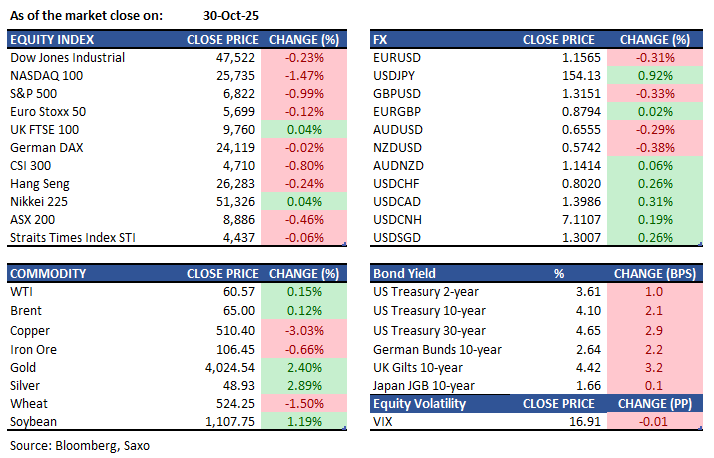
- US - The S&P 500 fell 1% and Nasdaq dropped 1.4% on Thursday, led by tech and communication services losses. Meta sank 11.3% due to a $15.9 billion tax charge and increased AI spending, while Microsoft's disclosure of a $3.1 billion OpenAI impact and elevated AI costs pushed its shares down 2.6%. Financials and real estate sectors performed well, with Alphabet rising 2.5% on strong earnings and Eli Lilly climbing 4.7% after raising revenue guidance. JPMorgan (2.2%), Visa (1.9%), and Goldman Sachs (2.5%) also posted gains. In after hours, Apple gained 2.3% after providing a strong forecast December quarter due to good iPhone 17 sales, while Amazon rose 13% after reporting accelerating growth in its cloud computing business. Coinbase added 3% after beating earnings estimates by 45%. Netflix climbed over 3% after unveiling a 10-for-1 stock split.
- EU - The STOXX 50 and STOXX 600 both fell 0.2% on Thursday as investors assessed central bank policies, earnings, and mixed economic signals. The ECB maintained rates, citing steady inflation, while the Fed cut rates but warned December easing isn't assured. Eurozone GDP grew 0.2% in Q3 with uneven performance; strong growth in France and Spain contrasted with stagnation in Germany and Italy. Schneider Electric dropped 3.9% despite rising Q3 revenue, while Banco Santander and BBVA fell 1.7% and 1.5%, respectively, on earnings misses. ING jumped 5.5% on strong profit, and Airbus gained 2.5% after solid Q3 results and reaffirming its guidance.
- HK - Hang Seng Index slipped 0.2%, to 26,283 on Thursday, continuing its downward trend for a second session. Despite positive news from China’s commerce ministry about extending its trade truce with the U.S. after talks between Trump and Xi, investor sentiment remained cautious. Issues like tariff rollbacks posed limited relief to struggling Chinese exporters amid weak domestic demand. Anticipation around China's October PMI data and Hong Kong's Q3 GDP report added to market caution. Most sectors on the Hang Seng closed lower, particularly property and technology. Major stock losses included Techtronic Industries down 5.0%, Sunny Optical Tech dropping 4.8%, Prada Spa decreasing 4.3%, Trip.com falling 3.4%, and Henderson Land Development slipping 2.6%. BYD Q3 profit fell 33% to 7.82bn yuan and revenue slipped 3% to 194.98bn; deliveries fell 1.8% to 1.15m and gross margin narrowed to 17.6% from 21.9%. It faces intensifying China EV competition and government concerns over quality.
Earnings this week:
- Friday
Asia: Tokyo Electron, Daiichi Sankyo, Hoya, Denso, Maruti Suzuki India
Outside Asia: Exxon Mobil, AbbVie, Linde, Intesa Sanpaolo, Aon
FX:
- The yen hit its weakest since February after the BoJ kept rates unchanged and offered few hawkish signals. USDJPY rose up to 1.1% to 154.45 before steadying near 154.08, while Governor Kazuo Ueda said the risk of falling behind on inflation isn’t increasing. JGBs are set to decline, tracking US Treasuries.
- Elsewhere, EURUSD fell 0.3% to 1.1566 as the ECB left rates unchanged for a third meeting, and USDCHF rose 0.3% to 0.8020 as the SNB signalled readiness to intervene.
- The Australian and New Zealand dollars are poised for monthly declines amid an underwhelming US–China trade truce; AUDUSD was flat at 0.6555 and is set to end the month almost 1% lower.
Commodities:
- Oil is headed for a third monthly drop amid glut concerns, with OPEC+ poised to approve another supply increase this weekend. WTI slid toward $60, down over 3% for the month, while Brent hovered near $65. The group meets Sunday and is expected to restore more halted capacity to regain market share.
- Gold rebounded as traders digested the Trump–Xi meeting, rising as much as 2.5% after a near-5% four‑session slide. Trump called it “amazing,” saying China will halt rare‑earth controls and resume US soybean purchases, while Xi signalled willingness to cooperate on trade, energy and AI, Xinhua reported.
Fixed income:
- Treasuries ended lower after a US morning slide when Meta detailed a six-part $30bn bond sale, the year’s largest. Front-end tenors stayed pressured by cautious Fed signals on a December cut, evident in flows in SOFR futures spreads and the SOFR–fed funds basis. Long-end lagged on Meta’s 20-, 30- and 40-year tranches. In all, seven issuers sold $41.7bn of US investment-grade debt, the most since 2 September.
For a global look at markets – go to Inspiration.
This content is marketing content and should not be considered investment advice. Trading financial instruments carries risks and historic performance is not a guarantee for future performance.
The instrument(s) mentioned in this content may be issued by a partner, from which Saxo receives promotion, payment or retrocessions. While Saxo receives compensation from these partnerships, all content is conducted with the intention of providing clients with valuable options and information.