
Access all our platforms from a single account.

Asia Market Quick Take – 05 October, 2026

Key points:
- Macro: US payrolls miss and 4.2% jobless rate lower October hike odds
- Equities: Nasdaq 100 gains 1% to close at fresh highs after weak payrolls
- FX: Dollar slips after weak payrolls; yen firms slightly, euro lags on fiscal worries
- Commodities: Gold remains choppy while brent holds above $100
- Fixed income: Treasury yields stay elevated across the curve
------------------------------------------------------------------
Disclaimer: Past performance does not indicate future performance.
Macro:
- US Jobs Miss: September non-farm payrolls came in at just 29,000, well below the 84,000 consensus estimate. Prior months were revised down by a combined 60,000. The unemployment rate ticked up to 4.2% from 4.1%, materially reducing the probability of a Fed rate hike at the October meeting to 20%.
- Fed Speak: Fed Vice Chair Bowman signalled no urgent need for further rate action, joining a growing chorus of officials favouring a pause. Dallas Fed President Logan, however, maintained that rates need to rise an additional 50bp or more. Fed minutes from the September meeting are due Wednesday and will be closely watched for further colour on the rate path.
- US-Iran War / Middle East: Geopolitical risk remains elevated. The US reportedly deployed a third aircraft carrier strike group to the Middle East. Saudi-backed Yemeni forces launched a full-scale military bid to recapture Houthi-controlled areas, pushing Brent above $100. The Australian Treasurer described the US-Iran conflict as an economic "disaster," citing its inflationary and growth-dampening effects globally.
- G7 Oil Reserve Release: The G7 agreed to release 100 million barrels of crude and fuel from emergency reserves over the next four months to counter elevated energy prices, following US pressure.
- European Bond Contagion Risk: French bond spreads widened sharply amid fiscal concerns and missed deficit targets, with contagion spreading to Italian and Belgian bonds. Traders flagged echoes of the 2011 European debt crisis.
Equities:
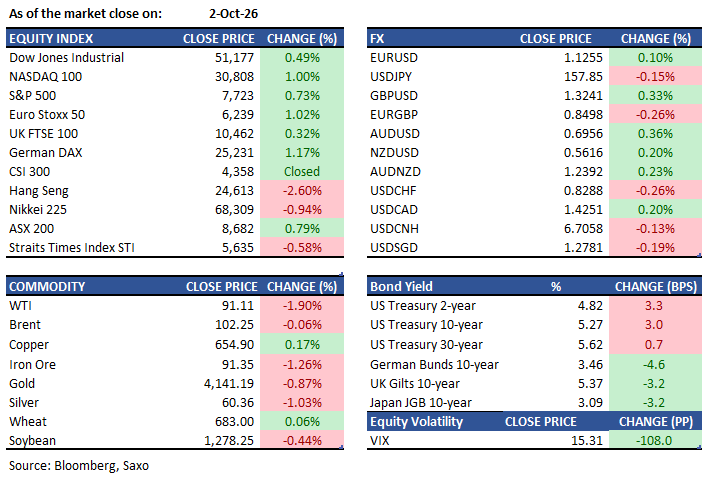
- US — On Friday 2 October, the S&P 500 rose 0.73% to 7,722.72, the Nasdaq 100 gained 1.00% to 30,807.93 (a fresh record high), and the Dow added 0.49% to 51,176.96, as the soft payrolls print reduced near-term Fed hike expectations. The SOX semiconductor index surged 2.4%, led by Teradyne, KLA, and Applied Materials. Accenture jumped 22% in its biggest single-day gain on record following strong results. Bank stocks remained under pressure, with the KBW Bank Index down ~14% from its August peak; Citigroup fell as much as 4.6% on Thursday. In after-hours trading, Fair Isaac (FICO) fell 6.3% and TransUnion dropped 2.7%.
- EU — European equities ended the prior week under pressure from rising bond yields. The Stoxx Europe 600 fell 1.1% for the week, touching a three-month low. The CAC 40 dropped 2.24% on the week to 7,897.19, its worst weekly decline since April, weighed by French fiscal concerns. The Euro Stoxx 50 ended the week 1.02% lower at 6,238.50. Friday saw a partial recovery: the DAX rose 1.2%, the Stoxx 600 gained 0.8%, and the FTSE 100 added 0.3%. IG Group was the standout single-stock mover, plunging 27% — its worst drop in a decade — after cutting its 2026 revenue growth outlook to mid-single digits from 10–15%.
- Asia — Asian equities are modestly higher in early Monday trade, led by Japan, after a sharply weaker US payrolls report reduced pressure for further Fed rate hikes. The Nikkei 225 is up about 1.8% and the Topix 0.8%, with AI and semiconductor stocks outperforming. Mainland China and South Korea are shut for holidays; early Golden Week data from China point to flat traffic and softer spending, a potential drag on consumer and travel names when markets reopen. With the Hang Seng, ASX 200, and Straits Times Index trading, the MSCI Asia Pacific index is up around 0.4%, though gains are limited by the closure of major markets. TSMC ADRs rallied 3% on Friday on reports of independent demand, with the ADR premium expanding to near 20%.
Earnings this week:
- Thursday: PepsiCo, Seven & i Holdings
- Friday: Delta Air Line
FX:
- USD broadly softer post-payrolls: The soft September jobs report drove the dollar lower on Friday as Fed hike bets were pared. The Bloomberg Dollar Spot Index retreated from recent highs, though the move was partially retraced as Treasury yields rebounded into the close.
- JPY approached the 158 level before the payrolls data and has since firmed modestly to 157.66. The BOJ's September meeting summary stopped short of signalling an imminent rate hike, keeping yen bulls cautious. USDJPY edged only 0.16% higher over the past five days.
- EUR underperformed as French fiscal concerns widened OAT-Bund spreads and contagion fears spread to Italian and Belgian bonds, weighing on the single currency. EURUSD at 1.1253, down 0.68% on the week.
- AUD has been pressured by a stronger dollar and elevated oil prices, though strategists at ANZ are hesitant to chase further downside without a fresh catalyst.
Commodities:
- Brent crude is trading at $102.39/bbl (+0.14% today), having surged back above $100 on Thursday as the US reportedly deployed a third aircraft carrier to the Middle East and Saudi-backed Yemeni forces launched operations against Houthi-controlled areas. WTI is at $90.83/bbl. The G7's agreement to release 100 million barrels from emergency reserves provided a partial offset, helping Brent slip below $100 briefly on Friday before recovering.
- Gold spot is trading at approximately $4,150/oz. The metal is caught between safe-haven demand from geopolitical risk and the headwind of multi-decade high Treasury yields. Gold ended last week down ~2%, with the 10-year yield's proximity to 5.33% limiting upside.
Fixed income:
- The 10-year Treasury yield hit 5.33% intra-week — its highest since 2002 — before partially retracing to 5.258% following the weak payrolls print. The 2-year yield stands at 4.812% and the 30-year at 5.609%. The belly of the curve underperformed on Friday as investors sold into the initial post-payrolls rally, with 5-year yields leading losses and flattening the 5s30s spread.
- French OAT spreads versus Bunds widened sharply last week amid missed deficit targets and political gridlock, with spillover into Italian and Belgian spreads. European CDS markets are flashing warning signs, with five-year swaps surging across the region. Traders are on alert for further contagion, with memories of the 2011 European debt crisis being invoked.
- EM dollar-denominated bonds have suffered larger losses than local-currency debt in the current Treasury selloff, as the combination of a stronger dollar and higher US yields creates a double headwind. EM carry trades recorded their first quarterly loss in two years in Q3, though several asset managers including Ninety One and Generali are maintaining positions, betting the strategy can survive yields above 5%
For a global look at markets – go to Inspiration.
This content is marketing content and should not be considered investment advice. Trading financial instruments carries risks and historic performance is not a guarantee for future performance.
The instrument(s) mentioned in this content may be issued by a partner, from which Saxo receives promotion, payment or retrocessions. While Saxo receives compensation from these partnerships, all content is conducted with the intention of providing clients with valuable options and information.