
Access all our platforms from a single account.

Asia Market Quick Take – 02 October, 2026

Key points:
- Macro: Market looks towards the Sept NFP due today
- Equities: Accenture +24% after Q4 beats; Nike down 8.6% after revenue miss
- FX: Euro slips sub-1.13, a first since May 2025; AUD hovers near three-month low
- Commodities: Brent crude surges back above $100
- Fixed income: 30-year UK gilt yields hit 6% for first time since 1998
------------------------------------------------------------------
Disclaimer: Past performance does not indicate future performance.
Macro:
- Oil surges past $100 on Middle East escalation risk. Brent crude rose above $102 after the Wall Street Journal reported the US is sending a third aircraft carrier strike group to the Middle East, reviving fears of renewed US-Iran conflict.
- Fed speakers turn cautious on further hikes. Fed Vice Chair Philip Jefferson and Governor Michelle Bowman both signalled a desire to hold rates steady, saying policymakers need more time to assess the economy before deciding on further increases. Fed Dallas President Lorie Logan struck a more hawkish tone, saying rates need to rise an additional 50bps or more. Minneapolis President Kashkari sees one more hike this year and one in 2027.
- US labour market remains resilient. Initial jobless claims fell 1,000 to 197,000 in the week ended 26 September, below the 200,000 consensus estimate and the lowest since July. Continuing claims dropped 11,000 to 1.701 million, a three-year low.
- ISM manufacturing prices paid surged. September ISM data showed a sharp beat on the prices paid component, initially extending the Treasury selloff before yields reversed later in the session.
- UK gilt yields hit multi-decade high. The 30-year gilt yield climbed to 6% for the first time since 1998, driven by the global bond selloff and UK fiscal concerns.
- Tokyo headline CPI came in at 2.7% (vs 2.5% est) in Sept, highest this year while the CPI ex-fresh food and energy touched 3% (vs 2.5% est)
- September US nonfarm payrolls due today. Consensus expects approximately 90,000 jobs added in September, down from 162,000 in August. Markets are watching closely for any shift in Fed rate expectations ahead of the October meeting.
Equities:
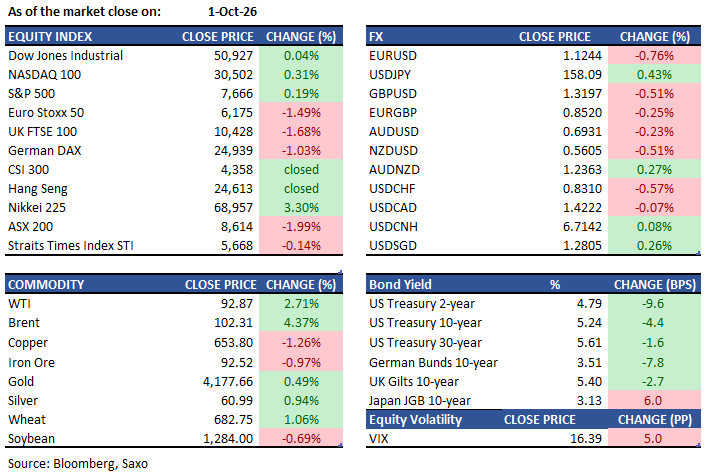
- US — US equities closed modestly higher on Thursday after a volatile session, with the S&P 500 rising 0.2% to 7,666.45, the Nasdaq 100 up 0.3% to 30,501.56, and the Dow Jones essentially flat at 50,926.56. A rebound in Treasuries from multi-decade highs provided relief. Accenture surged 15.8% — its biggest single-day gain on record — after Q4 revenue and bookings beat estimates, lifting IT services peers. Banks were the key drag, with Citigroup falling as much as 4.6%. After hours, Nike sank 8.6% after Q1 revenue of $11.21bn missed the $11.33bn estimate and the company guided for a high-single-digit revenue decline in the current fiscal year. FICO fell 6.3% and TransUnion dropped 2.7% post-market.
- EU — European equities fell sharply on Thursday as surging bond yields and fiscal concerns in France and the UK weighed heavily on sentiment. The Stoxx Europe 600 dropped 1.3% to 626.62, its lowest close since June, with banks leading declines. The FTSE 100 fell 1.7% — its biggest drop since May — as 30-year gilt yields hit 6%, with HSBC down 4.1% and Games Workshop falling 6.2%. The DAX lost 1.0%, with Bayer down 5.3%. The Euro Stoxx 50 fell 1.5% to 6,175.45. Pandora fell 3.3% after its CEO flagged stabilisation at a "lower level" in US consumer sentiment.
- Asia — Asian equities are broadly lower on Friday morning as oil's surge above $100 revives inflation concerns. The MSCI Asia Pacific gauge is down 0.4%. The Nikkei 225 is indicated down approximately 1% to around 68,254 after surging 3.3% on Thursday, driven by a sharp rebound in chip stocks following Micron's strong earnings beat. The KOSPI opened down 0.5% to 6,938 and is currently off 0.4% at 6,941. The Hang Seng (24,613.27) and STI (5,667.67) are showing no change in early trade, with the STI having fallen 0.1% on Thursday, led lower by City Developments (-3.7%), while DFI Retail Group gained 6.6%. New World Development reported a record FY net loss of HK$28.15bn after a major writedown on a Hong Kong airport complex, though the Cheng family pledged financial support. Nike's after-hours miss is expected to weigh on Asian sportswear suppliers at the open.
Earnings and events this week:
- Friday: No major earnings expected; focus shifts to the September Non-Farm Payrolls report.
FX:
- EURUSD fell as much as 1% on Thursday, the steepest drop since mid-June, breaking below $1.13 for the first time since May 2025. Hedge funds have been loading up on euro puts as French fiscal and political risks mount, with bearish options bets running more than 2:1 versus bullish ones.
- USDJPY rose to around 158.45, a one-week high, after the Bank of Japan's September meeting summary stopped short of signalling a near-term rate hike. The yen has since partially recovered intraday, with the move appearing yen-driven rather than dollar-driven.
- The MSCI EM currency index fell 0.3% as the dollar rallied toward its 2026 highs. The South African rand was among the worst performers. Asian currencies including the rupee and rupiah also weakened against the dollar.
- AUDUSD fell as much as 0.6% in New York to its lowest since 2 July, sliding 1.3% on the week and on track for a fourth consecutive weekly loss, as traders trimmed bets on further RBA rate hikes.
Commodities:
- Brent for December settled up 4.4% above $102/bbl on Thursday after the WSJ reported the US is deploying a third aircraft carrier strike group to the Middle East, raising fears of renewed US-Iran conflict. Dated Brent, reflecting physical delivery, reportedly settled around $121/bbl — significantly above futures — signalling tight physical supply. Brent closed at $102.31 on Thursday.
- Gold fluctuated in a range around $4,170–4,178/oz as competing forces — rising bond yields (typically a headwind) and geopolitical safe-haven demand — offset each other. Gold ended Thursday up 0.5% at $4,177.66.
- LME copper fell 1.2% to $14,243.50/tonne on Thursday as the global bond selloff and elevated oil prices stoked fears of a demand slowdown, particularly in energy-intensive industrial sectors.
Fixed income:
- The 10-year Treasury yield rose as high as 5.34% intraday on Thursday — the highest since 2002 — before rebounding sharply. A softer-than-expected ISM manufacturing report and dovish commentary from Fed Vice Chair Jefferson and Governor Bowman triggered a bull steepening rally. The 10-year closed at approximately 5.24%, down 5bps on the day, while the 2-year fell 10bps to 4.79%.
- The surge in long-end gilt yields — driven by the global bond selloff and UK fiscal concerns — was the primary catalyst for the FTSE 100's worst session since May. The move also spilled over into European sovereign spreads, with French OAT spreads over Bunds widening as budget uncertainty intensified.
- The spread on the riskiest US corporate bonds (CCC-rated) crossed 1,000bps over Treasuries for the first time since the regional banking crisis in March 2023, rising from 860bps at the start of September. The level typically implies elevated probability of default or restructuring, signalling growing stress in the lowest tier of the high-yield market.
For a global look at markets – go to Inspiration.
This content is marketing content and should not be considered investment advice. Trading financial instruments carries risks and historic performance is not a guarantee for future performance.
The instrument(s) mentioned in this content may be issued by a partner, from which Saxo receives promotion, payment or retrocessions. While Saxo receives compensation from these partnerships, all content is conducted with the intention of providing clients with valuable options and information.