
Access all our platforms from a single account.

Asia Market Quick Take – 01 October, 2026

Asia Market Quick Take – 01 October 2026
Key points:
- Macro: Headline and Core PCE came in cooler than expected
- Equities: Tech outperformed, industrials lagged; Micron flat despite blow out earnings
- FX: AUDUSD under selling pressure near two month low
- Commodities: Gold drops 6% in September, its worst month since June
- Fixed income: US 30-year yield hits 24-year high; 10-year hits 5.3%
------------------------------------------------------------------
Disclaimer: Past performance does not indicate future performance.
Macro:
- US PCE inflation rose 0.3% month-over-month in August 2026, after a revised 0.1% gain in July and below the 0.4% forecast. Goods prices climbed 0.3%, led by a 4.4% jump in gasoline and other energy, while services rose 0.3%. Core PCE increased 0.2%, under the 0.3% expectation. Year-on-year, headline PCE stayed at 3.4% and core at 3.0%, both still above the Fed’s 2% target.
- US GDP grew at a 2.2% annualized rate in Q2 2026, revised up on stronger investment, consumer, and government spending, led by nonresidential structures such as data centers.
- Germany’s annual inflation rose to 3.3% in September 2026, the highest since December 2023 and above expectations, driven mainly by a surge in energy prices. Core inflation stayed at 2.4%, and the EU-harmonized rate also reached 3.3%, above the ECB’s 2% target.
- US personal consumption expenditures rose 0.9% in August 2026, the strongest since March and above expectations, with broad increases in goods and services. Personal income rose 0.2%, disposable income 0.3%, and real consumer spending 0.6%.
Equities:
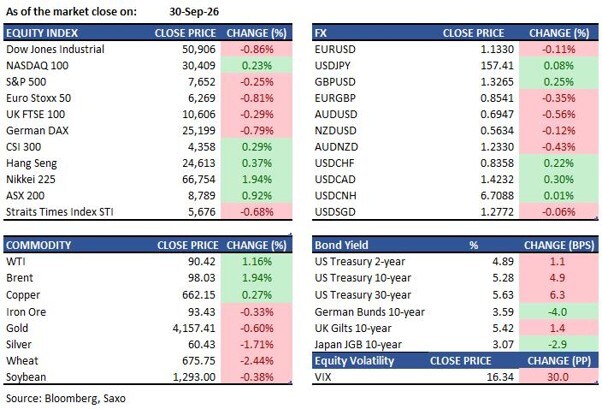
- US — US equities closed mixed on Wednesday, capping the S&P 500's worst month since June. S&P 500 fell 0.3% to 7,651.54 and Dow Jones dropped 0.9% to 50,906.05, while the Nasdaq rose 0.2% to 26,861.06. Jabil was the largest single-stock decliner, falling 10.0%, while Meta led the S&P 500 lower, down 1.8%. Financials fell 1.2% for a third straight session. In after-hours trading, Alphabet rose ~1.7% after Google announced a new product, while Micron wavered despite a strong earnings beat, losing initial gains to close +0.37%. S&P 500 futures rose 0.5% in early Asian trading on Thursday.
- EU — European equities posted their worst month since March, with the Stoxx 600 falling 0.5% on Wednesday to 634.89, down 2.5% for September. The DAX fell 0.8% to 25,199.19, the FTSE 100 dropped 0.3% to 10,606.00, and the SMI declined 0.6%. Siemens was the largest drag on the Stoxx 600, falling 2.3%, while AT&S Austria had the largest single-stock drop at -7.2%. Commerzbank fell 4.0% in Frankfurt. Kongsberg was a notable outperformer, rising ~5.6% after signing a NOK 10 billion NASAMS contract with Belgium.
- Asia — Asian markets are trading mixed at the open on Thursday. The Nikkei 225 rose ~1% to 67,425.65 in early trade, supported by a rebound in chip-related names following Micron's upbeat outlook. The Kospi opened 0.3% lower at 6,814.49. The STI fell 0.7% on Wednesday to 5,675.88, its second consecutive session of losses, with Venture Corp the worst performer among blue chips. Hong Kong markets are closed today for the National Day holiday. On Wednesday, the Nasdaq Golden Dragon China Index gained 0.6%. New World Development reported a FY net loss of HK$28.15 billion, widening sharply from HK$16.3 billion a year earlier, with revenue of HK$19.99 billion missing the HK$26.58 billion estimate. Asian chip stocks are in focus following Micron's results.
Earnings and events this week:
- Thursday: Nike
- Friday: No major earnings expected; focus shifts to the September Non-Farm Payrolls report.
FX:
- The yen was the standout performer in September, gaining ~1.8% vs. the dollar for its best month on a trade-weighted basis since the carry trade unwind in July 2024. However, it weakened back to 157.58 per dollar on Thursday morning after the BOJ released its September meeting summary, which offered no new hawkish signals.
- Sterling outperformed G10 peers on Wednesday, rising ~0.3% vs. the dollar after UK Q2 GDP was revised higher. UK PM Andy Burnham's suggestion he could campaign to rejoin the EU at the next general election also provided modest support.
- The Australian dollar underperformed G10 peers after Australian CPI rose less than expected, reducing expectations for near-term RBA tightening. AUDUSD consolidates near a two-month low below 0.6950.
- The Mexican peso was the world's worst-performing major currency in September, falling ~6% as carry traders fled. Societe Generale, Morgan Stanley and Banco Base all cut their year-end peso forecasts.
Commodities:
- WTI traded near $90 a barrel and Brent near $98 as of Thursday morning, steadying after a 1.2% gain on Wednesday. Uncertainty persists over whether the recovery in Middle East flows can be sustained following a tanker strike in the Strait of Hormuz. European natural gas futures rose as much as 4.7% on Wednesday on the tanker incident and increased German stockpiling activity.
- Gold closed Q3 at $4,155.60 per ounce, up 3.3% for the quarter but down 6.2% in September — its worst month since June. The metal found some support from the softer-than-expected core PCE print, with bullion trading around $4,155 in early Thursday Asian trade. ETFs added gold holdings for five consecutive days heading into month-end.
- Deutsche Bank forecast copper could surge more than 50% to $22,050 per tonne within six months on a "copper crunch" driven by shrinking stockpiles. Separately, Chinese lithium carbonate futures plunged ~25% in September, falling below 120,000 yuan per tonne from over 160,000 yuan at the start of the month, on concerns over flagging EV battery demand.
Fixed income:
- The 30-year Treasury yield rose to 5.639% on Wednesday, the highest since 2002, as resilient US consumer spending and heavy corporate supply (including a $30 billion eight-part deal from Paramount) overwhelmed the relief from the softer PCE print. The 10-year yield rose to hit 5.3%.
- The France-Germany 10-year spread widened to 120 basis points for the first time since 2012, as investors positioned for political uncertainty and the risk of a populist government loosening fiscal policy ahead of next year's elections.
- The Bank of England warned that elevated hedge fund leverage in gilts raises the risk of stress crystallising across markets simultaneously. The UK 10-year yield is near levels last seen during the 2008 financial crisis, and 30-year gilt yields are approaching 6%, the highest since 1998.
For a global look at markets – go to Inspiration.
This content is marketing content and should not be considered investment advice. Trading financial instruments carries risks and historic performance is not a guarantee for future performance.The instrument(s) mentioned in this content may be issued by a partner, from which Saxo receives promotion, payment or retrocessions. While Saxo receives compensation from these partnerships, all content is conducted with the intention of providing clients with valuable options and information.