
Access all our platforms from a single account.

Asia Market Quick Take – 30 July, 2026

Key points:
- Macro: Fed holds rates for 5th time; Warsh offers little guidance
- Equities: US stocks slump on Fed Day; Meta sinks on guidance, Microsoft rallies
- FX: Dollar eases after Fed hold; euro, sterling steady, yen stays pressured
- Commodities: Brent crude rallied to $90 and gold recovers
- Fixed income: 30-year Treasury yield hits 19-year high & curve steepens sharply
------------------------------------------------------------------
Disclaimer: Past performance does not indicate future performance.
Macro:
- The Fed kept rates at 3.50%–3.75% for a fifth meeting in July 2026, with three officials favoring a hike, leaving a September increase possible. It reported solid growth, strong productivity and investment, stable unemployment, and inflation still above the 2% target, and reaffirmed its commitment to price stability. Kevin Warsh offered little guidance but said the Fed “will not hesitate to act” and that higher rates “could well be part of the solution” to curb excessive inflation.
- US–Iran fighting threatened global energy supplies after an attack on US forces in Jordan prompted a strong response vow from President Trump. Talks stalled over Tehran’s insistence on control of the Strait of Hormuz, while the conflict spread to the Red Sea, where Iran-backed Houthis threatened a Saudi blockade and Riyadh joined US strikes on Iran-linked targets in Iraq.
- The 30-year fixed US mortgage rate rose 7 bps to 6.76% in the week ending July 24, 2026, the highest since August 2025, amid higher Treasury yields and persistent inflation fears tied partly to Middle East tensions. Rates are up about 70 bps since late February, reinforcing “higher for longer” Fed expectations. Higher costs are cooling housing demand: total applications fell 6.4%, with purchases down 3.6% and refis down 9.9%.
Equities:
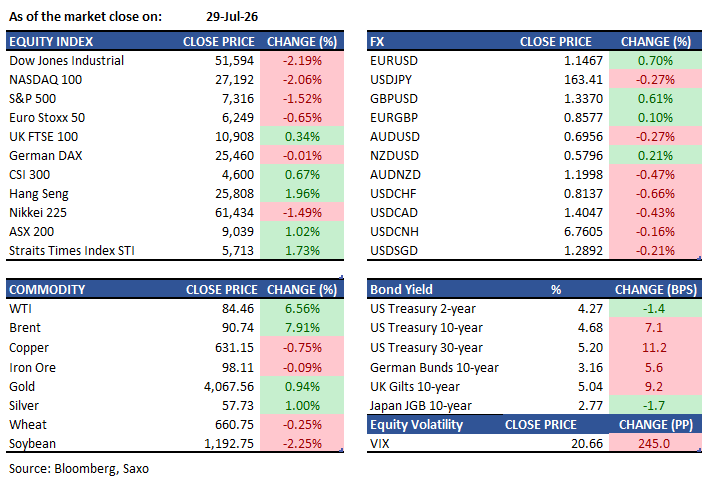
- US — US equities suffered their worst Fed Day performance since December 2024. The S&P 500 fell 1.5% to 7,316.15, the Dow Jones dropped 2.2% to 51,594.14, and the Nasdaq 100 declined 2.1%, entering correction territory at 11% below its June record. The Philadelphia Semiconductor Index dropped 5.3%. Nvidia fell 3.6% and Lennox International plunged 21% after disappointing results. After hours, Meta fell after guiding Q3 revenue of $61–64bn, with the midpoint below the $63.2bn consensus. Microsoft rose ~3% after Azure cloud revenue grew 43%, beating the ~40% estimate. Qualcomm fell as much as 8% after issuing light guidance on supply crunch for computer parts, especially memory. Lam Research gained ~3% after beating estimates and issuing a strong outlook.
- EU — European stocks closed mixed on Wednesday. The Stoxx 600 fell 0.3%, the Euro Stoxx 50 dropped 0.65%, and the DAX was little changed at 25,460. The FTSE 100 outperformed, rising 0.3% to 10,908 — briefly hitting an all-time intraday high of 10,951 — lifted by Shell (+2.8%) and Sage (+8.8%). Hermes plunged 11% on disappointing leather goods sales, while Kering surged 17% on strong Gucci numbers. ASM International slumped on a weak 2027 outlook, and Infineon fell 5.7% on the DAX.
- Asia — Asian equities are fluctuating in early Thursday trade as the semiconductor selloff from the US extends into the region. The Kospi opened 0.3% higher but swung to a 1.2% decline to 5,593 before recovering; the South Korean government stepped up leveraged ETF curbs following Wednesday's rout. Samsung Electronics advanced after reporting earnings, though the stock's reaction remains volatile — mirroring the pattern seen after SK Hynix's results the prior day. The Nikkei reversed an earlier drop as Hitachi and Nintendo gained, with Advantest's ADR having surged overnight after raising its full-year forecast well above estimates. Hang Seng and broader China markets are opening amid a mixed backdrop, with the Nasdaq Golden Dragon China Index having risen 1.7% on Wednesday. STI moves are yet to be confirmed at time of writing.
Earnings this week:
- Thursday - Apple, Amazon, Mastercard, Coinbase, PRADA, Budweiser APAC
- Friday — ExxonMobil, Moderna, AbbVie, Chevron, Kioxia
FX:
- USD weakened broadly on Wednesday after the Fed delivered a 9–3 hold and Chair Warsh avoided guidance on future hikes, prompting markets to push back pricing of the next 25bp move to December and DXY slipped to 100.89 (-0.09%).
- EURUSD at 1.1467 and GBPUSD at 1.3370 were little changed as options kept euro ranges tight and sterling underperformed slightly ahead of today’s Bank of England decision, where a hold at 3.75% is expected.
- USDJPY edged lower to 163.41 with some intraday safe-haven support, though banks still see scope for a move toward 165 amid persistent yen-funded carry.
- AUD and NZD posted small gains, while USDCAD dipped and USDCHF ticked slightly higher, making the franc a modest laggard.
- USDCNH fell 0.2% to 6.7611 as the yuan strengthened on the back of the weaker dollar. The PBOC set its Wednesday fixing at 6.7899, slightly firmer than Tuesday's 6.7928.
Commodities:
- Brent crude settled near $91 a barrel on Wednesday — an ~8% single-session spike — after Iran fired ballistic missiles at US forces in Jordan and Trump vowed retaliatory strikes. US distillate stockpiles are at their lowest seasonal level since 2000. The conflict is reportedly set to drag on for months, keeping a geopolitical risk premium embedded in prices.
- Gold climbed as much as 0.8% to touch $4,100/oz in Asian trade Thursday after the Fed held rates. The relief rally reflects unwinding of rate-hike bets, though analysts caution that rising real yields and a potential dollar rebound could limit gains. Gold is down ~6.7% year-to-date at around $4,030/oz, having failed to act as a geopolitical hedge throughout the Iran conflict.
- Benchmark European gas futures rose as much as 5.7% on Wednesday after Trump renewed threats against Iran, reviving concerns over Middle East energy supply disruption. Two LNG tankers were struck by drones at Egypt's Damietta port, adding to supply anxiety. Qatar sent its first LNG shipment through the Strait of Hormuz in three weeks.
Fixed income:
- The US 30-year yield surged as much as 14 basis points to nearly 5.23% on Wednesday — the highest since 2007 — as investors dumped long-end bonds in response to Warsh's non-committal press conference. The 10-year yield rose 5.6bps to 4.663%, while the 1-year yield fell 6.5bps to 4.022%, producing an aggressive bear steepening. The 5s30s spread widened to 82.6bps from 72.1bps. Heavy bearish options flow targeted a further move in the 30-year yield toward 5.3% within weeks.
- The Treasury curve twist-steepened aggressively post-FOMC, with the 2s30s gap widening to its most in two months. Market measures of inflation expectations rose alongside the long-end selloff, reinforcing the bond market's message that Warsh's tough talk has not been backed by action. Rate swaps reflected roughly a 60% probability of a September hike immediately after the decision, though that has since been pared back.
- Asia investment-grade dollar bond spreads widened to a three-month high on Wednesday, with the primary market muted ahead of the Fed. JGBs are seen lower in Thursday trade, tracking the US long-end move.
For a global look at markets – go to Inspiration.
This content is marketing content and should not be considered investment advice. Trading financial instruments carries risks and historic performance is not a guarantee for future performance.
The instrument(s) mentioned in this content may be issued by a partner, from which Saxo receives promotion, payment or retrocessions. While Saxo receives compensation from these partnerships, all content is conducted with the intention of providing clients with valuable options and information.