
Access all our platforms from a single account.

Portfolio lessons for long term investors from 2025

Key points:
- Diversification was rewarded in 2025: gold led, non-US equities outperformed the S&P 500, and broad commodities ex-energy did well.
- The expected leaders didn’t repeat: bitcoin cooled, the US dollar weakened, and energy lagged despite broader commodity strength.
- The main takeaway isn’t forecasting—it’s portfolio design: rebalance with discipline, diversify across different return drivers, and run “what if” checks into 2026.
2025 in one glance
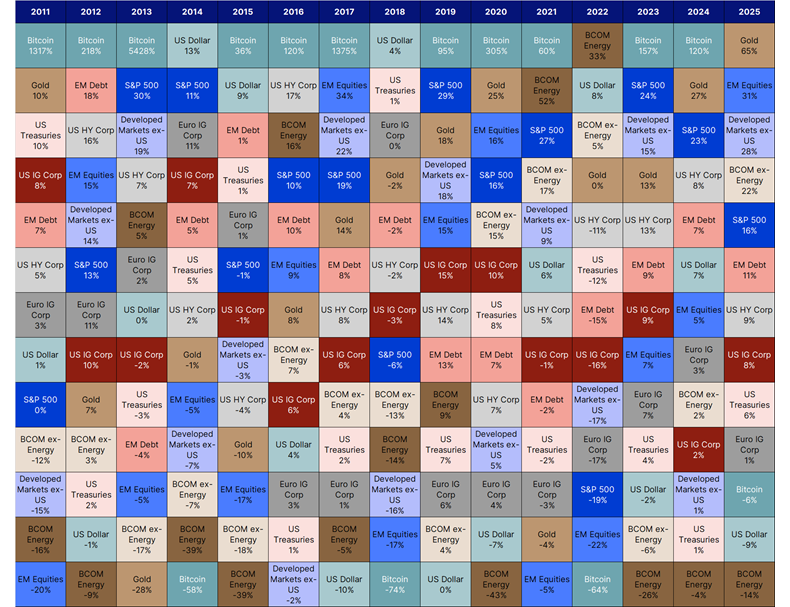
2025 delivered a clear message: market leadership can shift quickly, and portfolios need to be prepared for that.
Source: Saxo
If you have trouble viewing the above table, click here: Cross Asset Returns Over the Last 15 Years
- Big winner: Gold +65% — the standout of the year.
- Equity leadership rotated: EM equities +31% and Developed Markets ex-US +28% beat the S&P 500 +16%.
- Commodities diverged: BCOM ex-Energy +22% did well, while BCOM Energy -14% lagged.
- Dollar pain trade: US Dollar -9%.
- Crypto cooled: Bitcoin -6%.
Different parts of the portfolio worked for different reasons—which is exactly what diversification is meant to achieve.
What 2025 taught long-term investors
1) Last year’s winner is not next year’s plan
In 2023 and 2024, bitcoin was the standout performer. In 2025 it turned negative, while gold moved to the top of the table.
The takeaway is not a debate about which asset is “better.” It is a reminder that markets rotate, and the trades that become most popular can also become the most vulnerable when conditions change.
Portfolio lesson: avoid building a strategy around what just worked. It can leave you exposed when leadership shifts.
2) Global diversification was rewarded
For several years, investors could feel comfortable with a US-heavy approach. In 2025, returns broadened: EM equities (+31%) and Developed Markets ex-US (+28%) outperformed the S&P 500 (+16%).
This doesn’t mean the US market is no longer attractive. It does mean that relying on one region can create unnecessary dependence on a single set of outcomes—policy, growth, earnings, and valuation trends.
Portfolio lesson: global exposure is not about being “balanced for the sake of it.” It is about being prepared when leadership rotates away from the same winners.
3) Diversifiers did their job
Gold and broad commodities ex-energy performed well in 2025. For long-term investors, that is important because these assets often play a different role than equities: they can help when the macro backdrop is uncertain, when inflation concerns re-emerge, or when investors want protection against geopolitical risk.
Diversifiers are rarely popular in calm markets. Their value becomes clearer when a portfolio needs sources of return that are not tied to equity performance alone.
Portfolio lesson: a good portfolio does not depend on one engine. It has more than one way to work.
4) Currency moves can quietly shape outcomes
The US dollar fell -9% in 2025. That matters because currency moves can lift or drag returns, even when the underlying assets perform as expected.
Many investors carry more USD exposure than they realise, simply because their holdings are dominated by US assets or USD-based instruments. When the dollar moves, it can change the results meaningfully.
Portfolio lesson: understand whether you are unintentionally making a large currency bet—and whether you are comfortable with it.
5) “Commodities” are not one trade
A key feature of 2025 was the divergence inside commodities: BCOM ex-Energy rose +22%, while BCOM Energy fell -14%.
This is a useful reminder that energy prices are driven by their own set of factors—supply decisions, inventories, demand sensitivity, and geopolitics—while other commodity groups can behave quite differently.
Portfolio lesson: broad labels can hide important differences. Investors should be clear about what they own and why.
The bottom line
2025 was a reminder that long-term investing is less about finding the next hero and more about building a portfolio that can withstand leadership changes.
- Gold winning doesn’t mean it will keep winning.
- Non-US outperformance doesn’t mean the US is “finished.”
- Bitcoin cooling doesn’t mean crypto is irrelevant.
It simply means markets rotate, narratives fade, and discipline tends to beat prediction over time.
This material is marketing content and should not be regarded as investment advice. Trading financial instruments carries risks and historic performance is not a guarantee of future results.
The instrument(s) referenced in this content may be issued by a partner, from whom Saxo receives promotional fees, payment or retrocessions. While Saxo may receive compensation from these partnerships, all content is created with the aim of providing clients with valuable information and options..
The instrument(s) referenced in this content may be issued by a partner, from whom Saxo receives promotional fees, payment or retrocessions. While Saxo may receive compensation from these partnerships, all content is created with the aim of providing clients with valuable information and options..