
Access both platforms from your single Saxo account.

Global Market Quick Take: Asia – April 30, 2025

Key points:
- Macro: Trump expected to sign 3 orders to reduce tariffs on autos
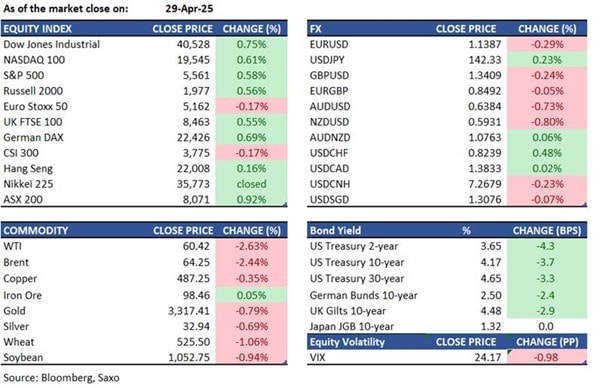
- Equities: S&P 500 is up 0.58%, its 6 consecutive rise.
- FX: Aussie and Kiwi were the weakest against the dollar
- Commodities: Oil fell again, staying near a three-week low
- Fixed income: 10-year Treasury yield has declined for six consecutive sessions
------------------------------------------------------------------
Disclaimer: Past performance does not indicate future performance.
Macro:
- Trump will sign three orders today to reduce tariffs on auto manufacturing, offering rebates for US-made cars and exempting imported parts from steel and aluminum tariffs. This announcement is expected to please the domestic auto industry.
- In March 2025, Japan's retail sales increased by 3.1% year-on-year, below the expected 3.5% and down from February's 1.3% growth. This marked the 36th consecutive month of expansion, but the slowest since last October. Monthly sales dropped 1.2%.
- The US goods trade deficit hit a record $162 billion in March 2025, above the expected $146 billion, as firms increased imports due to tariff threats. Imports grew 5% monthly and 30.8% annually to $342.7 billion, led by consumer goods, industrial supplies, and capital goods.
Equities:
- US - US stocks rose on Tuesday, driven by news of a nearing trade deal and strong corporate earnings. The S&P 500 gained 0.58%, marking its sixth consecutive rise, the longest since November. The Dow Jones increased by 300 points (0.75%), its best streak since July, and the Nasdaq rose 0.55%. Honeywell (+5.4%) and Sherwin-Williams (+4.9%) led the Dow with strong quarterly results. General Motors dropped 1.1% after cancelling its share buyback and outlook due to tariff concerns, while Amazon remained stable after clarifying it wouldn't display tariff charges. UPS fell 0.5% despite better-than-expected earnings and plans to cut 20,000 jobs. The U.S. trade deficit in goods hit a record high, consumer confidence declined, and job openings in March were 7.19 million, below expectations.
- EU - The Stoxx 50 declined by 0.5% on Tuesday, driven by Schneider Electric's 6.6% drop after missing revenue estimates and reducing its profit margin outlook. Luxury and retail stocks also contributed, with LVMH down 2% and Inditex falling 3.7%. Adidas fell nearly 3% despite strong profits, warning of potential price hikes due to US tariffs. Conversely, the Stoxx 600 rose 0.4%, continuing its six-session winning streak. HSBC exceeded expectations and announced a $3 billion buyback, while Deutsche Bank impressed with a 39% profit increase. BP fell after a 49% drop in Q1 profit from weaker oil prices. The autos sector struggled, with Volvo Cars down 1.2% after suspending guidance, and Porsche dropping 4.2% after lowering forecasts due to US tariffs.
- HK - The Hang Seng rose by 36 points (0.2%) to close at 22,008 on Tuesday, driven by gains in tech and financials following a subdued session. During the Politburo meeting, Beijing refrained from new stimulus but reiterated support for exporters and workers affected by tariffs, with contingency plans in place. Mainland markets will close from May 1 for a 5-day Labour Day break. Auto stocks rose, with Geely up 3.7% and Li Auto 2.2%, as President Trump plans to ease duties on foreign auto parts. Wuxi AppTec surged 4% on strong Q1 profits. Other gainers included Sichuan Kelun-Biotech (9.5%), Alibaba Health (6.5%), Trip.com (2.9%), and Meituan (2.8%). Sinopec fell 1.4% after weaker quarterly earnings.
Earnings this week:
Wednesday: Microsoft, Meta, Robinhood, Qualcomm, eBay
Thursday: Apple, Amazon, Block, CVS, Mastercard, Hershey
Friday: Exxon, Chevron
FX:
- The dollar strengthened against all G10 currencies following reports of eased auto tariffs by the Trump administration. The euro dropped as inflation expectations neared a one-year high. The Bloomberg Dollar Spot Index rose 0.2% after a 0.5% decline on Monday.
- USDCAD increased by 0.1% to 1.3844 after Canada's Liberal Party's narrow election win, with the loonie leading G10 currencies against the dollar.
- EURUSD fell 0.3% to 1.1384, and USDJPY rose 0.2% to 142.28.
- GBPUSD dropped 0.3% to 1.3404. AUDUSD declined 0.7% to 0.6388, and NZDUSD fell 0.6% to 0.5942, as China advised against yielding to US tariff threats. The Aussie and Kiwi were the worst performers against the dollar.
- Economic data: Australia March/1Q CPI, March Private Sector Credit, China April Manufacturing, Composite PMIs, China Caixin April Manufacturing PMI, Eurozone GDP, France GDP, CPI, PPI, Germany CPI, GDP, unemployment, US GDP, PCE price index, employment cost index, ADP employment
Commodities:
- Oil remained near a three-week low after a 2% drop, as trade war concerns and rising US stockpiles affected prices. WTI was around $60, and Brent below $65. Upcoming data may confirm a US economic slowdown, with consumer confidence at a five-year low.
- China's copper market gauge reached its highest since late 2023 as buyers scramble for supplies. The Yangshan premium rose from $35 a ton in late February to $94 on Tuesday, per Shanghai Metals Market data.
- Gold fell as expectations rose that Trump would soften auto tariffs, reducing haven demand. Bullion dropped 1.3% to $3,299.76 an ounce, after a 0.7% gain previously.
Fixed income:
- Treasuries rose after disappointing March JOLTS and April consumer confidence data, maintaining gains. Trading featured a significant block flattener with 2-year and ultra 10-year contracts. Treasuries are set for a fourth month of gains as tariffs hint at economic weakening, while a major trader bets $18 million that the Fed won't cut rates this year.
For a global look at markets – go to Inspiration.