
Quarterly Outlook

Breaking down evidence of global warming

Anders Nysteen
Senior Quantitative Analyst, Saxo Bank

Summary:  Human-generated emissions over the past 150 years most likely will persist for centuries and result in long-term changes in the climate system

The United Nation’s body for assessing science related to climate change – the Intergovernmental Panel on Climate Change (IPCC) – estimated in 2018 that human activities have caused a global temperature rise of around 1.0°C above pre-industrial levels [IPCC].  

Plenty of other research groups are seeking to understand the drivers of global temperature rises by applying various climate models and simulations. The estimates of anthropogenic climate change rely on a comparison with an artificially generated model assuming the conditions of the earth without human activity. As this parallel scenario will never be realised, these climate models seek to find the best qualified guess for the parallel scenario by looking at the fundamental drivers of climate change in the past prior to human existence. As this is a difficult task, a broad variety of climate models with associated uncertainties are presented every year, all contributing to the broader climate discussion.

We do not seek to take any stance in the climate debate, but an understanding of temperature drivers is a solid basis for having a qualified view. This is also from an economic point of view, as climate change can have major geographical impacts that require a shift in agricultural production, demographical reallocations etc.  

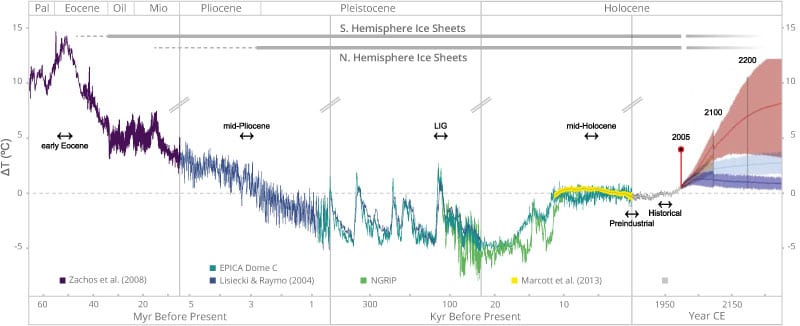
Figure 1 – Temperature trends for the past 65 million years: 
ANNY chart 1

Source: Global mean annual temperatures, chart from Burke et al., https://www.pnas.org/content/115/52/13288. The last part of the timeline is a prediction by the source authors and should be ignored in this context. 

The temperature of the Earth fluctuates a great deal and on a number of timescales (see Figure 1). The larger trends have been a long-term cooling from tens of millions of years before the present era in which the CO2 concentration in the atmosphere declined, and a more recent period of heating since the last Ice Age. Periodic variations in the temperature occur in cycles of 10k-100k years, driven by changes in the orbit of the Earth. These timescales are much longer compared to the changes during the past 150 years, when the global temperature has been in a rising trend. This is shown in the Berkeley Earth surface temperature project in Figures 2. 

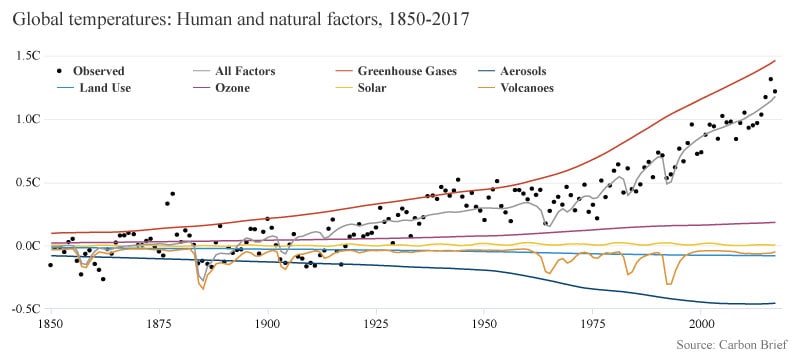
A simple climate model presented by Carbon Brief breaks down global warming since the industrial revolution into contributions from different factors as indicated in Figure 2. In a simplified overview, the major factors that will affect the Earth’s climate are: 

  • Greenhouse gasses, such as carbon dioxide and methane. These absorb infrared radiation emitted from Earth’s surface and re-radiate it back to Earth’s surface, driving a net rise in warming.

  • Ozone, which is a short-lived greenhouse gas that also traps outgoing heat — although ozone reactions in the upper atmosphere result in a net cooling.
      
  • Aerosols, which are tiny particles such as dust or even pollutants from human activity that float in the atmosphere. They drive a net cooling effect by forming clouds that reflect sunlight.
     
  • The type of vegetation on land. This affects the absorption of sunlight, as dense forests absorb more sunlight than fields with a more reflective surface.

  • Sunspots. These are storms on the surface on the Sun with huge magnetic activity, and they may affect the climate of the Earth. However, no upward trends in these activities has been measured since 1978.
     
  • Volcanoes, which erupt particles (effectively aerosols as above) into the atmosphere that block sunlight and thus in general have a net short-term cooling effect.  

Figure 2: 
ANNY chart 2

According to Carbon Brief, the human-generated impacts such as the increased greenhouse effect from CO2 and other emissions have had a major influence on rising global temperatures relative to any natural effects. This agrees with the research by IPCC, stating that human-generated emissions over the past 150 years most likely will persist for centuries and result in long-term changes in the climate system. If the present trend persists, IPCC estimates that the global temperature will rise another 0.5°C within the next 10-30 years, and the risk of a climate-related damage for natural and human systems is likely to be higher at this point than at present levels. [IPCC] 

The broad variety of climate models propose many different future scenarios. Some of them contain extreme tail-risk scenarios with a very low probability of realisation. But if they are realised, they can have major social and economic impacts: causing major flooding, scarcity of food supply etc. In the end, none of these models may contain the actual scenario which is going to be realised, but it is worth keeping up to date with the newest research – even the low-probability scenarios – as risks gather that climate change makes a larger and accelerating impact on our future. 

[IPCC: IPCC, 2018: Summary for Policymakers, Global Warming of 1.5°C] 

Get the full report

Outrageous Predictions 2026

01 /

  • Executive Summary: Outrageous Predictions 2026

    Outrageous Predictions

    Executive Summary: Outrageous Predictions 2026

    Saxo Group

    Read Saxo's Outrageous Predictions for 2026, our latest batch of low probability, but high impact ev...
  • A Fortune 500 company names an AI model as CEO

    Outrageous Predictions

    A Fortune 500 company names an AI model as CEO

    Charu Chanana

    Chief Investment Strategist

    Can AI be trusted to take over in the boardroom? With the right algorithms and balanced human oversi...
  • Dollar dominance challenged by Beijing’s golden yuan

    Outrageous Predictions

    Dollar dominance challenged by Beijing’s golden yuan

    Charu Chanana

    Chief Investment Strategist

    Beijing does an end-run around the US dollar, setting up a framework for settling trade in a neutral...
  • Obesity drugs for everyone – even for pets

    Outrageous Predictions

    Obesity drugs for everyone – even for pets

    Jacob Falkencrone

    Global Head of Investment Strategy

    The availability of GLP-1 drugs in pill form makes them ubiquitous, shrinking waistlines, even for p...
  • Dumb AI triggers trillion-dollar clean-up

    Outrageous Predictions

    Dumb AI triggers trillion-dollar clean-up

    Jacob Falkencrone

    Global Head of Investment Strategy

    Agentic AI systems are deployed across all sectors, and after a solid start, mistakes trigger a tril...
  • Quantum leap Q-Day arrives early, crashing crypto and destabilizing world finance

    Outrageous Predictions

    Quantum leap Q-Day arrives early, crashing crypto and destabilizing world finance

    Neil Wilson

    Investor Content Strategist

    A quantum computer cracks today’s digital security, bringing enough chaos with it that Bitcoin crash...
  • Taylor Swift-Kelce wedding spikes global growth

    Outrageous Predictions

    Taylor Swift-Kelce wedding spikes global growth

    John J. Hardy

    Global Head of Macro Strategy

    Next year’s most anticipated wedding inspires Gen Z to drop the doomscrolling and dial up the real w...
  • SpaceX announces an IPO, supercharging extraterrestrial markets

    Outrageous Predictions

    SpaceX announces an IPO, supercharging extraterrestrial markets

    John J. Hardy

    Global Head of Macro Strategy

    Financial markets go into orbit, to the moon and beyond as SpaceX expands rocket launches by orders-...
  • Britain’s Great EU Backdoor Return

    Outrageous Predictions

    Britain’s Great EU Backdoor Return

    Neil Wilson

    Investor Content Strategist

    Faced with rolling fiscal, economic, trade and political crises the UK government sneaks back into t...
  • Despite concerns, U.S. 2026 mid-term elections proceed smoothly

    Outrageous Predictions

    Despite concerns, U.S. 2026 mid-term elections proceed smoothly

    John J. Hardy

    Global Head of Macro Strategy

    In spite of outstanding threats to the American democratic process, the US midterms come and go cord...

This content is marketing material. 

None of the information provided on this website constitutes an offer, solicitation, or endorsement to buy or sell any financial instrument, nor is it financial, investment, or trading advice. Saxo Capital Market Ltd. (SCML) provides execution-only services, with all trades and investments based on self-directed decisions. Analysis, research, and educational content is for informational purposes only and should not be considered advice or a recommendation.

SCML content may reflect the personal views of the author, which are subject to change without notice. Mentions of specific financial products are for illustrative purposes only and may serve to clarify financial literacy topics. Content classified as investment research is marketing material and does not meet legal requirements for independent research.

SCML partners with companies that provide compensation for promotional activities conducted on its platform. Some partners also pay retrocessions contingent on clients investing in products from those partners. 

While SCML receives compensation from these partnerships, all educational and research content remains focused on providing information to clients.

Before making any investment decisions, you should assess your own financial situation, needs, and objectives, and consider seeking independent professional advice. SCML does not guarantee the accuracy or completeness of any information provided and assumes no liability for any errors, omissions, losses, or damages resulting from the use of this information.

Please refer to our full disclaimer and notification on non-independent investment research for more details.

Saxo
40 Bank Street, 26th floor
E14 5DA
London
United Kingdom

Contact Saxo

Select region

United Kingdom
United Kingdom

Trade Responsibly
All trading carries risk. To help you understand the risks involved we have put together a series of Key Information Documents (KIDs) highlighting the risks and rewards related to each product. Read more
Additional Key Information Documents are available in our trading platform.

Saxo is a registered Trading Name of Saxo Capital Markets UK Ltd (‘Saxo’). Saxo is authorised and regulated by the Financial Conduct Authority, Firm Reference Number 551422. Registered address: 26th Floor, 40 Bank Street, Canary Wharf, London E14 5DA. Company number 7413871. Registered in England & Wales.

This website, including the information and materials contained in it, are not directed at, or intended for distribution to or use by, any person or entity who is a citizen or resident of or located in the United States, Belgium or any other jurisdiction where such distribution, publication, availability or use would be contrary to applicable law or regulation.

It is important that you understand that with investments, your capital is at risk. Past performance is not a guide to future performance. It is your responsibility to ensure that you make an informed decision about whether or not to invest with us. If you are still unsure if investing is right for you, please seek independent advice. Saxo assumes no liability for any loss sustained from trading in accordance with a recommendation.

Apple, iPad and iPhone are trademarks of Apple Inc., registered in the U.S. and other countries. App Store is a service mark of Apple Inc. Android is a trademark of Google Inc.

©   since 1992