
Access both platforms from your single Saxo account.

Asia Market Quick Take – 02 March, 2026
Asia Market Quick Take – 2 March, 2026
Key points:
- Macro: Tensions rise as US-Israel strike Iran
- Equities: US futures down 1% on Iran strikes; Dell up 22% on strong server demand
- FX: Middle East tensions boost USD; CHF rises
- Commodities: Oil jumps; Strait closes. Gold, silver rise amid Middle East tensions
- Fixed income:Treasury yields fall; US bonds gain strength. Japan's yield curve set to rebound
------------------------------------------------------------------
Disclaimer: Past performance does not indicate future performance.
Macro:
- Joint US-Israeli strikes on Iran have escalated tensions in the Middle East. Concerns grow over disruptions in the Strait of Hormuz, a key oil passage. Tehran claims it's open, but shipping companies are rerouting. Iran attacked US assets in neighboring countries like the UAE and Iraq.
- In January 2026, US producer prices increased by 0.5%, exceeding the expected 0.3%. Service prices rose 0.8%, with notable gains in equipment wholesaling. Goods prices dropped 0.3%, mainly due to gasoline. Yearly producer prices rose 2.9%, and core prices climbed 3.6%, both above forecasts.
- Germany's inflation rate dropped to 1.9% in February 2026, below the 2.0% forecast, and the harmonized index fell to 2.0%, meeting the ECB's target. Goods inflation decreased to 0.8%, with sharper energy price declines and slower food inflation. Services inflation stayed at 3.2%, and core inflation remained at 2.5%.
Equities:
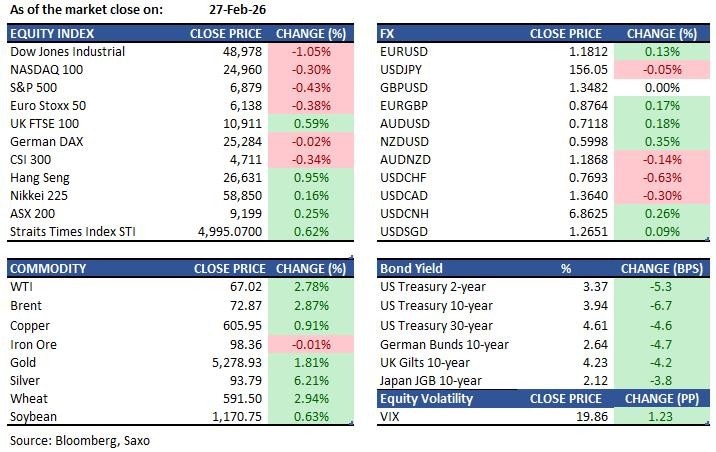
- US - S&P 500 and Nasdaq down 0.4% and the Dow off 1.1%, as hotter‑than‑expected inflation and a tech pullback pushed major indexes into the red for February. The data signaled firms may be passing tariff costs to consumers, clouding prospects for Fed rate cuts. CoreWeavefell 18.5% after weak Q1 guidance, while Nvidia slid 4.1%. Dell jumped 22% on strong AI server demand, and record $233B in February buyback authorizations helped support large caps. U.S. stock futures fell Monday as escalating Middle East conflict unnerved markets. On Saturday, Joint U.S.-Israeli strikes killed Iran’s Supreme Leader and effectively shut the Strait of Hormuz, prompting Tehran to target U.S. assets across the region. Potential sectors hit includes airlines while defence and drone systems would benefit.
- EU - The Eurozone’s STOXX 50 slipped 0.5% while the broader STOXX 50 hit a record, rising 0.2%. Inflation in France and Spain exceeded expectations, but Germany’s eased, reinforcing expectations the ECB will hold rates. Banks dragged markets lower, with Santander down nearly 3% on potential MFS‑related defaults. BASF fell on weaker annual sales, while Swiss Re and Deutsche Telekom rose on strong profit and earnings.
- HK - Hang Seng rose 249 points, nearly 1%, to 26,657 on Friday, reversing the prior session’s drop and ending the week up 0.8% amid broad sector gains. Optimism built ahead of China’s March 5 National People’s Congress, with hopes for tech and consumption‑supportive policies. Property stocks jumped 2.8% after Shanghai eased homebuying rules, while consumer and tech names rebounded. Notable gainers included Sun Hung Kai Properties, Pop Mart, Muyuan Foods, and AIA. Still, the index fell 2.8% in February.
Earnings this week:
- Monday - Berkshire Hathaway, Sealed Air, MongoDB, Norwegian Cruise Line, AES, Plug Power, ADT, Riot Platforms, SpaceMobile, Credo, California Resources, BigBear.ai, Quantum Computing Inc
- Tuesday - Target, Best Buy, AutoZone, CrowdStrike, Sea Limited, Box Inc, GitLab, Rayonier Advanced Materials, Paysafe
- Wednesday - Broadcom, Veeva Systems, Okta, Wix.com, Dycom, Stevanato Group, National Vision, Abercrombie & Fitch
- Thursday - Costco Wholesale, JD.com, Kroger, Marvell Technology, Samsara, Pattern Energy, Ciena, GoPro, American Eagle, Victoria's Secret
- Friday - Embraer, Algonquin Power, Genesco, Drilling Tools International
FX:
- The Middle East conflict challenges global market resilience, prompting a shift from risk. The USD is surging as traders seek haven assets amidst US-Iran tensions. The CHF is gaining, while risk-sensitive currencies like the AUD and ZAR decline. AUDUSD slid 1% to 0.7048, NZDUSD dropped 0.7% to 0.5957, and EURUSD fell 0.4% to 1.1761.
- USDCHF slipped 0.2% to 0.7680, USDJPY stayed steady at 156.07, USDZAR jumped 1.2% to 16.1297, and USDMXN rose 0.9% to 17.3807. These movements highlight heightened safe-haven flows, with RBNZ’s Breman pointing to a possible rate hike in late 2026.
Commodities:
- Oil prices spiked amid the US-Israeli conflict with Iran, severely impacting the global crude market due to the closure of the Strait of Hormuz. Brent crude soared 8% to over $78 per barrel, while WTI approached $72, as tanker traffic through the strait has largely stopped. This conflict introduces a perilous phase for the global oil market, with rising energy costs potentially increasing inflationary pressures worldwide.
- Gold jumped over 1% to $5,350 per ounce, and silver rose nearly 2% to $95 due to increased safe-haven demand following US-Israeli strikes in Iran that killed Ayatollah Ali Khamenei. This escalated Middle East tensions, disrupting Gulf maritime traffic and oil flow.
Fixed income:
- Treasury yields are declining in Asia as US bonds and the dollar reassert their safe-haven status. Investors anticipate that ongoing Middle East tensions will prompt Fed officials to adopt a more cautious economic outlook. Consequently, the 4% mark may serve as a near-term cap for 10-year bonds, with macro traders remaining defensive.
- The Japanese yieldcurve flattening trend is set to reverse due to rising energy prices and a weakening yen. Disruptions in the Strait of Hormuz could elevate inflation risks. With 10-year yields down 24 basis points since January, there's room for long-term yield rebound.
For a global look at markets – go to Inspiration.
This content is marketing content and should not be considered investment advice. Trading financial instruments carries risks and historic performance is not a guarantee for future performance. The instrument(s) mentioned in this content may be issued by a partner, from which Saxo receives promotion, payment or retrocessions. While Saxo receives compensation from these partnerships, all content is conducted with the intention of providing clients with valuable options and information.