
You can access both of our platforms from a single Saxo account.

Women investors are growing fast, and the next opportunity is diversification

Summary: This IWD, the investing story is shifting from representation to momentum: more women are opening and funding accounts, giving compounding time to do its job. The next step is outcomes. Building more resilient, multi-asset portfolios so women can stay invested through different market cycles.
International Women’s Day (IWD) often focuses on representation, and rightly so. But in investing, this year’s more powerful story may be about momentum.
More women are not just talking about money. They are taking charge of it.
Saxo’s client data shows that female participation has risen meaningfully in recent years:
- Absolute number of female direct clients: +40% since 2021
- Female share of direct client base: 19.8% to 23.5% (+3.7 percentage points)
- Women as share of new funded direct clients: 25.1% (2021) to 28.9% (2026 YTD run rate)
The pipeline is improving, and the direction of travel is clear: more women are entering the market and funding accounts.
That matters for more than just representation. It matters because the earlier people start investing, the more time they give compounding to work.
Time in the market is not just a cliché – it is one of the few advantages available to every investor, regardless of account size.
A simple compounding illustration shows why participation matters so much: starting earlier can meaningfully improve long-term outcomes, even without larger annual contributions. The most important step is still getting started.
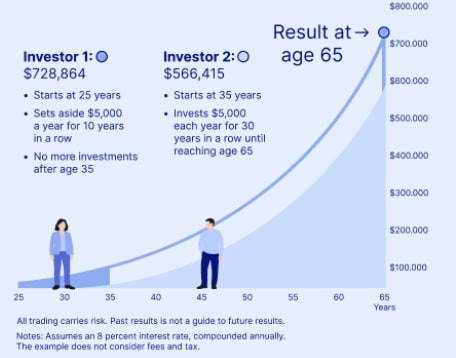
If participation is the first milestone, the next one is making that money work smarter across market cycles, and that is where better diversification becomes the real opportunity. For many investors, the most practical way to start diversifying is to become more multi-asset.
This is why the IWD investing conversation needs to evolve. The first milestone is participation. The next is portfolio design.
The real opportunity is not just to invest, but to diversify
While participation trends are encouraging, the 2025 return data suggests there is still work to do on outcomes as there was a 3.4-percentage point difference on annual returns in men’s favour. But that headline alone tells us very little about how investors got there.
The more useful insight lies in behaviour and portfolio construction.
That matters because women in Saxo’s client base are more likely to be buy-and-hold investors and slightly less likely to be multi-asset than men. A buy-and-hold approach is still a strong foundation. But in a world of policy uncertainty, shifting rate expectations, geopolitical shocks, and fast market rotations, passive exposure to a single asset class can become a tougher ride. The issue is not buy-and-hold itself, it is concentration.
Looking at the current client base, 35% of Saxo’s female clients are multi-asset, versus 39% of males. Multi-asset in this context means owning more than one type of asset or product (for example, stocks plus ETFs, or stocks plus bonds).
Diversification is the broader goal: reducing concentration risk across assets, sectors, geographies, styles, and income sources. In practice, becoming more multi-asset is often the easiest first step toward better diversification.
A useful IWD lesson hidden in the data
Within the women’s data we learn more about how actions impact outcomes.
In 2025, women who deployed a multi-asset investment strategy like described above had on average a 1.1-percentage point higher return. More importantly, the share of women who ended the year with a positive return was a staggering 12-percentage points higher for multi-asset investors compared to those who invested in a single asset.
This may be the most practical and empowering takeaway in the data. It suggests that the next leap in outcomes may not come from taking bigger risks or trading more often. It may come from building portfolios that are better prepared for different market conditions.
“Women do not just need to start investing, they need to build stronger portfolios so they can stay invested through market cycles.”
Invest with intention and build smarter portfolios
When it comes to investing, men and women often approach risk differently — and that is okay. Women are often more cautious, more research-driven, and less inclined to take high-volatility bets. Men are often more comfortable with higher-conviction risk-taking. Neither style is inherently better.
In fact, caution can be a strength. Doing the research, taking a longer-term view, and avoiding unnecessary risk can be exactly what helps investors stay consistent through market cycles.
The opportunity is not to change that mindset. It is to strengthen it with better portfolio construction, especially by becoming more multi-asset.
This is not about investing like men. It is about building on women’s strengths — research, discipline, and consistency — with better portfolio design.
That is why the right IWD message is not “invest more aggressively.” It is to build on existing strengths: keep the discipline, keep buy-and-hold as the foundation, and strengthen the portfolio with a broader mix of assets.
Think of it like a wardrobe, not a wishlist
A good portfolio is a bit like a well-built wardrobe: you do not want ten versions of the same outfit. You want different pieces for different occasions — formal wear for work, something fun for a party, swimwear for a beach holiday, and comfortable basics for everyday life.
Investing works the same way.
Different assets can play different roles:
- some for growth,
- some for income,
- some for stability,
- some for liquidity,
- and some as potential hedges when markets get noisy.
Many women already do this instinctively in daily life: balancing priorities, planning for different scenarios, and making resources go further. Investing benefits from the same mindset.
The aim is not complexity for the sake of it. It is resilience.
The question, then, is what being "multi-asset" looks like in practice.
A simple way to become more multi-asset
So, if you have already started investing in stocks or ETFs, the next step may simply be this: add a new asset class before adding your next stock. Being multi-asset does not mean making things complicated. It means adding one more building block so the portfolio is not dependent on a single type of exposure.
- If you are stock-only, consider adding an ETF to broaden exposure across sectors, geographies, or themes.
- If you already hold stocks or ETFs, consider adding bonds to add ballast and income potential when equity markets are more volatile.
- If your portfolio is growth-heavy, consider income-oriented tools such as securities lending to potentially earn additional income on long-term holdings.
A more multi-asset portfolio can improve balance, reduce dependence on a single market theme, and make long-term investing more resilient across changing conditions.
It’s not about who’s better — it’s about what works
The point is not to declare one gender “better” at investing. The point is that different investors bring different strengths, and stronger outcomes often come from matching strategy to behaviour.
Some investors thrive on speed and conviction. Others are better at consistency, patience, and long-term planning. Both approaches have value. The real advantage comes from understanding your own style and building around it intelligently.
Whether you are a bold investor looking to participate in big themes, or a careful planner focused on long-term wealth building, the goal is the same: a portfolio that works across cycles, not just in one market phase.
This International Women’s Day, the strongest investing message may be this: women are already taking charge in growing numbers. The next chapter is not just more participation; it is also more portfolio power.
And for many investors, that starts with becoming more multi-asset.