Women mingling 2

Women investors are growing fast, and the next opportunity is diversification

Macro
Charu Chanana 400x400
Charu Chanana

Chief Investment Strategist

Summary:  This IWD, the investing story is shifting from representation to momentum: more women are opening and funding accounts, giving compounding time to do its job. The next step is outcomes. Building more resilient, multi-asset portfolios so women can stay invested through different market cycles.


International Women’s Day (IWD) often focuses on representation, and rightly so. But in investing, this year’s more powerful story may be about momentum.

More women are not just talking about money. They are taking charge of it.

Saxo’s client data shows that female participation has risen meaningfully in recent years:

  • Absolute number of female direct clients: +40% since 2021
  • Female share of direct client base: 19.8% to 23.5% (+3.7 percentage points)
  • Women as share of new funded direct clients: 25.1% (2021) to 28.9% (2026 YTD run rate)

The pipeline is improving, and the direction of travel is clear: more women are entering the market and funding accounts.

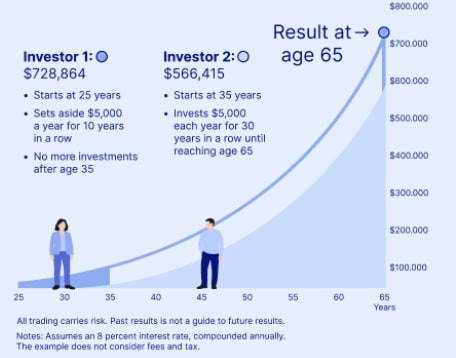
That matters for more than just representation. It matters because the earlier people start investing, the more time they give compounding to work.

Time in the market is not just a cliché – it is one of the few advantages available to every investor, regardless of account size.

A simple compounding illustration shows why participation matters so much: starting earlier can meaningfully improve long-term outcomes, even without larger annual contributions. The most important step is still getting started.

IWD

If participation is the first milestone, the next one is making that money work smarter across market cycles, and that is where better diversification becomes the real opportunity. For many investors, the most practical way to start diversifying is to become more multi-asset.

This is why the IWD investing conversation needs to evolve. The first milestone is participation. The next is portfolio design.


The real opportunity is not just to invest, but to diversify

While participation trends are encouraging, the 2025 return data suggests there is still work to do on outcomes as there was a 3.4-percentage point difference on annual returns in men’s favour. But that headline alone tells us very little about how investors got there.

The more useful insight lies in behaviour and portfolio construction.

That matters because women in Saxo’s client base are more likely to be buy-and-hold investors and slightly less likely to be multi-asset than men. A buy-and-hold approach is still a strong foundation. But in a world of policy uncertainty, shifting rate expectations, geopolitical shocks, and fast market rotations, passive exposure to a single asset class can become a tougher ride. The issue is not buy-and-hold itself, it is concentration.

Looking at the current client base, 35% of Saxo’s female clients are multi-asset, versus 39% of males. Multi-asset in this context means owning more than one type of asset or product (for example, stocks plus ETFs, or stocks plus bonds). 

Diversification is the broader goal: reducing concentration risk across assets, sectors, geographies, styles, and income sources. In practice, becoming more multi-asset is often the easiest first step toward better diversification.


A useful IWD lesson hidden in the data

Within the women’s data we learn more about how actions impact outcomes.

In 2025, women who deployed a multi-asset investment strategy like described above had on average a 1.1-percentage point higher return. More importantly, the share of women who ended the year with a positive return was a staggering 12-percentage points higher for multi-asset investors compared to those who invested in a single asset.

This may be the most practical and empowering takeaway in the data. It suggests that the next leap in outcomes may not come from taking bigger risks or trading more often. It may come from building portfolios that are better prepared for different market conditions.

“Women do not just need to start investing, they need to build stronger portfolios so they can stay invested through market cycles.”


Invest with intention and build smarter portfolios

When it comes to investing, men and women often approach risk differently — and that is okay. Women are often more cautious, more research-driven, and less inclined to take high-volatility bets. Men are often more comfortable with higher-conviction risk-taking. Neither style is inherently better.

In fact, caution can be a strength. Doing the research, taking a longer-term view, and avoiding unnecessary risk can be exactly what helps investors stay consistent through market cycles.

The opportunity is not to change that mindset. It is to strengthen it with better portfolio construction, especially by becoming more multi-asset.

This is not about investing like men. It is about building on women’s strengths — research, discipline, and consistency — with better portfolio design.

That is why the right IWD message is not “invest more aggressively.” It is to build on existing strengths: keep the discipline, keep buy-and-hold as the foundation, and strengthen the portfolio with a broader mix of assets.


Think of it like a wardrobe, not a wishlist

A good portfolio is a bit like a well-built wardrobe: you do not want ten versions of the same outfit. You want different pieces for different occasions — formal wear for work, something fun for a party, swimwear for a beach holiday, and comfortable basics for everyday life.

Investing works the same way.

Different assets can play different roles:

  • some for growth,
  • some for income,
  • some for stability,
  • some for liquidity,
  • and some as potential hedges when markets get noisy.

Many women already do this instinctively in daily life: balancing priorities, planning for different scenarios, and making resources go further. Investing benefits from the same mindset.

The aim is not complexity for the sake of it. It is resilience.

The question, then, is what being "multi-asset" looks like in practice.


A simple way to become more multi-asset

So, if you have already started investing in stocks or ETFs, the next step may simply be this: add a new asset class before adding your next stock. Being multi-asset does not mean making things complicated. It means adding one more building block so the portfolio is not dependent on a single type of exposure.

  • If you are stock-only, consider adding an ETF to broaden exposure across sectors, geographies, or themes.
  • If you already hold stocks or ETFs, consider adding bonds to add ballast and income potential when equity markets are more volatile.
  • If your portfolio is growth-heavy, consider income-oriented tools such as securities lending to potentially earn additional income on long-term holdings.

A more multi-asset portfolio can improve balance, reduce dependence on a single market theme, and make long-term investing more resilient across changing conditions.


It’s not about who’s better — it’s about what works

The point is not to declare one gender “better” at investing. The point is that different investors bring different strengths, and stronger outcomes often come from matching strategy to behaviour.

Some investors thrive on speed and conviction. Others are better at consistency, patience, and long-term planning. Both approaches have value. The real advantage comes from understanding your own style and building around it intelligently.

Whether you are a bold investor looking to participate in big themes, or a careful planner focused on long-term wealth building, the goal is the same: a portfolio that works across cycles, not just in one market phase.

This International Women’s Day, the strongest investing message may be this: women are already taking charge in growing numbers. The next chapter is not just more participation; it is also more portfolio power.

And for many investors, that starts with becoming more multi-asset.


Quarterly Outlook

01 /

  • Q1 Outlook for Traders: Five Big Questions and Three Grey Swans.

    Quarterly Outlook

    Q1 Outlook for Traders: Five Big Questions and Three Grey Swans.

    John J. Hardy

    Global Head of Macro Strategy

    Strap yourself in for key market questions that must be answered in 2026.
  • Q1 Outlook for Investors: “AI” party hangover needs discipline and diversification

    Quarterly Outlook

    Q1 Outlook for Investors: “AI” party hangover needs discipline and diversification

    Charu Chanana

    Chief Investment Strategist

    2026 is a high-valuation, high-dispersion year: the AI story matures, policy becomes less predictabl...
  • Q4 Outlook for Investors: Diversify like it’s 2025 – don’t fall for déjà vu

    Quarterly Outlook

    Q4 Outlook for Investors: Diversify like it’s 2025 – don’t fall for déjà vu

    Jacob Falkencrone

    Global Head of Investment Strategy

  • Q4 Outlook for Traders: The Fed is back in easing mode. Is this time different?

    Quarterly Outlook

    Q4 Outlook for Traders: The Fed is back in easing mode. Is this time different?

    John J. Hardy

    Global Head of Macro Strategy

    The Fed launched a new easing cycle in late Q3. Will this cycle now play out like 2000 or 2007?
  • Q3 Investor Outlook: Beyond American shores – why diversification is your strongest ally

    Quarterly Outlook

    Q3 Investor Outlook: Beyond American shores – why diversification is your strongest ally

    Jacob Falkencrone

    Global Head of Investment Strategy

  • Q3 Macro Outlook: Less chaos, and hopefully a bit more clarity

    Quarterly Outlook

    Q3 Macro Outlook: Less chaos, and hopefully a bit more clarity

    John J. Hardy

    Global Head of Macro Strategy

    After the chaos of Q2, the quarter ahead should get a bit more clarity on how Trump 2.0 is impacting...
  • Equity outlook: The high cost of global fragmentation for US portfolios

    Quarterly Outlook

    Equity outlook: The high cost of global fragmentation for US portfolios

    Charu Chanana

    Chief Investment Strategist

  • Commodity Outlook: Commodities rally despite global uncertainty

    Quarterly Outlook

    Commodity Outlook: Commodities rally despite global uncertainty

    Ole Hansen

    Head of Commodity Strategy

  • Upending the global order at blinding speed

    Quarterly Outlook

    Upending the global order at blinding speed

    John J. Hardy

    Global Head of Macro Strategy

    We are witnessing a once-in-a-lifetime shredding of the global order. As the new order takes shape, ...
  • Asset allocation outlook: From Magnificent 7 to Magnificent 2,645—diversification matters, now more than ever

    Quarterly Outlook

    Asset allocation outlook: From Magnificent 7 to Magnificent 2,645—diversification matters, now more than ever

    Jacob Falkencrone

    Global Head of Investment Strategy

Disclaimer

The Saxo Group entities each provide execution-only service and access to Analysis permitting a person to view and/or use content available on or via the website is not intended to and does not change or expand on this. Such access and use are at all times subject to (i) The Terms of Use; (ii) Full Disclaimer; (iii) The Risk Warning; (iv) the Rules of Engagement and (v) Notices applying to Saxo News & Research and/or its content in addition (where relevant) to the terms governing the use of hyperlinks on the website of a member of the Saxo Group by which access to Saxo News & Research is gained. Such content is therefore provided as no more than information. In particular no advice is intended to be provided or to be relied on as provided nor endorsed by any Saxo Group entity; nor is it to be construed as solicitation or an incentive provided to subscribe for or sell or purchase any financial instrument. All trading or investments you make must be pursuant to your own unprompted and informed self-directed decision. As such no Saxo Group entity will have or be liable for any losses that you may sustain as a result of any investment decision made in reliance on information which is available on Saxo News & Research or as a result of the use of the Saxo News & Research. Orders given and trades effected are deemed intended to be given or effected for the account of the customer with the Saxo Group entity operating in the jurisdiction in which the customer resides and/or with whom the customer opened and maintains his/her trading account. Saxo News & Research does not contain (and should not be construed as containing) financial, investment, tax or trading advice or advice of any sort offered, recommended or endorsed by Saxo Group and should not be construed as a record of our trading prices, or as an offer, incentive or solicitation for the subscription, sale or purchase in any financial instrument. To the extent that any content is construed as investment research, you must note and accept that the content was not intended to and has not been prepared in accordance with legal requirements designed to promote the independence of investment research and as such, would be considered as a marketing communication under relevant laws.

Please read our disclaimers:
- Notification on Non-Independent Investment Research (https://www.home.saxo/legal/niird/notification)
- Full disclaimer (https://www.home.saxo/en-hk/legal/disclaimer/saxo-disclaimer)

None of the information contained here constitutes an offer to purchase or sell a financial instrument, or to make any investments. Saxo does not take into account your personal investment objectives or financial situation and makes no representation and assumes no liability as to the accuracy or completeness of the information nor for any loss arising from any investment made in reliance of this presentation. Any opinions made are subject to change and may be personal to the author. These may not necessarily reflect the opinion of Saxo or its affiliates.


Hong Kong

Contact Saxo

Hong Kong S.A.R
Hong Kong S.A.R

Saxo Capital Markets HK Limited (“Saxo”) is a company authorised and regulated by the Securities and Futures Commission of Hong Kong. Saxo holds a Type 1 Regulated Activity (Dealing in Securities); Type 2 Regulated Activity (Dealing in Futures Contract); Type 3 Regulated Activity (Leveraged Foreign Exchange Trading); Type 4 Regulated Activity (Advising on Securities) and Type 9 Regulated Activity (Asset Management) licenses (CE No. AVD061). Registered address: 19th Floor, Shanghai Commercial Bank Tower, 12 Queen’s Road Central, Hong Kong.

Trading in financial instruments carries various risks, and is not suitable for all investors. Please seek expert advice, and always ensure that you fully understand these risks before trading. Trading in leveraged products may result in your losses exceeding your initial deposits. Saxo does not provide financial advice, any information available on this website is ‘general’ in nature and for informational purposes only. Saxo does not take into account an individual’s needs, objectives or financial situation. Please click here to view the relevant risk disclosure statements.

The Saxo trading platform has received numerous awards and recognition. For details of these awards and information on awards visit www.home.saxo/en-hk/about-us/awards.

The information or the products and services referred to on this site may be accessed worldwide, however is only intended for distribution to and use by recipients located in countries where such use does not constitute a violation of applicable legislation or regulations. Products and services offered on this website are not directed at, or intended for distribution to or use by, any person or entity residing in the United States and Japan. Please click here to view our full disclaimer.

Apple, iPad and iPhone are trademarks of Apple Inc., registered in the US and other countries. AppStore is a service mark of Apple Inc. Android is a trademark of Google Inc.