
Access all our platforms from a single account.

Global Market Quick Take: Asia – August 1, 2025

Key points:
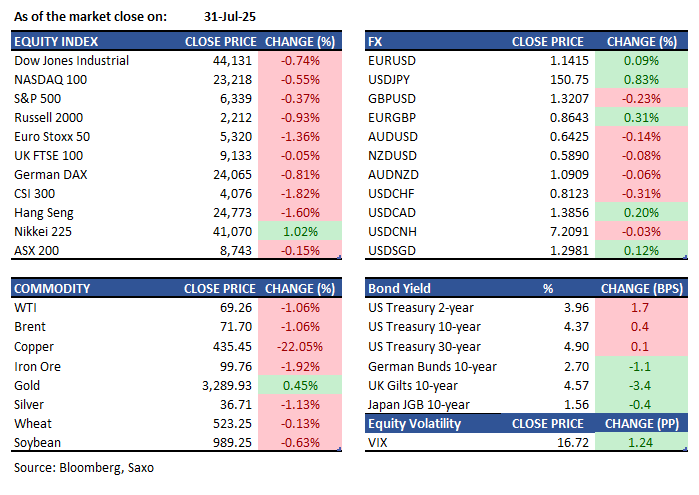
- Macro: Trump imposes tariffs between 10% and 41% on various imports and countries
- Equities: Amazon fell 6.6% after lower than expected guidance.
- FX: USD strengthened; DXY exceeded 100, USDJPY above 150 post-BoJ dovishness
- Commodities: Comex copper plummeted 22%, erasing NY's premium over London
- Fixed income: In the muted session, the yield curve bear-flattened
------------------------------------------------------------------
Disclaimer: Past performance does not indicate future performance.
Macro:
- Trump signed an executive order imposing reciprocal tariffs between 10% and 41% on U.S. imports from various countries. India's exports to the U.S. face a 25% tariff, Taiwan's 20%, and South Africa's 30%. Additionally, Trump raised tariffs on Canadian goods from 25% to 35%, according to the White House.
- US PCE price index rose 0.3% in June, its highest in four months, after a 0.2% increase in May, as expected. Goods prices increased by 0.4% and services by 0.2%. The core PCE index, excluding food and energy, matched forecasts with a 0.3% rise, following a 0.2% rise in May. Food prices went up 0.3%, while energy prices rebounded 0.9% after a 1% drop. US core PCE price index rose 0.3%, the largest increase in four months, matching market expectations.
- US initial jobless claims rose by 1,000 to 218,000, below market expectations of 224,000 and near a three-month low. Outstanding claims held steady at 1,946,000, slightly down from 2021 highs of over 1,960,000, indicating a robust labor market despite a steady slowdown in hiring.
- Germany's annual inflation rate remained at 2% in July 2025, unchanged from June and above market expectations of 1.9%. Food prices increased to 2.2%, while energy costs decreased less at -3.4%. Service inflation slowed to a three-year low of 3.1%.
- Japan's unemployment rate stayed at 2.5% in June 2025 for the fourth month, matching market estimates. The number of unemployed remained at a three-month low of 1.72 million, while employment fell by 50,000 to 68.32 million. The labor force dropped by 40,000 to 70.04 million, and those outside the labor force decreased by 50,000 to 39.57 million.
Equities:
- US - S&P 500 dropped 0.5%, marking its third consecutive loss, while the Nasdaq 100 fell 0.4%. The Dow lost 330 points, weighed down by healthcare stock declines. Market sentiment was affected by President Trump's decision to maintain a 25% tariff on Mexican imports and impending broader trade actions. The core PCE rose 0.3% in June and 2.8% annually, creating doubt over a possible rate cut in September. Meta surged 11.2% after surpassing earnings estimates and projecting strong sales, and Microsoft gained 3.9%, reaching a market cap over $4 trillion due to Azure's growth. In after-hours trading, Apple had a strong quarter, beating both top and bottom-line estimates, and gained 2.4%. Amazon fell 6.6% even though they also beat expectations, but operating income guidance was weaker than expected.
- EU - STOXX 50 fell 1.3% to 5,325, and the STOXX 600 decreased 0.7% to 546. AB InBev plummeted 11.6% due to declining sales in Brazil and China. Ferrari dropped 11.7%, its biggest fall since listing in 2016, after missing both earnings and revenue estimates. Sanofi fell 7% following a revenue miss, and Schneider Electric lost 4.5% despite strong data center business results. Hermes and Adidas each fell over 4%, extending their declines from yesterday's earnings disappointments. Conversely, BBVA surged 8% on positive earnings.
- HK - Hang Seng fell 1.6% to 24,773, its third consecutive loss and lowest close in two weeks. Sentiment waned as China's official PMI revealed the slowest services growth in eight months and significant declines in factory output due to trade barriers and extreme weather. Losses were widespread across property, consumer, and financial stocks, notably affecting Laopu Gold (-9.2%), Meituan (-4.7%), Pop Mart Intl. (-4.5%), and China Overseas Land (-4.2%). Despite these recent declines, the index rose 2.9% in July, marking its third monthly gain due to hopes for continuing the U.S.-China tariff truce and Beijing's growth-focused actions.
Earnings this week:
Friday: Chevron (CVX), Exxon (XOM)
FX:
- Dollar index rose above 100, near a two-month high, with a projected 3% July gain, its first rise this year. Persistent inflation reflected in June's 2.8% year-on-year core PCE supports steady Fed rates. Markets await Friday's jobs report.
- G10 currencies were mixed, with CHF and EUR outperforming the USD. EUR rebounded due to the EU-US trade deal and FOMC announcement. EURUSD trades at 1.1430, with the 100 DMA near at 1.1357.
- GBP fell to $1.323, its weakest since May 12, due to UK economic concerns and anticipated rate cuts. Sterling has dropped 3.7% in July, its worst performance since September 2022, amid fiscal worries and slowing growth.
- JPY weakened after BoJ Governor Ueda's dovish comments, reversing initial USDJPY fluctuations post-rate decision. Reduced rate hike expectations saw USDJPY rose above 150 level.
- Economic Calendar - China Caixin Manufacturing PMI, EU Inflation Rate, US Non Farm Payrolls, US Unemployment Rate, US ISM Manufacturing PMI
Commodities:
- Oil is set for its biggest weekly gain since mid-June as Trump pressures Russia amid looming US tariffs. WTI held above $69 a barrel, up 6% for the week, while Brent settled below $72. Trump threatened penalties on Russia and India over Russian crude and arms deals.
- Gold held its advance but is set for a weekly loss as Trump announced tariff rates. The US will impose a 10% global minimum and 15% or higher on surplus countries. Spot gold was up 0.1% to $3,291.46 in Singapore, down 1.4% this week.
- The global copper market experienced a major shock as Trump imposed 50% tariffs on imports, excluding refined metals. US prices plummeted, erasing the New York premium over London. Comex futures fell 22%, moving from a 30% premium to a discount compared to the LME benchmark within a week.
Fixed income:
- Treasuries stayed rangebound as the curve flattened post-Fed, with long-end yields down 1bp. This followed mixed data releases including PCE and jobless claims. Month-end demand persisted, possibly delayed until after the FOMC. Open interest in September Japanese futures rose by 3,283 contracts, signaling increased long positions after the Bank of Japan maintained its policy rate.
For a global look at markets – go to Inspiration.
This content is marketing content and should not be considered investment advice. Trading financial instruments carries risks and historic performance is not a guarantee for future performance.
The instrument(s) mentioned in this content may be issued by a partner, from which Saxo receives promotion, payment or retrocessions. While Saxo receives compensation from these partnerships, all content is conducted with the intention of providing clients with valuable options and information.