
Access all our platforms from a single account.

Global Market Quick Take: Asia – June 25, 2025

Global Market Quick Take: Asia – June 25, 2025
Note: This is marketing material.
Key points:
- Macro: Israel and Iran ceasefire and Powell’s slight dovish tilt in testimony
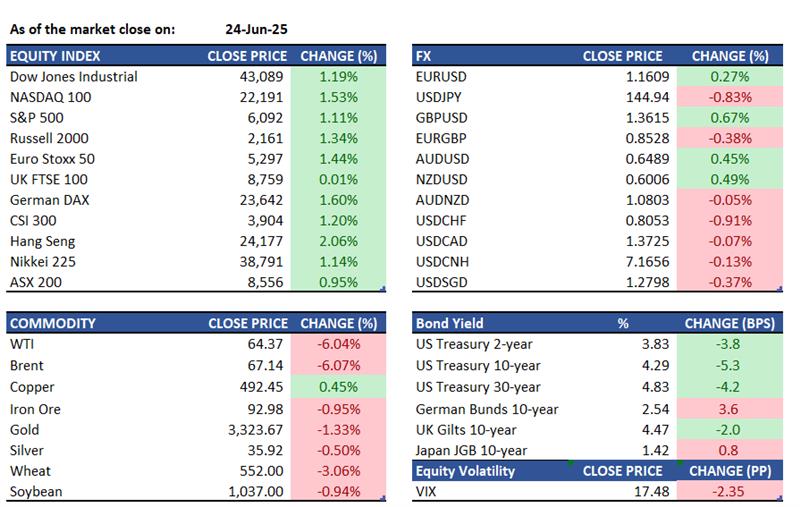
- Equities: Nasdaq 100 rose 1.5%, closing at a new all-time high
- FX: USD weakened post-ceasefire; DXY fell below 98; GBP rose above 1.361
- Commodities: Oil saw its largest two-day drop since 2022
- Fixed income: Treasuries extended gains on weak June consumer confidence data
------------------------------------------------------------------
Disclaimer: Past performance does not indicate future performance.
Macro:
- Israel and Iran seemed to be complying with a ceasefire agreement announced by President Trump overnight, after his firm response to reports of initial breaches by both parties.
- Powell said inflation could come in weaker than expected, which would support an earlier rate cut. However, if inflation or labor market strength persists, that could delay any rate cuts.
- Canada's annual inflation rate held steady at 1.7% in May 2025, aligning with market expectations and remaining below the Bank of Canada's 2% target for the second month after removing the federal consumer carbon tax.
- The US current account deficit grew by 44.3% to $450.2 billion in Q1 2025, surpassing expectations of $443.3 billion. The goods deficit rose to $466 billion as imports increased by $158.2 billion to $1 trillion, led by nonmonetary gold and consumer goods, primarily medicinal, dental, and pharmaceutical products.
Equities:
- US – US stocks surged on Tuesday, with the S&P 500 up 1.1%, nearing a record high, the Nasdaq 100 rising 1.5% to close at all-time high, and the Dow gaining 507 points. Investor optimism grew as the US-brokered ceasefire between Israel and Iran held, despite minor incidents. Falling oil prices, down over 6%, pressured energy giants like Exxon Mobil (-3%) and Chevron (-2.2%), while benefiting fuel-sensitive companies like Delta (+2.7%) and United Airlines (+2.7%). Semiconductor stocks led the tech sector, with Nvidia (+2.6%), Broadcom (+3.9%), and AMD (+6.8%) performing strongly.
- EU - DAX rose 1.6% to 23,642, driven by fiscal spending plans, positive data, and easing Middle East tensions. Germany approved increased investments and defence spending plans. Travel and building materials stocks led gains, with Deutsche Lufthansa up 7% and Heidelberg Materials nearly 6%. The FTSE 100 closed flat, underperforming as BP and Shell fell 4.8% and 3.7% due to lower crude prices following the ceasefire announcement.
- HK - HSI rose 2.1% to 24,177, marking its third consecutive gain and a two-week high as all sectors advanced. Positive sentiment followed U.S. futures' rise after Trump's phased ceasefire announcement between Iran and Israel. In China, stocks hit a three-month high, with the yuan strengthening due to improved sentiment and capital inflows. Tech and auto stocks led gains, including Li Auto (3.8%), Horizon Robotics (3.3%), Xiaomi (3.7%), and China Unicom (2.0%).
Earnings this week:
- Wednesday: General Mills (GIS), Micron (MU), Jefferies (JEF)
- Thursday: Walgreens Boots Alliance (WBA), Nike (NKE), American Outdoor Brands (AOUT)
FX:
- USD weakened as its safe-haven appeal diminished following President Trump's announcement of a ceasefire between Israel and Iran, despite some violations throughout the day. After Trump's intervention against Israel, the ceasefire appeared to hold. Dollar index fell below 98.
- EUR traded around 1.1618, showing little reaction to the German IFO data, which reported a larger-than-expected rise in the Business Climate metric.
- CHF and JPY outperformed, with USDCHF and USDJPY reaching 0.8050 and 144.55, respectively, despite limited currency-specific news.
- GBPUSD peaked at 1.3648 and hovered around 1.3620, as BoE Deputy Governor Ramsden explained his dovish stance at the previous meeting was due to perceived labour market loosening, aligning with the MPC's "gradual and careful" approach.
- CAD stabilised at 1.37 against USD after retreating from its eight-month high. Steady inflation at 1.7% influenced monetary policy expectations, slowing anticipated rate cuts.
- Economic calendar – AU monthly CPI indicator, FR Consumer Confidence, FR Unemployment Benefit Claims, US MBA 30-Yr Mortgage Rate, Us New Home Sales, Fed Chair Powell Testimony
Commodities:
- Gold remained down as the Iran-Israel ceasefire eased tensions, reducing haven demand. It traded at about $3,325 an ounce early in Asia, following a 1.3% drop yesterday. The truce followed US President Trump's criticism of early violations.
- Oil increased after its largest two-day decline since 2022, amid the Iran-Israel ceasefire and reports of falling US crude stockpiles. Brent crude rose 1% to nearly $68 a barrel, while WTI topped $65. The ceasefire reduced regional supply risks.
Fixed income:
- Treasuries climbed, following weaker-than-expected June consumer confidence data. Fed Chair Powell, addressing the House Financial Services Committee, stated the central bank is not rushing to cut rates amid tariff uncertainties but noted that lower inflation and weaker labour could prompt an earlier cut. Fed-dated OIS priced in around 60 basis points for the year's rate cuts, up from 54 basis points at Monday's close. Bets totalling $38 million in premiums focus on August calls for US 10-year options, hedging against a drop in 10-year Treasury yields to 4% from the current 4.3%.
For a global look at markets – go to Inspiration.