
Access all our platforms from a single account.

Asia Market Quick Take – 25 September, 2026
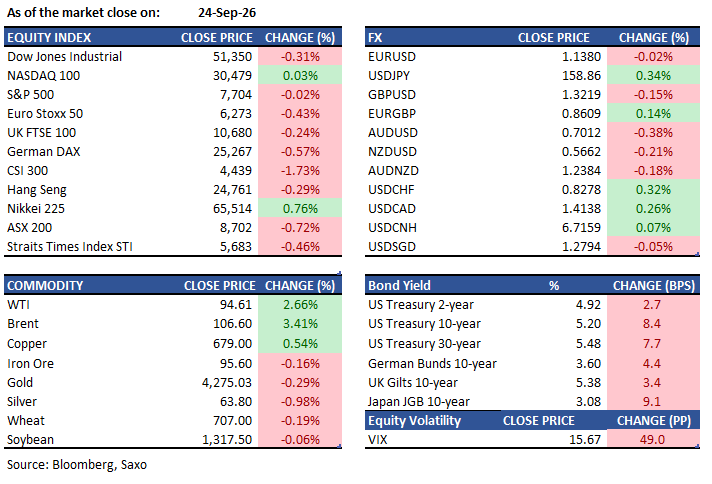
Key points:
- Macro: US weekly jobless claims at 60-year low
- Equities: Oracle drops after force majeure in New Mexico data centre
- FX: USDJPY extends gains to 159 on broad based US dollar strength
- Commodities: Brent crude hit $108 and gold remains below $4,300
- Fixed income: US 30-year Treasury yield at 5.47%, highest since 2004
------------------------------------------------------------------
Disclaimer: Past performance does not indicate future performance.
Macro:
- The US and Iran are weighing a Qatar-mediated phased deal to reopen the Strait of Hormuz and lift the US blockade, with Tehran demanding control of Hormuz and less US military pressure. The White House says Trump is open to talks but not under pressure. Houthi militants also fired missiles at Saudi cities, while US oil is heading for a 2% weekly decline.
- UK GfK consumer confidence rose to -13 in September 2026, the highest since August 2024 and above forecasts, as views on personal finances and the economy improved after Labour’s election. But sentiment remains negative, other surveys are mixed, and GfK warned rising energy and fuel costs could yet undermine confidence.
- US weekly jobless claims fell to 197,000, near a 60‑year low and below expectations, while continuing claims stayed close to three‑year lows, signaling a still‑strong labor market.
- Norges Bank raised its policy rate by 25 bps to 4.50% on persistent inflation, while Sweden’s Riksbank held rates.
Equities:
- US — The S&P 500 was little changed on Thursday as bond volatility kept risk appetite subdued, with most index constituents declining even as the headline held flat. The 30-year Treasury yield hitting its highest since 2004 weighed broadly. Palantir, Palo Alto Networks and Datadog were noted as standouts in software. After hours, Costco beat Q4 EPS estimates at $6.75 vs. $6.53 expected, aided by tariff refunds, though paid membership growth disappointed; shares were little changed post-close. TD SYNNEX fell ~4% in premarket after gross margins missed despite a headline beat. Oracle plunged after declaring force majeure at its New Mexico data center, also pressuring Bloom Energy and Blue Owl.
- EU — European equities fell for a second consecutive session on Thursday. The Stoxx Europe 600 dropped 0.5% to 636.43, the DAX fell 0.6% to 25,266.53 (lowest since 24 July), the FTSE 100 declined 0.2% to 10,679.99, and the SMI slipped 0.1%. Brent crude surging to $108/bbl on Iran conflict escalation fears drove energy stocks higher but weighed on the broader market. ASML was the largest drag on the Stoxx 600; Infineon fell 3.9% on the DAX; Rentokil dropped 4.3% on the FTSE 100; Logitech fell 6.1% on the SMI. Beazley is set to leave the FTSE 100 effective 1 October.
- Asia — Asian markets face a negative open Friday, with futures pointing to further losses as the global bond selloff deepens. On Thursday, Chinese stocks underperformed — the CSI 300 fell 1.7% and the Hang Seng China Enterprises Index trimmed losses to close down 0.2%, as investors cut risk ahead of the Trump-Xi summit and the US-China trade truce disappointed. Nine Dragons Paper surged as much as 7.4% after full-year net income beat estimates. CTF Services reported FY net income of HK$2.39bn, missing the HK$2.64bn estimate, though revenue beat; the company proposed a 1-for-10 bonus issue.
Events this week:
- Friday – China, Korea, Taiwan markets closed
FX:
- USDJPY nudged closer to 159 as Asian currencies came under broad stress. Goldman Sachs cut its 12-month dollar-yen forecast to 150 (from 165), citing a more constructive domestic policy backdrop and the prospect of Japanese capital repatriation strengthening the yen outlook.
- The MSCI Emerging Market Currency Index fell 0.4% on Thursday, its worst session since 15 May, with the Colombian peso (-2.2%) and Mexican peso (-1.3%) leading declines as the carry trade weakened.
- USDCNH rose for a third consecutive day to 6.7164, the highest since 4 September, as dollar strength persisted and the PBOC weakened its daily fixing for a second day, despite the US-China trade truce extension.
- AUDUSD traded near 0.70, under pressure from the strong dollar and rising global yields, with the Australian dollar among the weakest G10 performers over the week.
Commodities:
- Brent crude surged to $108/bbl on Thursday after an adviser to Iran's supreme leader suggested the conflict with the US could extend to the Indian Ocean, before partially paring gains. Oil has been the primary macro driver this week, with energy-led inflation fears the key catalyst behind the global bond selloff.
- Gold is set to end the week lower, trading near $4,270/oz (down >2%) as high energy prices lift Fed hike expectations; oil steadied after Thursday’s surge amid a US-Iran impasse on Hormuz and talk of a phased deal to reopen flows and lift a port blockade.
Fixed income:
- The US 30-year Treasury yield rose to ~5.47% on Thursday, its highest since 2004, while the 10-year yield climbed 6.8bps to 5.185%. The curve steepened sharply, with the 5s30s spread widening to 42.5bps from 39.1bps, as the long end bore the brunt of selling driven by oil-fuelled inflation fears and a disappointing Treasury buyback operation that accepted only a fraction of the $6bn on offer.
- T-bill auctions on Thursday faced a "buyer strike," with four-week bills clearing at 3.85% (highest since November) and eight-week bills at 3.99%. Foreign central banks took their smallest share of the shorter tenor in nearly three years. Traders are now buying puts on 10-year Treasuries to hedge against a larger selloff around next Friday's payrolls print.
- Asian government bonds are set to extend losses on Friday, with Australian and New Zealand 10-year yields already slipping and Japanese debt futures pointing lower.
For a global look at markets – go to Inspiration.
This content is marketing content and should not be considered investment advice. Trading financial instruments carries risks and historic performance is not a guarantee for future performance.
The instrument(s) mentioned in this content may be issued by a partner, from which Saxo receives promotion, payment or retrocessions. While Saxo receives compensation from these partnerships, all content is conducted with the intention of providing clients with valuable options and information.