
Access all our platforms from a single account.

Asia Market Quick Take – 24 September, 2026

Key points:
- Macro: US economic activity surges
- Equities: US stocks retreated on higher yields & oil prices
- FX: USD strengthens on back of strong economic data
- Commodities: Brent crude snaps five-day slide, reclaims $100
- Fixed income: US Treasury yields surge to near two-decade highs
------------------------------------------------------------------
Disclaimer: Past performance does not indicate future performance.
Macro:
- Iran’s President Masoud Pezeshkian told the UN Iran will keep pursuing nuclear technology for economic use and may restrict Strait of Hormuz shipping while sanctions and a US blockade persist. In the US, Energy Secretary Chris Wright said the Trump administration is seeking voluntary diesel export cuts from refiners instead of a formal ban.
- US business activity is growing at its fastest pace in over five years, with the S&P Global flash Composite PMI rising to 58.4 in September, boosting expectations of further Fed rate hikes.
- US Services PMI rose to 58.7 in September 2026, the strongest in over five years and above expectations, driven by strong domestic demand. Backlogs and employment climbed near record levels despite surging input costs from higher fuel and transport, weaker export orders, and below-trend business confidence.
- The S&P Global US Manufacturing PMI rose to 57.0 in September 2026 from 53.9, far above expectations and the strongest since May 2022. All components improved, with production and new orders accelerating, employment at its highest since early 2021, inventories rising faster, and delivery times lengthening.
- Germany’s flash Composite PMI rose to 53.8 in September 2026, an 11‑month high and above expectations, as services rebounded, manufacturing stayed solid, new orders and backlogs grew, and hiring increased despite rising fuel‑driven cost pressures.
- Singapore’s inflation rose to 2.3% in August 2026, a two‑year high, with broad-based price increases and core inflation up to 2.2%, reinforcing expectations of elevated price pressures into mid‑2027.
Equities:
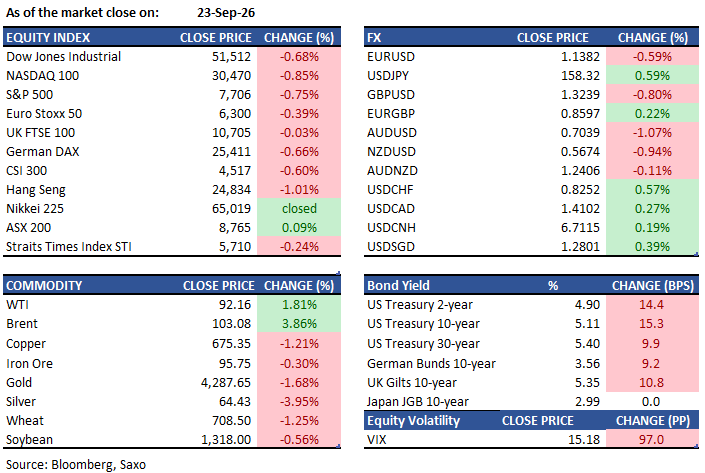
- US: US equities fell sharply on Wednesday as surging Treasury yields and rising oil prices reignited inflation fears. The S&P 500 slid 0.8% to 7,706, the Nasdaq Composite dropped 1.1% to 26,936 — retreating from an all-time high — and the Dow fell 0.7% to 51,512. Energy was the sole sector to close in the green. Blackstone was a notable underperformer in financials after its intra-quarter update showed continued monetisation challenges. Meta Platforms bucked the trend and continued to rise 1%. In after-hours trading, Everpure gained ~5.8% during its financial analyst day, while Stitch Fix also moved higher.
- EU: European equities fell on Wednesday as Brent crude's return above $100/bbl and rising bond yields outweighed better-than-expected PMI data. The Stoxx 600 dropped 0.4% to 639.92, the DAX fell 0.7% to 25,411, and the FTSE 100 was broadly flat at 10,705. Allianz was the largest drag on the Stoxx 600, declining 4.0%. Insurance and autos were the worst-performing sectors. Classifieds and telecom stocks sold off on AI disruption fears following new agentic AI tool releases from Meta and others, with Scout24 falling 5.2%, Rightmove -2.5%, and Telefonica -2.3%. UBS fell 1.7% after the Swiss parliament's upper house backed stricter capital requirements for the bank.
- Asia: Asian markets are reopening to a challenging backdrop this morning. Japan's Nikkei returns from the Silver Week holiday with Nikkei 225 futures having been approximately 1.4% higher than Friday's close, though the overnight US equity selloff and Treasury rout may temper gains. The yen hovers near 158 per dollar, keeping currency intervention risk in focus. The KOSPI gained 0.9% on Wednesday ahead of the Chuseok holiday, with investors turning cautious. The Hang Seng China Enterprises Index saw mixed moves, with healthcare stocks attracting renewed interest as investors rotate from AI names. The MSCI ASEAN index fell 0.4% on Wednesday. Rare earth stocks across the region are in focus following the US-China trade truce extension to 10 January. SoftBank priced one of the largest junk-bond offerings on record at $11.1 billion to fund its AI ambitions, with ADRs gaining ~4% during the holiday break.
Earnings this week:
- Thursday: Darden Restaurants (Q1 2027), Costco Wholesale (Q4 2026, after market), H&M, BlackBerry
Key Events:
- Thursday: Trump-Xi Summit
FX:
- USD broadly stronger: The Bloomberg Dollar Spot Index rose 0.6% on Wednesday, reaching its highest level since end-July and extending its September gain to approximately 1.4%, driven by the strong US PMI data and surging Treasury yields.
- JPY near three-week low: USDJPY hovered around 158.29–158.40, its highest since 3 September, after gaining for four consecutive sessions in the wake of the Bank of Japan's recent rate hike. Yen weakness keeps currency intervention risk in focus as Japanese markets reopen today.
- AUD hits seven-week low: AUD/USD fell as much as 1.3% to 0.7026 in the New York session — its weakest since 7 August — as surging global bond yields and geopolitical tensions hit risk sentiment. The pair has since stabilised near 0.7038.
- USDCNH climbed to 6.7116, up ~0.3%, as the PBOC set a weaker daily fixing for the first time since 8 September, halting an extended yuan appreciation streak. Moves came ahead of the Trump-Xi summit in Washington.
- KRW the worst performer among major currencies, falling 0.84%.
Commodities:
- Brent crude settled around $103/bbl on Wednesday, ending a five-session losing streak and reclaiming the $100 handle. The move was driven by geopolitical tensions in the Middle East and reports that the White House is reportedly preparing a 90-day US diesel export ban. US diesel futures, however, slumped on the export ban speculation.
- Gold spot traded below $4,300, with the precious metal under pressure from the surging US dollar and rising real rates. Bullion has been highly sensitive to recent swings in oil prices and their implications for the Fed's rate path.
Fixed income:
- The 10-year Treasury yield jumped approximately 15bp to 5.116% on Wednesday — its highest level since July 2007 and potentially its largest single-day move since Liberation Day in April 2025. The 2-year yield rose 18bp to 4.933%, the 5-year surged 15bp to 4.987%, and the 30-year climbed 9bp to 5.391%. Approximately 80–85% of the selloff was driven by real rates rather than inflation breakevens, suggesting a real-rate repricing and higher-for-longer Fed pricing rather than an outright inflation panic.
- The $70 billion 5-year note auction tailed the when-issued yield by more than 3 basis points, awarded at 5.033% — the highest since 2006 and the 11th consecutive weak result. The poor auction accelerated the selloff across the curve. The iShares 20+ Year Treasury Bond ETF (TLT) fell 1.6% to a record low of $80.46, having lost more than half its value since its 2020 peak.
- Australian 3-year yields jumped 13bp to 5.07% — their highest since May 2011 — and 10-year yields surged 13bp to 5.38%, tracking the Treasury selloff. JGB futures gapped lower at the open as Japanese markets returned from the Silver Week holiday, with focus turning to next week's 2-year and 40-year JGB auctions. European government bonds also sold off in sympathy with Treasuries during Wednesday's session.
For a global look at markets – go to Inspiration.
This content is marketing content and should not be considered investment advice. Trading financial instruments carries risks and historic performance is not a guarantee for future performance.The instrument(s) mentioned in this content may be issued by a partner, from which Saxo receives promotion, payment or retrocessions. While Saxo receives compensation from these partnerships, all content is conducted with the intention of providing clients with valuable options and information.