
Access all our platforms from a single account.

Asia Market Quick Take – 12 May, 2026

Key points:
- Macro: US–Iran ceasefire on “massive life support” after rejecting Tehran’s plan
- Equities: S&P 500 and NASDAQ close at record highs
- FX: Yuan rose past 6.80 onshore and offshore, strongest since Feb 2023
- Commodities: Silver surged over 7%; WTI near $100
- Fixed income: US Treasuries extended losses; UK gilts tumbled
------------------------------------------------------------------
Disclaimer: Past performance does not indicate future performance.
Macro:
- Kevin Warsh’s Fed Board nomination cleared an initial Senate hurdle in a 49–44 vote, with a final confirmation vote to succeed Jerome Powell as chair expected later this week.
- Trump warned the US–Iran ceasefire was on “massive life support” after rejecting Tehran’s proposal, raising fears Hormuz will stay effectively closed, as Iran seeks an end to the US naval blockade and some sanctions relief. Trump is weighing renewed military action and vessel escorts, while Saudi Aramco’s CEO says weekly losses of about 100 million barrels could delay market normalization into next year.
- Japan’s household spending fell 2.9% y/y in March 2026, a fourth consecutive drop and worse than the expected 1.3% decline, with broad weakness across food, utilities, clothing, and transport. Spending on housing, household goods, healthcare, and education rose, but overall outlays fell 1.3% m/m, reversing February’s 1.5% gain.
- US existing home sales ticked up 0.2% to a 4.02 million annual rate in April 2026, below the 4.05 million forecast, as higher mortgage rates weighed. Sales fell in the West but rose in the Midwest, while inventory increased 5.8% to 1.47 million (4.4 months’ supply). The NAR cited improved affordability as incomes outpaced home price gains.
Equities:
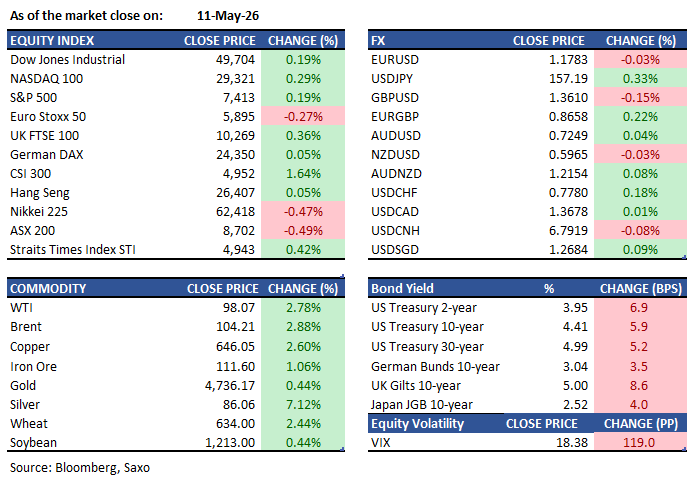
- US - US stocks rose Monday, with the S&P 500 up 0.2% and the Nasdaq 0.1% to new record highs, led by chipmakers on AI optimism. The Dow gained 95 points. Nvidia rose 2%, Tesla 3.9%, Qualcomm 8.4%, AMD 0.8%, and Micron 6.5% on expectations of tighter memory supply. Energy, materials, and industrials also advanced, despite higher oil prices after Trump rejected Iran’s response to his proposal and ahead of a Trump–Xi summit later this week.
- EU - European stocks fell for a third session Monday as Middle East war risks and supply disruptions weighed on sentiment. The Eurozone’s STOXX 50 slipped 0.3% to 5,895 and the STOXX 600 was flat. Trump’s rejection of Iran’s counteroffer escalated rhetoric and extended the halt in regional energy exports. Consumer discretionary and Paris-listed luxury names led losses, with LVMH down over 4% and Hermès and L’Oréal off about 3%, while Schneider Electric rose 2.3% and Siemens gained 1.4% ahead of earnings.
- Asia - Asian stocks rose Monday, led by South Korea as AI demand drove a tech surge. The Kospi jumped 4.3% to a record 7,822.24, with SK Hynix up 11.5% and Samsung also strong. In Hong Kong, the Hang Seng was little changed at 26,406.84, with HSBC up 1.8%. China’s Shanghai Composite gained 0.7% to its highest since 2015, and the STAR 50 rose as much as 5.1% to a record. Shenzhen LDROBOT soared up to 150% on its Hong Kong debut, while Singapore’s Straits Times Index saw modest moves, tracking global chip momentum.
Earnings this week:
- Tuesday: Oklo, Sea limited, Oncloud, JD.com,
- Wednesday: Alibaba, Tencent, Cisco, SoftBank Group
- Thursday: Applied materials, Honda
FX:
- The Japanese yen became the worst performing G10 currency year-to-date, down 0.25% against the US dollar and trading at 157.11 to the US currency. The dollar gained 0.35% to 157.22 yen on Monday, the largest one-day percentage gain since Tuesday, May 5, 2026. US Treasury Secretary Bessent is scheduled to meet Prime Minister Sanae Takaichi and Finance Minister Satsuki Katayama in Tokyo on Tuesday.
- The Chinese yuan strengthened above 6.8 against the dollar both onshore and offshore, trading at the highest level since February 2023 in the run up to President Trump's China visit. USD/CNY slipped 0.1% to 6.7959, while USD/CNH fell 0.1% to 6.7933. Goldman Sachs said the yuan is more than 20% undervalued against the US dollar and raised its forecasts to 6.80 in three months, 6.70 in six months and 6.50 in a year.
- The British pound erased gains in the New York afternoon session, declining a second day in three amid growing calls for Prime Minister Keir Starmer to step down.
- The euro looks poised to fall as downside risks to the euro-area economy continue to mount. Economists have already cut their growth forecast for the bloc this year and look to have underestimated the negative economic impact of the war in Iran. The Bloomberg Economics Growth Data Surprise Index fell to the lowest since Covid-19 earlier this month.
Commodities:
- Oil prices rose on Monday after President Trump said the fragile ceasefire between the US and Iran is close to unraveling, prolonging the effective closure of the crucial Strait of Hormuz. Brent futures advanced 2.9% to settle near $104 a barrel, the highest in almost a week, while WTI climbed 2.8% to around $98 a barrel. Trump is reportedly meeting with his national security team to discuss next steps in the Middle East conflict, including possibly resuming military action.
- The CBOE Silver ETF Volatility Index of expected volatility in silver rose 20%, the most since January 26, as the underlying benchmark advanced 0.4%. The Silver VIX was up 11.19 to 67.83, a move of at least two standard deviations. Silver jumped over 7% as technical signals drew fresh buying from hedge funds and other leveraged investors.
- Top-20 brokers on the Shanghai Futures Exchange registered aggregate net-short positions of 43,859 copper contracts across front seven months on Monday, the highest since April 7, 2026. Copper net-short positions in the most active June contract stood at 13,244.
Fixed income:
- US Treasuries extended losses on Monday, falling to session lows after a weak 3-year note auction produced soft demand metrics ahead of 10- and 30-year new-issue sales over the next two days. The 10-year yield rose 5.5 basis points to 4.41%, while the 30-year yield rose 4.8 basis points to 4.986%, the second highest this year. The US Treasury sold $58 billion in three-year notes at a yield of 3.965%, the highest result since June, with a bid-to-cover ratio of 2.54.
- Goldman Sachs and Bank of America are the latest in a growing cohort of Wall Street banks pushing back their forecasts for interest-rate cuts, arguing that both jobs and inflation data make a case for the Federal Reserve to keep rates on hold until at least the end of the year. Traders are increasing bets that the Fed will keep policy on hold through 2026 and may even hike in early 2027.
- UK gilts tumbled on Monday amid pressure on Prime Minister Keir Starmer to lay out a timetable for his departure. US bonds outperformed gilts during the session. A heavy corporate new-issue slate was also a factor weighing on Treasuries.
For a global look at markets – go to Inspiration.
This content is marketing content and should not be considered investment advice. Trading financial instruments carries risks and historic performance is not a guarantee for future performance.
The instrument(s) mentioned in this content may be issued by a partner, from which Saxo receives promotion, payment or retrocessions. While Saxo receives compensation from these partnerships, all content is conducted with the intention of providing clients with valuable options and information.