Access all our platforms from a single account.

Asia Market Quick Take – 11 May, 2026
Key points:
- Macro: Trump rejects Iran’s response and prolongs close of Straits
- Equities: Intel +14% after deal with Apple; Futures lower on Trump response to Iran
- FX: Norwegian krone is the top-performing G10 currency YTD
- Commodities: Brent crude futures rose as much as 3.5% to $104.80
- Fixed income: 30-year US Treasury yields ended the week below 5%
------------------------------------------------------------------
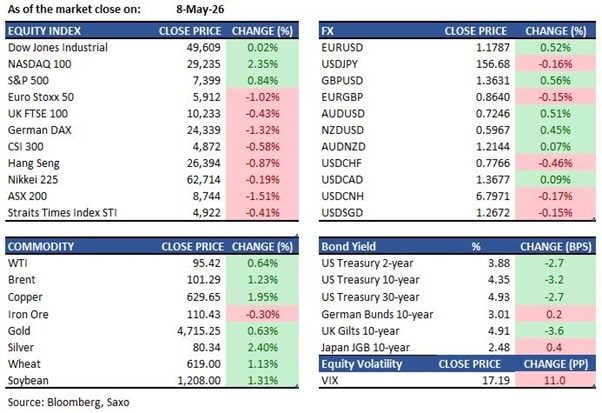
Disclaimer: Past performance does not indicate future performance.
Macro:
- Trump rejected Iran’s latest response to his proposal to end the 10-week conflict as “totally unacceptable,” prolonging the effective closure of the Strait of Hormuz.
- The US added 115K jobs in April 2026, beating forecasts but down from a revised 185K in March, with gains in health care, transport/warehousing, and retail partly offset by losses in information, federal government, and manufacturing. Revisions left February–March employment 16K lower, pointing to a cooling but still resilient labor market.
- China’s exports rose 14.1% y/y to a record USD 359.4bn in April 2026, far above forecasts, as firms stockpiled components amid Iran-war cost fears. US shipments rebounded 11.3% despite tariffs, while Jan–Apr exports climbed 14.5% to USD 1.34tn, with sales to the US down 10.2%. Trump-Xi meeting will happen this week 14-15 May.
- The Michigan Consumer Sentiment Index hit a record low of 48.2 in early May 2026, below April and forecasts, as current conditions slumped on price concerns. About one-third of consumers cited gas prices and 30% tariffs; year-ahead and long-run inflation expectations eased to 4.5% and 3.4%.
- US year-ahead inflation expectations eased to 4.5% in May 2026 from 4.7% in April, while the five-year outlook dipped to 3.4% from 3.5%, University of Michigan data showed.
- Canada lost 18,000 jobs in April 2026, missing expectations for a 15,000 gain. Full-time employment fell by 47,000 while part-time rose by 29,000; the employment rate edged down to 60.5%, with youth and core-aged male unemployment up and Ontario adding 42,000 jobs.
Equities:
- US: US equity-index futures edged lower after the S&P 500 Index rallied to a record on Friday. Contracts for the S&P 500 fell 0.2% in early trading after President Donald Trump rejected Iran's response to his latest proposal to end the war. The SOX index rose more than 5% on Friday to provide an external boost for Asian peers. Dell Technologies was downgraded to Neutral from Buy at UBS with a $243 price target. Intel's price target was raised to $96 from $56 at BofA following news of a potential foundry deal with Apple that could provide $10 billion in sales by 2030. Monster Beverage's price target was raised to $100 from $96 at Morgan Stanley following very strong Q1 and April results.
- EU: The Stoxx Europe 600 ended the week flat at around 620 points, despite a volatile stretch that saw the index slide toward 604 before surging nearly 4% to 626 points. The index struggled to mount a relief rally despite talk of a US-Iran deal, oil retreating from highs, resilient earnings, and strong bank beats. Commerzbank announced plans to cut as many as 3,000 roles and lifted financial targets as the bank resists a takeover from Italian rival UniCredit. Tenaris agreed to acquire Romanian pipe maker Artrom Steel Tubes for EUR86 million on a cash-free, debt-free basis. REA Group's 8% price rise suggests confidence in its position and indicates it is untroubled by CoStar-owned Domain, according to Jefferies analyst Roger Samuel.
- Asia: Asian stocks are set for a mixed open after President Trump rejected Iran's latest peace proposal, dimming prospects for a near-term resolution to the Middle East conflict. Nikkei futures are up 1.5% at 63,770 on the SGX, with the Nikkei Stock Average having fallen 0.2% to 62,713.65 on Friday. South Korea's Kospi is primed for more gains after a late surge Friday in futures and Korean ETFs, despite the advance in crude oil early Monday. The theme of Asian AI stocks outperforming is becoming a global narrative drawing in funds from all over the investing universe. Hong Kong's Hang Seng saw Hongkong Land lead gainers on May 7, rising 9.2% to US$8.70, while the worst performer was Hongkong Land on May 8, falling 5.2% to US$8.25. Singapore's Straits Times Index gained 0.3% on May 7 to finish at 4,941.96, with Venture Corp leading gainers by rising 10.9% to $18.28, while the index lost 0.4% on May 8 to finish at 4,921.90. The Kospi rallied more than 13% over three sessions earlier in the week, with Goldman Sachs raising its target to 9,000, citing Korea as its highest conviction view with forecast earnings growth of 300% this year.
Earnings this week:
- Monday: Circle, Hims&Hers, Rigetti, Barrick Mining
- Tuesday: Oklo, Sea limited, Oncloud, JD.com,
- Wednesday: Alibaba, Tencent, Cisco, SoftBank Group
- Thursday: Applied materials, Honda
FX:
- The dollar climbed against most G10 peers in early trading after US President Donald Trump rejected Iran's peace-deal response, with the Bloomberg Dollar Spot Index rising 0.1%, paring Friday's 0.2% drop.
- The pound was among the biggest laggards as UK Prime Minister Keir Starmer came under pressure to step aside following poor local election results, with GBPUSD indicated 0.1% lower at 1.3618.
- The yen dropped against the dollar while Japanese government bonds are expected to fall, with USDJPY up 0.1% to 156.91 as the dollar remains at elevated levels due to Middle East tensions.
- The Norwegian krone has become the best performing G10 currency in the year to date, up 9.51% against the US dollar, while the Swedish krona has become the worst performing G10 currency, down 0.04% against the dollar.
- AUDUSD down 0.2% to 0.7234 after a 0.6% rise last week. CFTC (week to 5 May): leveraged funds raised net AUD longs by 10,695 to 58,994; net NZD shorts up 2,461 to 19,294, the most bearish since 2019.
Commodities:
- Brent crude futures advanced as much as 3.5% to $104.80 a barrel, while WTI climbed to near $99 after Trump said Iran's response was totally unacceptable, prolonging the effective closure of the crucial Strait of Hormuz.
- Gold fell as Trump rejected Iran's latest peace offer to end the 10-week conflict, fanning inflation fears, with bullion trading near $4,698 an ounce after rising around 2% last week.
Fixed income:
- Yields on 30-year US Treasury bonds briefly touched 5.15%, the highest since July, before ending the week about 2 basis points lower at 4.94% as the bond market has been held hostage by oil prices.
- The yield premium for Asia ex-Japan's investment-grade dollar bonds widened at the end of last week after falling to an all-time low earlier, as risk sentiment is waning after President Trump and Iran rejected each other's latest proposal to end the war.
- Goldman Sachs has lifted its 10-year JGB yield forecast to 2.5% by end-2026 and 2.25% by end-2027, versus 2% previously across both years, to reflect a more durable risk premium across the curve.
- Final CME open interest data show continued liquidation in 2-year note futures after Thursday’s Treasury move, with sizeable new risk added in 5- and 10-year notes. SOFR futures saw a mix of unwinds and fresh positions, while May fed funds open interest rose modestly after Thursday’s heavy buying.
For a global look at markets – go to Inspiration.
This content is marketing content and should not be considered investment advice. Trading financial instruments carries risks and historic performance is not a guarantee for future performance. The instrument(s) mentioned in this content may be issued by a partner, from which Saxo receives promotion, payment or retrocessions. While Saxo receives compensation from these partnerships, all content is conducted with the intention of providing clients with valuable options and information.