
Access all our platforms from a single account.

Micron before earnings: using a covered call after a strong rally

Summary: Micron just had a sharp rally - and if you own 100 shares, you have a decision to make. Selling everything may feel too final. Holding without a plan may feel careless after such a large move. A covered call can sit right between those two choices ...
Micron before earnings: using a covered call after a strong rally
When shares have already moved sharply, a covered call can turn hesitation into a plan.
Key takeaways
- Micron shares have rallied sharply, leaving long-term shareholders with a practical question: hold, take some profit, or generate income from the position.
- Selling the 18 June 2026 USD 1,100 call brings in about USD 37.40 per share – roughly USD 3,740 per contract.
- The USD 1,100 strike is well above the current share price of around USD 914.50, with the expiry set before Micron’s expected 24 June earnings date.
- A covered call is not free money. The investor accepts capped upside, possible assignment, and continued downside exposure as a shareholder.
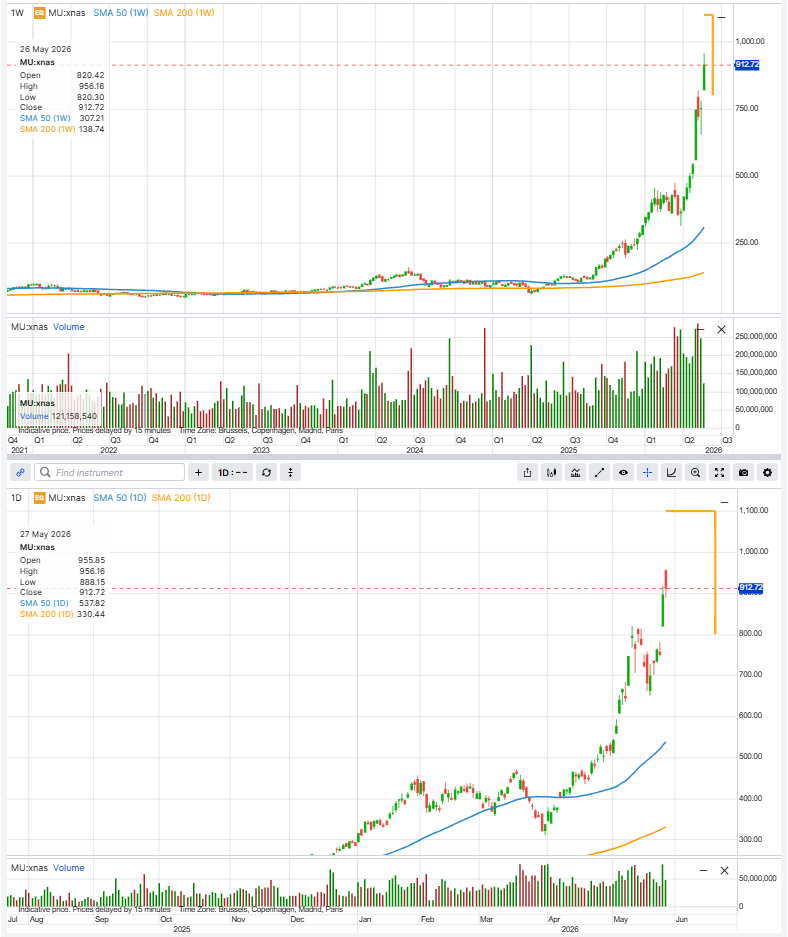
Micron’s recent rally has created a decision point for shareholders who may want to optimise yield without selling immediately. Source: SaxoTrader (snapshot 27 May 2026)
Why this setup may interest shareholders
A strong rally feels rewarding, but it can also make investors hesitate. Selling all shares may feel too final. Holding without a plan may feel careless after such a large move.
A covered call can sit between those choices. It lets the investor keep the shares for now, receive income upfront, and set a possible future sale price above the current market.
The key question is simple: would you be comfortable selling 100 Micron shares at USD 1,100 before earnings?
What is a covered call?
A covered call combines two parts: owning shares and selling a call option against those shares.
A call option gives the buyer the right to buy shares at a fixed price, called the strike price. When you sell the call, you receive a premium. In exchange, you may have to sell your shares at the strike price if the option is exercised.
The strategy is called “covered” because the investor already owns the shares that may need to be delivered. For US equity options, one standard contract usually covers 100 shares.
For a buy-and-hold investor, the simplest way to view a covered call is this: it is a planned sale price with income attached.
The Micron example
Using current option data, Micron is trading around USD 914.50. The investor owns 100 shares and sells one Micron call option with the following terms:
- Expiry: 18 June 2026
- Strike price: USD 1,100
- Premium received: about USD 37.40 per share
- Total premium: about USD 3,740 before costs and taxes
The USD 1,100 strike is well above the current share price. The investor is not selling today. They are agreeing to sell later, but only if Micron rises above the strike before the 18 June expiry.
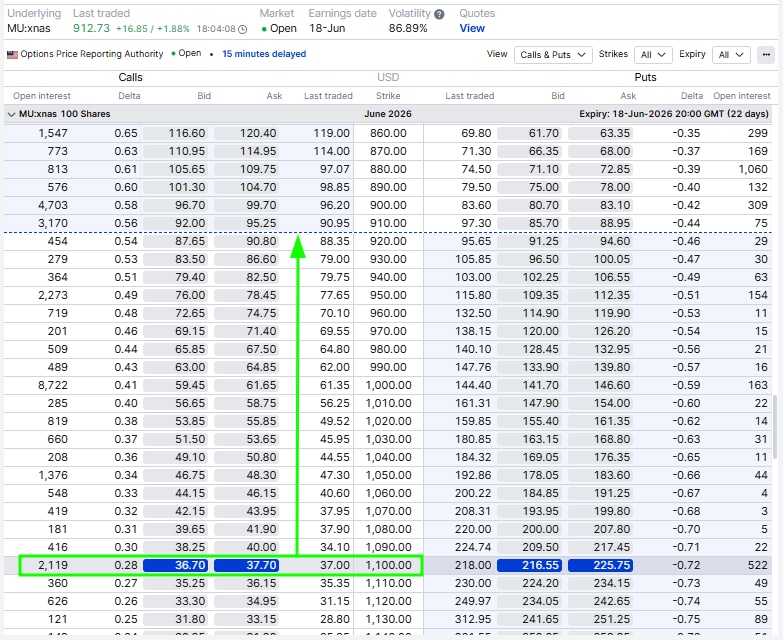
The 18 June 2026 USD 1,100 call shows a premium around USD 37.40 per share, or about USD 3,740 for 1 standard contract. Source: SaxoTrader (snapshot 27 May 2026)
Three possible outcomes
Micron stays below USD 1,100
If Micron remains below USD 1,100 at expiry, the call should expire worthless. The investor keeps the shares and keeps the premium. The income would be about USD 3,740 before costs and taxes. Compared with a 100-share position worth around USD 91,450, that equals roughly 4.1% of the share position value. The effective downside break-even shifts from USD 914.50 to about USD 877.10 – the current price minus the USD 37.40 premium received.
Micron rises above USD 1,100
If Micron trades above USD 1,100 at expiry, the shares may be called away. The investor may have to sell 100 shares at the strike price. The gain from USD 914.50 to USD 1,100 would be USD 185.50 per share, or USD 18,550 for 100 shares. Adding the USD 3,740 premium gives a total gain of about USD 22,290 before costs and taxes. The effective sale level is USD 1,137.40 – the USD 1,100 strike plus the USD 37.40 premium. If Micron rises far above USD 1,100, the covered call seller will not benefit from that extra upside.
Micron falls
If Micron falls, the premium provides a small cushion. The USD 37.40 premium lowers the effective holding cost from USD 914.50 to about USD 877.10. Below that level, the investor still has normal shareholder downside. A covered call is not strong downside protection – it is primarily an income strategy with a limited buffer. In the extreme case of the shares falling to zero, the loss measured from the current share price would be about USD 87,710 before costs and taxes: the USD 91,450 share position minus the USD 3,740 premium received.
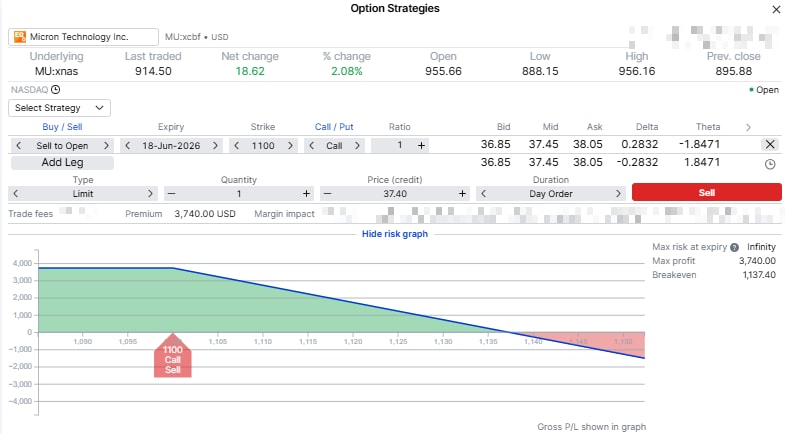
Covered call strategy ticket and risk graph] Caption: The covered call receives premium upfront, but the upside is capped if Micron rises above the strike price. Source: SaxoTrader (snapshot 27 May 2026)
Why not choose the expiry after earnings?
The 18 June expiry comes before Micron’s expected 24 June earnings date. That makes the timing important.
An option expiring after earnings may offer more premium. That can look tempting, especially after a big rally. But higher premium usually reflects higher expected risk. Earnings can trigger sharp price moves in either direction. For a first-time covered call seller, that can make the position harder to manage and the outcome less predictable.
This is why the expiry before earnings may be a cleaner choice for investors approaching covered calls for the first time. It allows the investor to generate income and set a possible exit level before the main event risk arrives.
When this may make sense
This covered call may fit an investor who already owns 100 Micron shares, has benefited from the rally, and would be comfortable selling at USD 1,100 before earnings.
It may not fit an investor who wants to hold Micron through earnings at all costs, or who would regret missing further upside above USD 1,100.
The strike should not be chosen because the premium looks attractive. It should be chosen because the sale price is acceptable.
The bottom line
A covered call can help Micron shareholders turn a strong rally into a more deliberate plan. It creates income today, sets a possible sale price above the current market, and avoids carrying the short call through the expected earnings release.
But it is not free money. The investor accepts capped upside, possible assignment, and continued downside exposure as a shareholder.
For long-term investors, that is the right way to think about it. A covered call is not about finding the perfect top. It is about deciding in advance what outcome you can live with.
This content is marketing material and should not be regarded as investment advice. Trading financial instruments carries risks and historic performance is not a guarantee of future results.
The Author is permitted to wait at least 24 hours from the time of the publication before they trade the instruments themselves.
The instrument(s) referenced in this content may be issued by a partner, from whom Saxo receives promotional fees, payment or retrocessions. While Saxo may receive compensation from these partnerships, all content is created with the aim of providing clients with valuable information and options.
This content will not be changed or subject to review after publication.
| Related articles/content |
|---|
| From shareholder to options user | 26 May 2026 Alphabet after earnings - how a covered call can help investors manage a strong rally | 30 Apr 2026 Tesla shares after earnings could a covered call make sense | 27 Apr 2026 A structured way to buy IWDA at a lower price using options | 20 Mar 2026 How to improve the yield on a long-term IWDA holdings | 12 Mar 2026 How to use a collar to protect stock gains - a Tesla case study | 20 Feb 2026 Palantir after earnings - using options to define a potential entry price | 4 Feb 2026 Golds pullback - thinking beyond buy or sell | 3 Feb 2026 Why options got so popular in recent years | 28 Jan 2026 Netflix earnings - using a cash-secured put to set a lower entry price | 16 Jan 2026 Micron covered call - harvesting extra income after a strong rally | 13 Jan 2026 |
| More from the author |
|---|