
Access all our platforms from a single account.

Asia Market Quick Take – October 24, 2025

Key points:
- Macro: Japan’s inflation rose 2.9% from August’s 10 month low of 2.7%
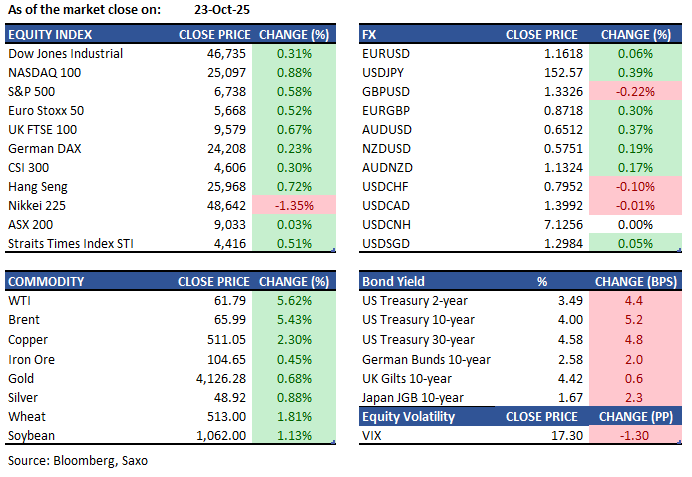
- Equities: US equities rebounded; Intel gained 7.7% after strong earnings
- FX: U.S.-China meeting boosts AUD and NZD, tensions escalate with Russia
- Commodities: Oil set for biggest weekly gain since June; gold to end nine‑week run
- Fixed income: US 10-year Treasury yield climbs back above 4%
------------------------------------------------------------------
Disclaimer: Past performance does not indicate future performance.
Macro:
- Japan's inflation rate increased to 2.9% in September 2025 from 2.7% in August, driven by higher electricity and gas prices. While price growth eased or stabilized across various sectors, education costs further decreased. Food prices rose 6.7%, slowing from 7.2%, with rice prices seeing the smallest yearly increase. Core inflation rose to 2.9%, aligning with expectations. BOJ's Hajime Takata renewed his call for an interest rate hike due to easing tariff concerns and progress toward the inflation target.
- US existing home sales rose 1.5% to 4.06 million in September 2025, driven by lower mortgage rates and better housing affordability. Single-family home sales increased by 1.7%, while condos and co-ops held at 370,000. Sales rose in the Northeast, South, and West but declined in the Midwest. Inventory rose 1.3% to 1.55 million units. The median home price increased by 2.1% to $415,200, marking the 27th consecutive month of price gains. Year-on-year, sales rose 4.1%.
- US existing home sales increased 1.5% to 4.06 million in September 2025, aided by lower mortgage rates. Single-family sales grew 1.7%, condos and co-ops stayed at 370,000. Sales rose in all regions except the Midwest. Inventory was up 1.3% to 1.55 million units. The median price increased 2.1% to $415,200, marking 27 months of gains, with a 4.1% annual sales increase.
Equities:
- US - The S&P 500 rose 0.6%, the Dow added 0.3%, and the Nasdaq gained 0.9%. Tech leaders Nvidia, Amazon, and Broadcom each advanced about 1%, while Oracle climbed 2.5%. Honeywell and American Airlines surged 6.8% and 7.2% on robust results. Tesla rose 1.7% after early losses, and energy stocks rallied as oil prices jumped on new U.S. sanctions against Russian producers. In the after hours, Intel gained 7.7% after beating Q3 expectations, reporting revenue of $13.65 billion and rebounding from last year’s $16.6 billion net loss. CEO Lip-Bu Tan’s cost-cutting efforts lifted gross margin to 40% vs 35.7% forecast and adjusted earnings came in at $0.23 per share, above the $0.01 forecast. Super Micro Computer fell 7% after cutting Q1 sales forecast, reducing it from $6-$7 bn to $5bn due to ‘design win upgrades’ that pushed some revenue to Q2.
- EU - European stocks advanced Thursday, with the STOXX 50 up 0.6% and STOXX 600 gaining 0.4%, supported by strong earnings and energy sector strength. Kering surged 8.7% on signs of recovery at Gucci, while Unilever rose 0.7% after reaffirming its 2025 outlook. Thales added 2.5% on target confirmation, and SAP climbed 2.2% despite mixed Q3 results. Energy majors BP, Repsol, and Eni gained 3% as oil prices jumped over 5% following new U.S. and EU sanctions on Russia. Roche slipped 2% on disappointing results, while Dassault Systèmes plunged over 20% after cutting its revenue growth outlook, making it the session’s worst performer.
- HK - Hong Kong stocks fell 0.7%, to 25,601 on Thursday morning, marking a second day of losses after Wall Street’s decline. Sentiment weakened as reports suggested the U.S. may impose broad export restrictions on China, following Beijing’s rare earth curbs. Investors also awaited Hong Kong’s September inflation data and a key communique from China’s fourth plenum, while caution persisted ahead of U.S. inflation figures and next week’s Fed meeting. Tech and consumer shares led declines, with Pop Mart (-5.2%), Mixue (-3%), and Kuaishou (-1.1%) among notable losers.
Earnings this week:
- Friday: Procter & Gamble, General Dynamics
FX:
- USD was stable as risk-on sentiment boosted Antipodean currencies and weakened the Yen. U.S. Treasury yields rose, shifting focus to Friday's U.S. CPI data. Escalating tensions between the U.S. and Russia were noted due to new sanctions amid a government shutdown.
- EUR remained steady around 1.1620, with ECB's Kazaks suggesting the next rate change could be a hike or cut, diverging from other ECB officials. Macron is urging the EU to act against China's trade practices as Eurozone consumer confidence beats forecasts.
- GBP dropped against the USD and EUR, burdened by weak CPI data, while BoE's Dhingra warned tariffs could slow growth. GBPUSD traded near 1.3330.
- JPY fell, affected by climbing U.S. Treasury yields despite early strength from wage hike reports in Japan. USDJPY trading above 152.50.
- ANZ and AUD rallied on U.S.-China meeting news, crucial for their trade ties with China.
- CAD remained flat despite crude gains; retail sales matched expectations, but core sales missed. PM Carney aims to meet Xi in Asia next week. USDCAD traded near 1.40.
Commodities:
- Oil headed for its biggest weekly advance since June after US sanctions on Rosneft and Lukoil upended the market, heightening supply risks and lifting demand for alternative grades. WTI traded near $62 after a 5.6% surge, while Brent hovered around $66. Russian flows to India are set to plunge; the impact on China is less certain.
- Gold looks set to snap a nine‑week winning streak after a sharp correction, as traders reassess an overheated rally. Bullion dipped towards $4,110 an ounce, putting it on course for a weekly decline of more than 3%. Investors are weighing improved US–China prospects, with the White House confirming President Donald Trump and Xi Jinping will meet next week to de‑escalate the trade war—any deal could ease geopolitical tensions and temper haven demand.
Fixed income:
- Treasury futures came under pressure early as US traders returned, weighed by an oil surge after US sanctions on Russia’s largest producers. Losses extended as equities built gains and after a 5‑year TIPS auction cleared with a tail of about 1bp. Australian bonds tracked Treasury losses ahead of a speech by Reserve Bank Governor Michele Bullock and a 2029 note auction.
For a global look at markets – go to Inspiration.
This content is marketing content and should not be considered investment advice. Trading financial instruments carries risks and historic performance is not a guarantee for future performance.
The instrument(s) mentioned in this content may be issued by a partner, from which Saxo receives promotion, payment or retrocessions. While Saxo receives compensation from these partnerships, all content is conducted with the intention of providing clients with valuable options and information.