
Access all our platforms from a single account.

Asia Market Quick Take – October 10, 2025

Key points:
- Macro: Japan’s PPI rises 2.7%, exceeding 2.5% forecasts
- Equities: PepsiCo and Delta Airlines rise after beating earnings
- FX: Euro hits two‑month low; USDJPY rises for a sixth straight day
- Commodities: Gold fell below $4,000; silver pulled back from $50, its highest since 1980
- Fixed income: The yield curve bear‑steepened modestly
------------------------------------------------------------------
Disclaimer: Past performance does not indicate future performance.
Macro:
- Japan’s producer prices rose 2.7% year-on-year in September 2025, matching August's pace but exceeding the forecast of 2.5%. Costs increased for most components while falling for chemicals, iron and steel, and petroleum. Month-on-month, producer prices increased by 0.3%, reversing August's 0.2% decline and topping the 0.1% forecast.
- ECB officials agreed the current policy supports the 2% inflation target. Views on inflation risks varied, but interest rates are seen as sufficient to handle potential shocks. The euro area economy is strong but faces growth risks, including geopolitical tensions. The ECB cut rates by 200 bps from June 2024 to June 2025, pausing after hitting the target. Rates are expected to remain steady, with possible tightening in late 2026.
Equities:
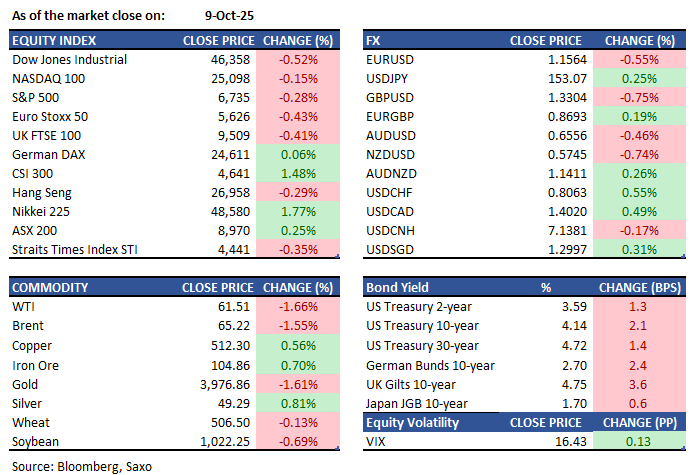
- US - Stocks fell Thursday as optimism surrounding AI, interest-rate cuts, and the ongoing government shutdown waned. The S&P 500 dropped 0.3%, Nasdaq 100 down 0.1%, and Dow Jones fell 243 points. The shutdown delayed key economic data, shifting focus to third-quarter earnings. Apple, Alphabet, Tesla, and Walmart lost over 0.7%, while PepsiCo rose 4.2% after strong earnings. Delta Air Lines jumped 4.3%, Nvidia gained 1.8%, and Costco climbed 3.1%. Investors anticipate 25-basis-point Federal Reserve rate cuts in October and December amid labor market concerns.
- EU - DAX advanced 0.5% on Thursday, setting a new record above 24,700, amid optimism for US rate cuts following the Fed's minutes despite weak trade data showing unexpected export and import declines in August. Traders monitored developments in France and Gaza. Heidelberg Materials led gains with nearly a 3% rise, and Bayer increased by 2.4% following positive Phase I Parkinson's therapy results. Auto stocks rebounded, with BMW up 1.7% after a profit warning dip, while Daimler Truck, Mercedes-Benz, Volkswagen, and Porsche Automobil gained between 0.8% and 1.2%.
- CH - The Shanghai Composite surged 1.32% to 3,934, reaching a decade high, while the Shenzhen Component gained 1.47% to 13,725 after the Golden Week holiday. Mining stocks rose amid Beijing's rare earth export controls, with Zijin Mining and China Northern Rare Earth up 10%. Tech stocks climbed on global AI momentum. Investors anticipate the Communist Party meeting and a possible Xi-Trump meeting at APEC.
- HK - Hang Seng fell 0.3% to 26,752, its fourth consecutive decline, as sectors weakened. Financials dropped post-HSBC's USD 13.6 billion buyout plan for Hang Seng Bank, with HSBC shares plunging 5.5%, while Hang Seng Bank soared 26%.Tech stocks declined due to China's expanded rare earth export controls, impacting tech and military applications. Consumer stocks also fell, led by pharma companies such as Sichuan Kelun-Biotech (-12.0%) and Innovent Biologics (-9.2%).
Earnings this week:
Asia
- Friday: Zhaojin Mining, Ryohin Keikaku, Tsuruha Holdings, Rorze, Bic Camera
Outside Asia
- Friday: Tryg, Atrium Ljungberg, Transcorp Power, Gerresheimer
FX:
- The euro slid to a two‑month low, with EURUSD down 0.7% to 1.1542, while yen selling persisted despite supportive remarks from Japan’s new LDP leader Sanae Takaichi; USDJPY rose 0.3% to 153.13 for a sixth straight day after a brief bounce when Takaichi said she isn’t in favour of an excessively weak currency. Takaichi has yet to secure a coalition deal with Komeito. In Europe, President Emmanuel Macron said he will name a new prime minister by Friday evening, avoiding a snap election for now.
- USDCAD broke above 1.40, up 0.6% to 1.4030, the strongest since 10 April.
- AUDUSD was little changed at 0.6556 after Thursday’s 0.5% slide, and NZDUSD steadied at 0.5747 after a 0.7% fall yesterday.
Commodities:
- Oil steadied near recent lows, holding the week’s biggest drop amid cautious optimism over easing Middle East tensions and supply. WTI traded below $62 after Thursday’s 1.7% fall, while Brent hovered near $65. Israel approved a framework for a peace deal including hostage and prisoner releases.
- Gold dipped back below $4,000 an ounce and silver retreated from its highest since 1980 as US equities softened and investors took profits. Overbought technicals left bullion vulnerable after a torrid four‑day surge. Platinum and palladium also fell.
Fixed income:
- Treasury yields edged higher ahead of the $22bn 30‑year reopening; the solid sale featured a record‑low dealer allotment but yields held near session highs into the close. SOFR options continued to target around 50bp of Fed cuts across upcoming meetings, while futures volumes stayed below average. The curve cheapened 1.5–3bp in a modest bear steepener, with the 10‑year ending near 4.145% and trading broadly in line with Bunds and Gilts.
For a global look at markets – go to Inspiration.
This content is marketing content and should not be considered investment advice. Trading financial instruments carries risks and historic performance is not a guarantee for future performance.
The instrument(s) mentioned in this content may be issued by a partner, from which Saxo receives promotion, payment or retrocessions. While Saxo receives compensation from these partnerships, all content is conducted with the intention of providing clients with valuable options and information.