Access all our platforms from a single account.

Asia Market Quick Take – 26 August, 2026
Key points:
- Macro: Iran and Oman discuss maritime joint corridor in SoH
- Equities: Stocks bounce as market awaits Nvidia earnings tonight
- FX: Dollar slips on softer yields; NZD, AUD outperform as USDJPY nears 160
- Commodities: Brent crude drops below $89, down ~4%, lowest in over a week
- Fixed income: Long end yield outperforms swaps, credited to the “Bessent Put”
------------------------------------------------------------------
Disclaimer: Past performance does not indicate future performance.
Macro:
- Iran and Oman are discussing a temporary joint maritime corridor in the Strait of Hormuz, with talks aimed at a permanent traffic and security framework. Pakistan’s army chief visited Tehran to support diplomacy, Qatar said its mediation continues, and oil prices eased as new U.S. measures on Iran were milder than expected, stopping short of secondary sanctions.
- Russian agency RIA reported that the US and Iran are close to a ceasefire deal that would include ensuring freedom of navigation in the Strait of Hormuz.
- The S&P CoreLogic Case‑Shiller 20-City Index rose 2.1% year-over-year in June 2026, the fastest since June 2025 and above the 1.7% forecast, but real prices fell for the 13th month as 3.5% inflation outpaced gains. Chicago (6.9%), New York (4.8%), and Cleveland (4.1%) led increases, while Seattle (-2.0%), Las Vegas (-1.9%), and Denver (-1.2%) declined.
- Germany’s economy grew 0.3% in Q2 2026, revised up from 0.2% but down from 0.4% in Q1. Exports rose 2.0%, outpacing 1.5% import growth, while domestic demand edged up 0.1% after a 0.3% fall. Investment stayed weak, with gross fixed capital formation down 0.2%, as machinery and equipment fell 1.4% and construction rose 0.1%. Year-on-year, GDP grew 1.0%, up from 0.7% in Q1.
- China’s budget spending rose 1.3% year-on-year to CNY 16.29 trillion in Jan–Jul 2026, with central outlays up 6.2% and local spending up 0.5%. Healthcare (+9.8%) and social security/employment (+7%) led increases, while energy/environment, agriculture, culture/tourism, transport, and urban/rural spending declined.
- Canada imposed 15%–50% tariffs on about $20 billion of U.S. imports after trade talks collapsed, while the U.S. plans 50% tariffs on Canadian autos, parts, and steel from January 1, 2027. Markets cut Bank of Canada rate-hike expectations despite higher energy prices.
Equities:
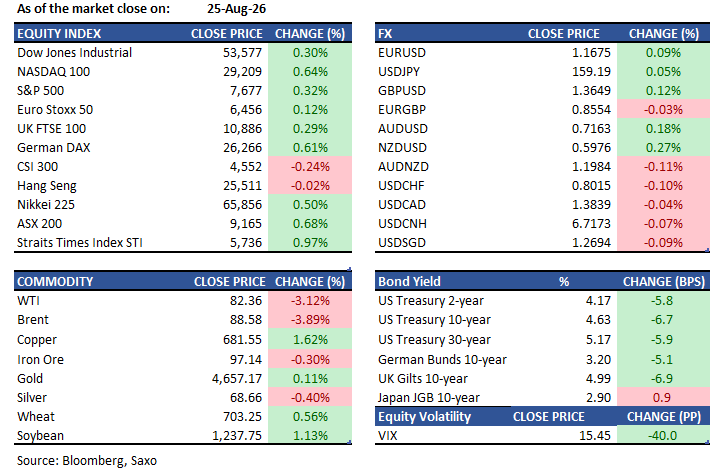
- US: US equities advanced as technology led and oil's decline eased inflation fears. S&P 500 rose 0.3% to 7,677.28, the Nasdaq 100 gained 0.6%, and the Dow Jones added 0.3% to 53,577.40. Nvidia surged 2.2%, snapping its longest losing streak since 2022. Moderna jumped 14.4%, the largest single-stock gain in the S&P 500. Crypto-linked names Robinhood and Coinbase also outperformed, gaining 8% and 4% respectively. Energy was the key laggard. In after-hours trading, Intuit fell ~10% after issuing a full-year earnings and revenue forecast well below consensus. Semtech surged ~3.3% after guiding Q3 EPS of $1.02–$1.08 versus the 73-cent estimate. Heico rose ~2.3% on a Q3 net sales beat.
- EU: European equities were broadly steady on Tuesday. The pound rose to the top of the G10 FX pile, with gilts slipping modestly. UK Prime Minister Andy Burnham's plans to devolve more government functions outside London are generating expectations of increased dealmaking activity in regional financial centres such as Manchester. Gold Fields outperformed on the Johannesburg bourse, rising as much as 1.6% after its interim dividend more than doubled to 16.25 rand per share versus 7.00 rand in the prior comparable period.
- Asia: Asian equities dipped on Tuesday, with the MSCI Asia Pacific gauge falling 0.4%, as investors cut technology exposure ahead of Nvidia's earnings. SK Hynix, Samsung Electronics, and Advantest were among the largest drags. The Kospi opened Wednesday down 0.2% at 6,727.25. Markets are set for a modest recovery this morning, buoyed by the sharp overnight decline in crude oil and a rebound in US chip stocks. Alibaba ADRs rose 1.5% after reports that founder Jack Ma purchased more than HK$600 million worth of the company's Hong Kong-listed shares. The Nasdaq Golden Dragon China Index rose 1.1% on Tuesday. Chinese stocks are approaching their worst relative performance versus the S&P 500 on record, weighed by the Xi tax clawback campaign. The Bank of Korea is expected to decide on a potential back-to-back rate hike on Thursday, with a slim majority of economists forecasting another increase. Taiwan's stock exchange announced tighter rules on settlement defaults. MSCI Asia Pacific futures point to a slightly positive open.
Earnings this week:
- Wednesday (26 Aug) — Nvidia, Salesforce, CrowdStrike, HP, Haidilao, Li Auto
- Thursday (27 Aug) — Marvell, IREN, Affirm
- Friday (28 Aug) — BYD, China Construction Bank, ICBC, Agricultural Bank of China, Bank of China
FX:
- USD weakened modestly on Tuesday, with the Bloomberg Dollar Spot Index down 0.1% to 1,192.82 as lower oil prices and falling US Treasury yields supported most G10 currencies.
- USDJPY stayed elevated at 159.19 after testing 159.49, keeping focus on the 160 line.
- AUD edged higher against most G10 crosses after RBA minutes from the Aug. 10–11 meeting showed the board discussed whether to raise or hold rates, ultimately deciding to wait for more data but pledging to hike again if needed. AUDUSD closed up 0.18% at 0.7163.
- EURUSD rose modestly to 1.1675 (+0.09%), supported by broad dollar softness but constrained by sharply higher European natural gas prices, which analysts see as a headwind to the EUR’s recent rally.
- GBPUSD climbed to 1.3649 (+0.12%), yet technicals now flag stretched overbought conditions and a potential near‑term pullback as daily momentum gauges, including slow stochastics, start to roll over.
- Markets now look to Fed Chair Warsh’s Jackson Hole speech for policy signals, even as EM FX continues to hold up despite higher US yields.
Commodities:
- Brent crude settled below $89 a barrel, down nearly 4% on the day and the lowest in over a week, as Iran-Oman diplomatic talks on an "interim framework" to reopen the Strait of Hormuz boosted de-escalation hopes. WTI settled just above $82 and extended declines in Asian hours to trade near $81/bbl. Brent has now fallen from a high of ~$95 last Friday, a decline of roughly $6 in two sessions.
- Gold traded around $4,660 an ounce, close to a three-month high struck in the prior session after briefly spiking to nearly $4,700 intraday on Tuesday. Gold has gained more than 7% over the past week, driven by the Treasury's expanded bond buyback programme reviving US fiscal concerns and dollar weakness.
- SHFE top-20 brokers boosted aggregate net-short copper positions to 22,752 contracts on Tuesday, the highest level in recent weeks, reflecting caution on the demand outlook.
Fixed income:
- Yields fell 5–7 basis points across the curve as crude oil's decline eased inflation concerns. The 10-year yield fell 6bps to 4.639% and the 30-year fell 5.8bps to 5.171%. The long end continued to outperform swaps, a dynamic attributed to the "Bessent Put" following the Treasury's 19 August expanded buyback announcement. The 30-year swap spread narrowed to its tightest since February.
- The US Treasury's 2-year note auction drew 4.204%, stopping through the 4.208% when-issued yield, indicating solid demand and helping anchor the front end. Traders also trimmed wagers on Fed rate hikes over the next year following the oil-driven inflation relief.
- Japan's upcoming bond auctions — a 10-year sale on 1 September and a 30-year on 3 September — are being watched closely as a potential source of global yield volatility. Poor demand at either auction could ricochet into US Treasuries, complicating Bessent's efforts to subdue long-end yields. JGB futures were down 11 ticks to 126.48 in overnight trading, with the benchmark 10-year JGB yield at 2.89%.
For a global look at markets – go to Inspiration.
This content is marketing content and should not be considered investment advice. Trading financial instruments carries risks and historic performance is not a guarantee for future performance.
The instrument(s) mentioned in this content may be issued by a partner, from which Saxo receives promotion, payment or retrocessions. While Saxo receives compensation from these partnerships, all content is conducted with the intention of providing clients with valuable options and information.