
Access all our platforms from a single account.

Asia Market Quick Take – 15 July, 2026

Key points:
- Macro: US inflation softens. Headline MoM –0.4% and Core at 0%
- Equities: Markets recovered on soft CPI print; IBM -25% after preliminary Q2 results
- FX: Soft CPI sank dollar; G10 and EM currencies broadly advanced on repricing
- Commodities: WTI extends rally to hit $80 while gold holds above $4,000
- Fixed income: July Fed hike premium all but eliminated as Treasuries surge
------------------------------------------------------------------
Disclaimer: Past performance does not indicate future performance.
Macro:
- US annual inflation fell to 3.5% in June 2026 from 4.2% in May, below the 3.8% forecast, as energy inflation eased sharply following a US–Iran ceasefire. Shelter and food inflation also ticked down. Month-over-month, CPI dropped 0.4%, the biggest fall since April 2020, driven by a 5.7% decline in energy and a 9.7% drop in gasoline. Core inflation fell to 2.6% from 2.9%, with core CPI flat on the month.
- Japan’s core machinery orders fell 12.4% m/m to JPY 962 billion in May 2026, the sharpest drop since December 2019 and far worse than the 4.2% decline expected. Both manufacturing and non-manufacturing orders slumped, with steep falls in shipbuilding, ICT electronics, real estate, and transport. Year-on-year, orders fell 1.5%, reversing April’s 15.6% surge and missing forecasts for a 12.9% rise.
- Fed Chair Warsh reaffirmed the Fed’s commitment to restoring price stability and ending the recent inflation surge. He said the economy is growing solidly, led by strong AI and data center investment, with moderate consumer spending, steady manufacturing, and a tight labor market featuring low unemployment and solid wage growth.
- Germany’s wholesale prices rose 4.9% year-on-year in June 2026, down from 5.9% in May but still supported by higher energy and raw material costs. Strong gains in mineral oil products and non-ferrous metals were partly offset by cheaper live animals, coffee/tea/cocoa/spices, and dairy/fats. Month-on-month, prices fell 0.7% after a 0.6% drop in May, against expectations for a 0.5% increase.
Equities:
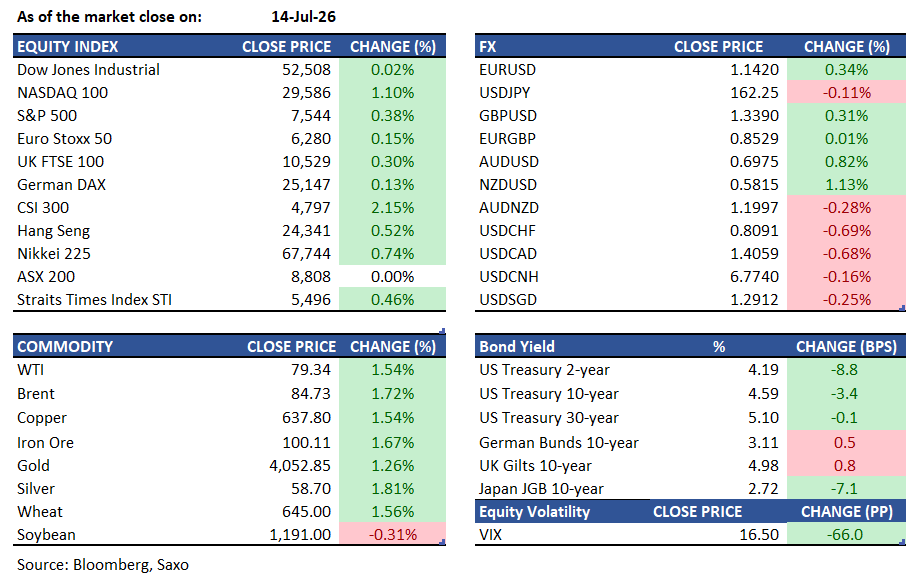
- US — The S&P 500 rose 0.4% to 7,543.59 on Tuesday and the Nasdaq 100 gained 1.1%, as the soft CPI print eased rate hike fears and chipmakers rallied. The Dow was little changed, weighed by IBM, which collapsed 25% — erasing $69 billion in market cap — after disappointing sales results. Goldman Sachs surged 9% after posting a record $7.2 billion stock-trading quarter. JPMorgan also reported a record profit. Nvidia led the S&P 500 higher, up 4.1%, while CrowdStrike jumped 12.1%. Apple fell ~1% after a KeyBanc downgrade to underweight on weak US device demand. Citigroup closed 5.3% lower. Lucid Group finished 16% lower, closing at a record low.
- EU — The Stoxx Europe 600 rose 0.2% to 642.10 on Tuesday, reversing an earlier decline of up to 0.9% after the US CPI surprise. The FTSE 100 gained 0.3% to 10,529.39, led by HSBC (+1.9%). The DAX edged up 0.1% to 25,147.03. The Euro Stoxx 50 closed 0.15% higher at 6,280.19. The SMI fell 0.2%, dragged by Novartis (-1.7%). Ericsson was the session's worst performer, plunging ~13% after warning of margin pressure at its main business. European software names including SAP, Dassault Systèmes and Capgemini also fell on read-across from IBM's results. ASML led the Stoxx 600 advance, rising 1.0%.
- Asia — Asian markets closed mixed on Tuesday following two days of sharp volatility. The Nikkei 225 finished up 0.7% after reversing early losses, supported by a tech rebound. The Kospi recovered 0.7% on Tuesday after Monday's near-9% plunge — the worst session in years — triggered by a leveraged unwind in SK Hynix and Korean memory chip names. As of Wednesday's open, the Kospi surged 3.3%–6.4% on the back of the softer dollar and positive US leads, with SK Hynix ADRs pointing to a strong recovery. The Hang Seng retreated during Tuesday's session amid US-Iran tensions, though China and HK indexes partially recovered. The STI closed up 0.5% at 5,495.61 on Tuesday, shrugging off the Hormuz escalation. Samsung was a notable mover, with reports of early discussions for a potential US share sale. Asian stocks broadly are set to extend gains Wednesday, supported by a weaker dollar and chip rally.
Earnings this week:
- Wednesday: Morgan Stanley; United Airlines; BlackRock, ASML
- Thursday: Netflix; GE Aerospace; Alcoa
FX:
- USD slid sharply after a softer-than-expected June CPI, with the DXY around 100.9, unwinding pre-data gains that had been driven by Hormuz tensions and Fed hike fears.
- EURUSD and GBPUSD edged higher on broad dollar weakness. EURUSD climbed modestly to 1.1430 from 1.1420 as the softer CPI data unwound previously bearish positioning, with earlier one-week risk reversals heavily skewed to puts now being reversed. EURCHF maintained a bullish technical bias above a key downtrend.
- USDJPY fell to 162.15 but underperformed other G10 moves given conflicting forces of higher JGB yields and strong carry.
- NZDUSD outperformed, climbing to ~0.5764 on firmer RBNZ hike expectations. AUDUSD lagged, staying range-bound near 0.6980 despite a mild post-CPI lift.
- USDCNH was steady despite views that the yuan is notably undervalued versus the EUR.
- USDKRW hitting a two‑month low near 1,486.20 on expectations of SK Hynix ADR-related dollar inflows and news that Korea will relax FX rules in H2 2026 to internationalize the won; the pair was steady around 1,489.85.
Commodities:
- Oil — sharp spike on Hormuz escalation: Brent crude surged more than 5% on Tuesday to as high as $87/barrel, extending Monday's near-10% jump, as the US-Iran truce collapsed and fresh tanker attacks in the Strait of Hormuz threatened supply flows. WTI traded around $79–$80/barrel. Oil prices have risen approximately 13% over the past two sessions on the escalation, though they remain below wartime peaks. Trump subsequently dropped the 20% Hormuz transit levy plan, providing some relief.
- Gold — rebounds from eight-month lows: Comex gold settled 1.6% higher at $4,061/oz on Tuesday, snapping a two-session losing streak. Bullion had fallen to an eight-month low near $4,000/oz on Monday as rising rate hike expectations and oil-driven inflation fears pressured the metal. The soft CPI print restored safe-haven and rate-sensitive demand, with gold rising as much as 2.5% intraday before paring gains after Warsh's cautious remarks.
- Copper and base metals: Base metals broadly gained on Tuesday, supported by the weaker dollar and easing rate hike fears. The materials sector was among the top performers in both the S&P/TSX and European indices. Structural supply concerns for copper persist, with mining financiers flagging a severe long-term supply shortage against surging AI and electrification demand.
Fixed income:
- Treasuries rally on CPI surprise: The US Treasury yield curve shifted materially lower on Tuesday following the soft CPI print. The 2-year yield fell as much as 14bps to 4.14% — its largest single-day decline since February — before ending the session richer by around 8bps. The 10-year yield fell 5bps to 4.575% and the 30-year fell 2.4bps to 5.083%. The move was a bull steepener, with the 5s30s spread widening to 77.3bps from 73bps.
- July Fed hike premium all but eliminated: Prior to the CPI release, markets had priced approximately 50% odds of a July rate hike following hawkish commentary from Fed Governor Waller. Post-CPI, July hike pricing collapsed to just 4–5bps. One-year inflation swaps fell 22bps to 1.97%, the first time below 2% since Q3 2024.
- Japan repatriation risk for Treasuries: Japanese government bond yields have risen to multi-decade highs, prompting growing concern that Japan — the largest foreign holder of US Treasuries — will reduce overseas bond allocations in favour of domestic JGBs. Analysis suggests a $100 billion reduction in Japanese Treasury holdings could exert sustained upward pressure on US yields, representing a structural headwind for the long end.
For a global look at markets – go to Inspiration.
This content is marketing content and should not be considered investment advice. Trading financial instruments carries risks and historic performance is not a guarantee for future performance.
The instrument(s) mentioned in this content may be issued by a partner, from which Saxo receives promotion, payment or retrocessions. While Saxo receives compensation from these partnerships, all content is conducted with the intention of providing clients with valuable options and information.