
Access all our platforms from a single account.

Asia Market Quick Take – 13 August, 2026

Key points:
- Macro: Headline and Core CPI matches forecasts. SoH remains closed.
- Equities: S&P 500 +0.3% while Dow -0.1%; Cerebras -16% after missing estimates
- FX: Dollar edges higher after in-line CPI; yen approaches 160, Swiss franc lags.
- Commodities: Brent settles at $88.98, up six straight sessions; gold holds above $4,400
- Fixed income: Yield curve bull steepened widening 5s30s spread to 88bps
------------------------------------------------------------------
Disclaimer: Past performance does not indicate future performance.
Macro:
- US inflation slowed to 3.4% y/y in July from 3.5%, as energy pressures eased. Headline CPI rose 0.1% m/m, with shelter and food both up 0.1%, while core CPI increased 0.2% m/m and 2.5% y/y (from 2.6%).
- Japan’s producer prices rose 7.2% y/y in July, slightly below 7.3% in June and 7.4% expected. On the month, prices edged up 0.1% after a revised 0.5% gain, the weakest increase in five months.
- Germany’s inflation accelerated to 2.8% y/y in July from 2.3%, driven by an 8.3% jump in energy and higher motor fuel costs after tax relief ended. Services inflation eased to 2.9%, food stayed at 0.4%, core dipped to 2.4%, and CPI rose 0.8% m/m; EU‑harmonized inflation also reached 2.8%.
- Japan’s producer prices rose 7.2% y/y in July 2026, slightly below June’s revised 7.3% and the 7.4% consensus, indicating softer‑than‑expected cost pressures. On the month, prices rose 0.1% after a 0.5% gain, the weakest increase in five months.
Equities:
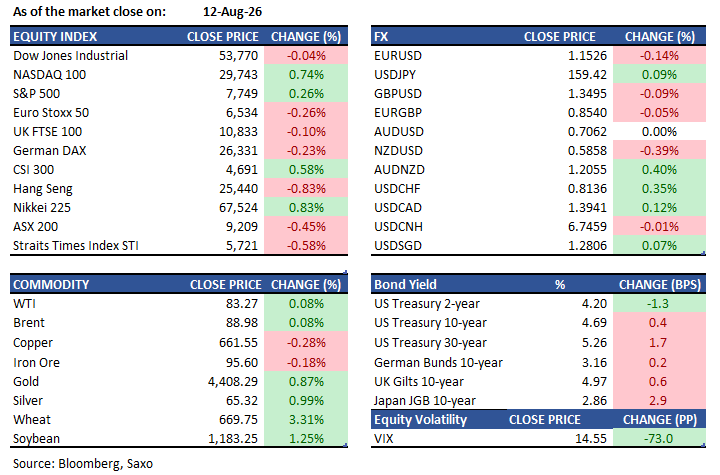
- US — US equities closed mostly higher on Wednesday as the in-line CPI print eased rate-hike fears and AI earnings momentum lifted sentiment. S&P 500 rose 0.3% to 7,748.50, the Nasdaq Composite gained 0.5% to 26,588.49, and the Dow slipped 0.04% to 53,770.27. The Nasdaq 100 reached a one-month high, driven by megacap chipmakers. The VIX fell to 14.5, its lowest since January 9. CoreWeave surged 19.2% after reporting Q2 revenue of $2.58 billion, beating estimates, with a $104 billion sales backlog while Lumentum rallied 13.6% after beating earnings. After hours, Coherent slid as much as 8% as its Q1 guidance disappointed despite a Q4 beat, while EquipmentShare gained 5.1% on a strong earnings beat. Cerebras Systems fell 16% after missing revenue (180m vs 194m est) and earnings (loss of 5 cents vs 17 cents est) estimates.
- EU — European equities edged lower on Wednesday as renewed Middle East tensions overshadowed the benign US inflation backdrop. The Stoxx Europe 600 fell 0.2% to 659.48, snapping a seven-day winning streak. The DAX dropped 0.2% to 26,331.07, the CAC 40 fell 0.5% to 8,674.94, the FTSE 100 declined 0.1% to 10,833.15, and the SMI lost 0.9% to 14,449.47. SAP fell 2.6% and Prosus dropped 5.9%, the largest declines in the Stoxx 600. On the upside, ABN Amro surged as much as 6.3% to a record high after a broad Q2 beat and guidance raise. Vestas jumped ~19.7% after raising its full-year adjusted EBIT margin guidance to 7%–9% from 6%–8%.
- Asia — Asian markets were broadly higher on Wednesday, led by a sharp rally in semiconductor names. The Kospi surged approximately 3% (Kospi 200 futures closed up 3.3%), driven by a surge in Samsung Electronics and SK Hynix on renewed AI optimism following strong neocloud earnings. Nikkei futures advanced in after-hours trade, tracking US gains. Hang Seng saw pressure from hedge funds cutting China stock exposure to a five-year low, with Goldman Sachs data showing net China allocation fell to 6% in July. The Nasdaq Golden Dragon China Index fell 2.4% on Wednesday. Tencent reported revenue of 204.78b yuan, beating estimates as their domestic games revenue grew 17% but net profit came in at 56b yuan, missing expectations as they continue to spend on compute, with capex rising 65% from last quarter. Galaxy Entertainment reported 1H revenue of HK$24.23 billion, slightly below estimates. Asian equity futures are pointing to further gains on Thursday following the benign US CPI print.
Earnings this week:
- Thursday: Applied Materials; JD.com
- Friday: Kweichow Moutai
FX:
- USD ended Wednesday firmer, with DXY up 0.19% to 100.01 after an initial post-CPI dip was fully reversed as the in-line July core CPI print (0.2% m/m, 2.5% y/y) failed to materially alter Fed hike expectations.
- USDCHF saw the largest G10 move, with the franc weakening 0.35% against the dollar — the biggest USD gain in the set.
- USDJPY edged closer to the psychologically significant 160 level, closing at 159.42. The yen has depreciated more than 1% in August, unwinding some of the late-July US-Japan coordinated intervention. Traders remain on intervention watch.
- EURUSD and GBPUSD both briefly rallied on the CPI release before reversing, ending modestly lower. Rate expectations — with the Fed still seen as more hawkish relative to peers — continued to support the dollar.
- USDCNH was essentially flat at 6.7459. The PBOC set its fixing at 6.7882, stronger for a second consecutive session. Bloomberg Economics noted that the late-July US-Japan yen intervention has spilled over, putting additional appreciation pressure on the yuan.
Commodities:
- WTI settled at $83.27 a barrel, little changed on the day, after surging approximately 11% over the prior five sessions on Hormuz supply fears. Brent settled at $88.98, up for six consecutive sessions. A massive EIA crude inventory build of 17.4 million barrels — the largest weekly move since January 2023 — was largely absorbed by the market, with analysts viewing it as an import-export dislocation rather than a demand deterioration.
- Comex front-month gold settled up 0.59% at $4,408.90 per ounce — the highest settlement since June 4 — after the in-line CPI data eased rate-hike fears. Bullion rallied as much as 1.6% intraday to above $4,440. Gold steadied near $4,400 in early Thursday trading. Gold ETFs added holdings for a fifth straight day.
- Silver settled up 1.2% at $65.555 per troy ounce, up in eight of the past eleven sessions.
Fixed income:
- The Treasury sold $42 billion of 10-year notes at a yield of 4.683% — the highest auction yield since 2007 — stopping through the when-issued yield by just 0.1bp, a sign demand fell slightly short of expectations. The Treasury is scheduled to sell $25 billion of 30-year bonds on Thursday.
- The short end outperformed following the CPI print. The 1-year yield fell 3.3bps to 3.999%, the 10-year fell 1.1bps to 4.682%, and the 30-year was little changed at 5.247%. The 5s30s spread widened to 88bps from 85.4bps, continuing the bull-steepener tone. Japanese government bonds are expected to rise, tracking moves in US peers, though the 5-year JGB yield hit 2.12% — its highest level since its debut — and the 2-year rate climbed to its peak since 1995 on Wednesday, weighed by yen weakness and BOJ hike expectations.
- US junk bond yields and risk premiums rose for a second session on Wednesday as elevated oil prices stoked inflation fears, with CCCs the worst-performing tier.
For a global look at markets – go to Inspiration.
This content is marketing content and should not be considered investment advice. Trading financial instruments carries risks and historic performance is not a guarantee for future performance.
The instrument(s) mentioned in this content may be issued by a partner, from which Saxo receives promotion, payment or retrocessions. While Saxo receives compensation from these partnerships, all content is conducted with the intention of providing clients with valuable options and information.