
Access all our platforms from a single account.

Asia Market Quick Take – 14 September 2026

Key points:
- Macro: Saudi closes east-west pipeline. Core CPI above expectations.
- Equities: Stocks up despite hotter core CPI; SpaceX weight in Nasdaq 100 doubles
- FX: JPY firm on BOJ hike bets; BOJ and FOMC decisions this week
- Commodities: Brent surges to $108 on Middle East supply shock
- Fixed income: 10-year Treasury nears 5% and the yield curve flattens
------------------------------------------------------------------
Disclaimer: Past performance does not indicate future performance.
Macro:
- Saudi Arabia shut its East–West crude pipeline after drone attacks, halting a key route that bypasses the Strait of Hormuz and with no restart date set, underscoring the line’s importance amid US–Iran tensions. Talks on a temporary Hormuz shipping corridor were postponed amid Saudi concerns, and Bahrain said it would not join.
- Iran had planned to unveil a temporary Hormuz shipping lane deal on Monday, but Oman postponed the Persian Gulf foreign ministers’ meeting indefinitely.
- New Zealand’s PSI rose to 51.2 in August 2026 from 50.6, its strongest and third straight month of expansion since December 2025, with new orders and stocks growing but deliveries, employment, and activity/sales still contracting.
- The University of Michigan’s consumer sentiment index fell to 47.8 in early September 2026, its weakest since May and below the 51.0 forecast. Sentiment is now 16% below pre‑Iran‑war levels and 13% below a year ago, with one‑year inflation expectations up to 4.6% and five‑year to 3.4%.
- US inflation stayed at 3.4% y/y in August 2026, unchanged from July and in line with forecasts, as gasoline and fuel oil surged while shelter and food inflation eased. Headline CPI rose 0.4% m/m, led by a 3.9% jump in gasoline. Core CPI rose 0.3% m/m, above expectations, driven by higher communication, airfares, education, used cars, and lodging, partly offset by lower medical care and auto insurance. Core inflation eased to 2.4% y/y, the lowest since March 2021.
Equities:
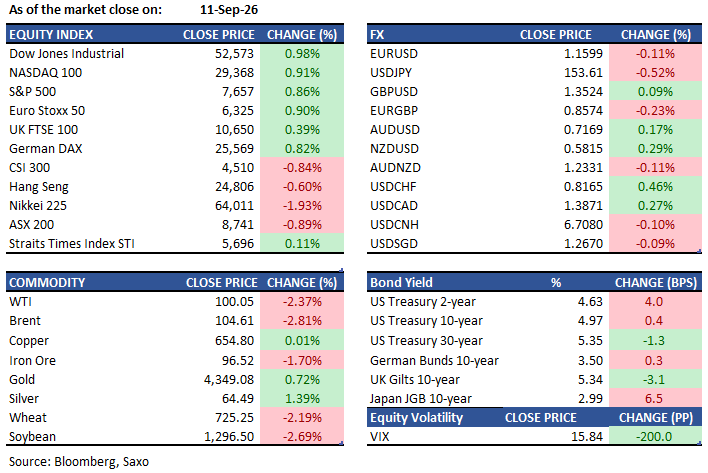
- US — US equities closed higher on Friday (12 Sep), with the S&P 500 ending the week at 7,657 and the Nasdaq 100 at 29,368, as the CPI print provided clarity on the Fed's path despite signalling higher rates. S&P 500 had fallen for four consecutive sessions prior to Friday's rebound, with energy the only sector reliably in the green during the week. Heading into Monday's open, S&P 500 futures are down ~0.6% and Nasdaq 100 futures are sliding over 1%, driven by the AI slowdown call and further oil gains. Notable movers: SpaceX is set for a weighting boost in the Nasdaq 100 to ~2.82% from ~1.28% after a quarterly rebalance. Corning (GLW) fell ~3% post-market after filing a $2 billion equity distribution agreement with Goldman Sachs. Boeing (BA) made a final contract offer to its engineers union SPEEA including a 10% guaranteed wage increase.
- EU — The Stoxx Europe 600 fell 1.7% last week (ending 12 Sep), its worst weekly performance in roughly two months, as Brent crude breaking above $100/bbl reignited inflation concerns and rate-hike bets. On Friday (11 Sep), the index recovered 0.5%, led by banks, with Siemens (+2.5%) the top contributor. The DAX rose 0.8% on Friday to 25,569, with Infineon (+5.0%) the standout. Barclays strategists flagged building stagflation risk for European equities, recommending reduced exposure to gas-sensitive industries. Novartis suffered its worst day on record earlier in the week, falling as much as 11% after a late-stage clinical trial failure.
- Asia — Asian equities are under pressure at Monday's open, with the MSCI Asia Pacific Index declining ~0.5%, as the AI slowdown call and surging oil prices weigh on sentiment. The Kospi is the notable underperformer, falling 3.0% to 6,702, with SK Hynix and other AI hardware names hit hard; South Korea also launched extended evening trading hours today through 8pm local time. The Nikkei 225 (64,011) and Hang Seng (24,806) are yet to open as of the time of writing, but both face headwinds from Nasdaq futures sliding over 1%. Oracle Chairman Larry Ellison's cancellation of a $7.5 billion stock sale is also adding to negative sentiment across the region's AI-linked names. Apple supplier stocks in Korea and Japan are being watched following Apple's launch of the foldable iPhone Duo and iPhone 18 Pro last week.
Events this week:
- Tuesday: Trip.com
- Wednesday: FOMC rate decision
- Thursday: BOE rate decision
- Friday: BOJ rate decision
FX:
- AUD is the session's laggard, slipping 0.29% vs. USD and 0.37% vs. JPY. Risk sentiment has soured on AI-related concerns — calls from leading AI executives over the weekend for a slowdown in frontier model development have weighed on risk assets broadly, with US equity futures also lower.
- USDJPY is slightly softer at 153.49. A BOJ rate hike this week is widely expected given recent policy messaging, keeping the yen bid. Traders are also watching the Fed decision on Wednesday.
- USD was little changed through last week even after a hotter-than-expected US core CPI print, which has bolstered the case for a Fed rate hike. Bond markets are reportedly fully pricing in two rate increases by year-end. The DXY is modestly firmer this morning at 99.18, up +0.06% on the day.
- GBP is nearly flat vs. USD but faces headwinds — the Bank of England is seen as potentially falling behind the curve on inflation, particularly given rising energy prices from Middle East tensions. A BOE decision is also due this week.
Commodities:
- Brent crude trades at $107.80/bbl (+3.1% today), while WTI is at $102.80/bbl (+2.7% today). Saudi Arabia's closure of the East-West pipeline following drone attacks, combined with the postponement of Iran-Gulf talks on Hormuz access, has driven the latest leg higher. Veteran commodities strategist Jeff Currie has warned of an "extremely high" risk of US gasoline prices hitting $5/gallon before the midterm elections.
- Gold hovers around its 100-day moving average, easing after hotter-than-expected US inflation lifted odds of a Fed hike; bullion traded near $4,340 after a third weekly drop, core CPI rose 0.3% in August, and despite ending Friday higher it was still down 1.8% for the week.
Fixed income:
- The US 10-year yield stands at 4.951%, just shy of the psychologically important 5% level last seen in October 2023. The move has been driven by oil-led inflation fears, a hotter-than-expected core CPI print, and rising term premium.
- The 2-year yield is at 4.609%, reflecting near-fully priced Fed hike expectations, while the 30-year yield sits at 5.341% — levels last seen in 2007. The curve has been flattening on the front end post-CPI, with the 2s10s spread compressing as markets price in a credible Fed response to inflation rather than the start of a prolonged tightening cycle.
- UK gilts have been among the most volatile in the global bond selloff, with 10-year gilt yields hitting 5.25% and 30-year yields reaching 5.89% — the highest since May 1998 — as traders price in multiple Bank of England rate hikes.
For a global look at markets – go to Inspiration.
This content is marketing content and should not be considered investment advice. Trading financial instruments carries risks and historic performance is not a guarantee for future performance.
The instrument(s) mentioned in this content may be issued by a partner, from which Saxo receives promotion, payment or retrocessions. While Saxo receives compensation from these partnerships, all content is conducted with the intention of providing clients with valuable options and information.