
Access all our platforms from a single account.

Asia Market Quick Take – 10 September 2026

Key points:
- Macro: Iran threatens escalations; Trump expects conflict beyond mid-term elections
- Equities: Meta jumps 6.5% on Muse AI launch; Apple dips after unveiling foldable iPhone
- FX: Dollar softens; JPY leads G10 on Bessent remarks; SGD hits 10‑month MYR high
- Commodities: Brent topped $101 (first since July); WTI up 8th consecutive day
- Fixed income: US 10-year Treasury yield hits 4.85%, highest since 2023
------------------------------------------------------------------
Disclaimer: Past performance does not indicate future performance.
Macro:
- Rising US–Iran tensions are heightening fears of Middle East energy supply disruptions. Iran has threatened escalation if US strikes continue, while President Trump expects the conflict—and high gasoline prices—to persist beyond the November midterms. The confrontation widened after Iran‑backed Houthi attacks on Saudi energy facilities forced temporary shutdowns.
- ADP weekly payrolls soft: US private payrolls rose an average of 12,000 per week in the four weeks ending 22 August, according to ADP and the Stanford Digital Economy Lab. The prior monthly estimate for August had already come in at a weak +38,000.
- Mortgage rates at a 13-month high: The 30-year fixed mortgage rate rose 6bps to 6.85% in the week ended 4 September, the highest in over a year. MBA mortgage applications fell 2.7% week-on-week, with refinancings down 6.2%.
- Treasury buyback disappoints: The US Treasury announced it will purchase up to $6 billion of longer-dated debt (10–20 year) — triple the initially communicated $2 billion — but markets had expected a larger operation. Yields rose on the announcement, with the 10-year hitting its highest level since 2023.
Equities:
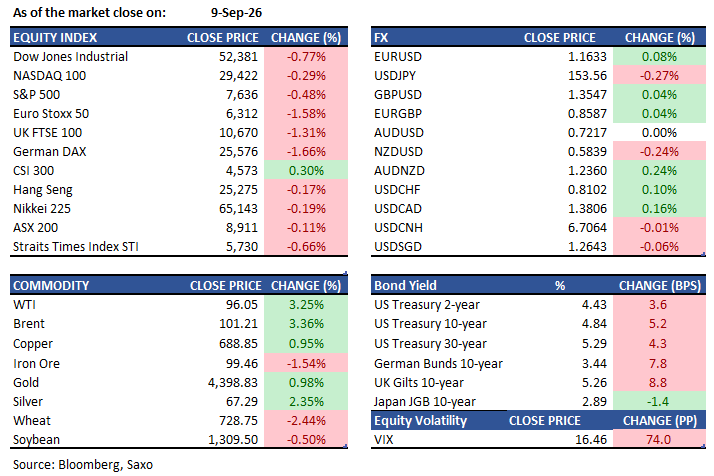
- US — S&P 500 fell 0.5% on Wednesday to 7,636.36, its third consecutive session of losses and the lowest close since 1 September. Nasdaq 100 dropped 0.3% and the Dow Jones Industrial Average lost approximately 350 points. Industrials and consumer discretionary were the worst-performing sectors. Among the Mag Seven, Alphabet fell 2.1%, Amazon -1.8%, Nvidia -0.9% while Meta surged +6.5% after debuting its Muse AI assistant. Apple unveiled its first foldable iPhone Duo in its Apple event yesterday, with the stock closing 1.2% lower. After hours, AeroVironment jumped ~7% after a strong Q1 beat, while Cooper Cos tumbled ~15% after slashing full-year guidance. American Eagle fell ~9% after comparable sales missed estimates. Index ETF futures are broadly flat in early Asia trade (SPY +0.1%, QQQ -0.03%).
- EU — European equities fell sharply on Wednesday, with the Stoxx 600 dropping 1.4% to 640.41 — its biggest single-day decline since 8 July. The DAX fell 1.7% to 25,576.45, the FTSE 100 lost 1.3% to 10,670.06 (its fourth consecutive down day), and the CAC 40 declined. Industrials and consumer discretionary led losses across the region. Notable movers included Inditex (-3.6%) after first-half earnings missed expectations, Rheinmetall (-3.8%), ASML (-1.3%), and Autotrader Group (-4.7%). Energy names were the lone bright spot. Traders are now pricing approximately 90bps of ECB rate hikes by December 2027.
- Asia — Asian markets are opening lower on Thursday, tracking Wall Street's third consecutive decline as surging oil prices and elevated Treasury yields stoke inflation fears ahead of Friday's US CPI. Equity futures for Japan, South Korea and Australia all pointed lower at the open. The Kospi opened 0.2% lower at 7,038.85, though it may outperform peers as overnight strength in US memory names — Samsung and SK Hynix were gaining in pre-market — provides some support. The Hang Seng closed Wednesday at 25,274.96, down 0.2%, with the Hang Seng China Enterprise Index off 0.3%; mainland investors were net buyers of HK$3.72 billion via Stock Connect for a third consecutive session. A notable mover in Hong Kong on Wednesday was Excelland Robotics, which opened 142% higher in its trading debut, while Haidilao fell after a major shareholder stake sale. Apple unveiled its first foldable iPhone (iPhone Duo) alongside the iPhone 18 Pro, which may lift Asian Apple supplier stocks at the open.
Earnings this week:
- Thursday: Adobe, Oracle
FX:
- USD fell for a third straight session to its lowest since February 17, while the DXY dipped 0.02% to 98.795, reflecting broad but modest dollar softness.
- The yen was the clear G10 outperformer: USDJPY slid to 153.52 (‑0.03%), after US Treasury Secretary Scott Bessent’s aggressive verbal support for the yen and claim of “asymmetric information” on BOJ moves emboldened JPY bulls and helped drive hedge‑fund positioning for a break below 150 by year‑end, with some options targeting 140.
- AUDUSD led gains at 0.7222, with EURUSD and GBPUSD both edging up to 1.1634 and 1.3549, while USDCNY was essentially unchanged at 6.7084 as the PBOC marginally firmed its daily fixing to 6.7769.
- SGD hit a 10-month high against the Malaysian ringgit at RM3.2207, as rising US Treasury yields and risk-off sentiment drove regional investors toward the SGD as a safe haven.
Commodities:
- Brent crude topped $101/bbl for the first time since July, settling more than 3% higher on Wednesday. WTI extended its rally to an eighth consecutive session, trading near $97/bbl. The move is driven by escalating US-Iran conflict, with US forces striking Iranian tankers near Kharg Island and Iran warning of further retaliation. European natural gas prices also hit a three-year high on the back of the energy supply disruption fears. China is reportedly picking up crude purchases this month after a buying hiatus.
- Copper hit a record high above $14,600/tonne on the LME earlier this week (currently $14,767.50), up 17% year-to-date. The rally is underpinned by anticipated US tariffs on refined metal imports, alongside structural demand from AI data centre buildout and the energy transition. Asian copper-related equities gained on the move.
- Gold is trading at $4,390.63/oz, marginally lower on the day (-0.2%), having recovered from a 2.6% three-day decline earlier this week. A weaker dollar is providing support, partially offsetting headwinds from rising real yields and elevated rate-hike expectations. Major money managers including Amundi are reportedly rebuilding gold positions, with a $5,000/oz year-end target cited.
Fixed income:
- US 10-year yield hit its highest level since 2023, closing Wednesday at approximately 4.83–4.85%, up ~5–6bps on the day. The move was driven by the combination of surging oil prices, a wave of corporate bond issuance (Tuesday's corporate supply topped nearly $40 billion), and disappointment over the Treasury's $6 billion buyback announcement. The 2-year yield rose to 4.42%, the highest since January 2025, as markets priced in a greater probability of a Fed rate hike. The 30-year yield stands at 5.29%.
- The $39 billion 10-year note auction drew solid demand despite pricing at 4.834% — the highest yield at a 10-year auction since August 2007. The auction stopped through the 4.849% when-issued yield at the deadline, with a bid-to-cover ratio of 2.71x, above the recent average.
- The US-China 10-year yield gap widened to a record 317bps, with US 10-year yields at ~4.85% versus Chinese 10-year yields holding steady at 1.68%. The record spread raises the risk of accelerated capital outflows from China and potential yuan pressure. Separately, JGB curve steepness continues to lead global duration repricing, with the JGB 2s10s spread at approximately 105bps — substantially steeper than most major peers — as fiscal and term-premium dynamics become increasingly important.
For a global look at markets – go to Inspiration.
This content is marketing content and should not be considered investment advice. Trading financial instruments carries risks and historic performance is not a guarantee for future performance.
The instrument(s) mentioned in this content may be issued by a partner, from which Saxo receives promotion, payment or retrocessions. While Saxo receives compensation from these partnerships, all content is conducted with the intention of providing clients with valuable options and information.