
Access all our platforms from a single account.

Asia Market Quick Take – 09 September 2026
Asia Market Quick Take – 9 September, 2026
Key points:
- Macro: US strikes Iran tankers near Kharg, triggering retaliations from Iran
- Equities: Stocks fell for 2nd consecutive day; Optical stocks outperformed
- FX: Yen strength drives further USD softness as markets await US CPI
- Commodities: Brent nears $100 and LME copper hits record high
- Fixed income: US Treasuries bear flattening, buyback in focus
------------------------------------------------------------------
Disclaimer: Past performance does not indicate future performance.
Macro:
- The US struck Iranian tankers near Kharg Island, triggering Iranian missile launches toward Jordan and warnings to tankers near Kuwait and Bahrain. Iran-backed Houthis hit Saudi energy facilities, and with Hormuz disrupted plus strong Chinese demand, refiners are bidding up African, Canadian and Latin American crude.
- Japan’s Reuters Tankan manufacturing index rose to +21 in September 2026, the highest since December 2021, driven by strong semiconductor and data center demand. Electronics jumped to +39, textiles and paper to +13, while steel and nonferrous stayed at -13. Non-manufacturers’ sentiment edged up to +29 on solid domestic consumption, with both manufacturers and non-manufacturers expecting +27 in three months.
- US one-year inflation expectations stayed at 3.6% in August 2026, while gas, food, medical care, college costs and rent expectations all rose. Three- and five-year inflation expectations were 3.2% and 3.0%. Expected earnings growth ticked up to 2.9%, and the perceived chance unemployment will be higher in a year climbed to 44.4%, the highest since April 2020.
- Germany’s trade surplus jumped to €21.3bn in July 2026 from €15.4bn in June, the biggest since August 2024, as imports fell far more than exports. Exports slipped 0.8% m/m, with EU sales down and US-bound exports up sharply, while imports dropped 5.7%. The January–July surplus rose to €125.8bn from €122.8bn a year earlier.
- Japan’s services sentiment index rose to 46.4 in August 2026, a fourth straight gain and the highest since February, helped by stronger household-related demand. The outlook index increased to 48.3, a six-month high, indicating expectations of further recovery despite natural-disaster concerns.
Equities:
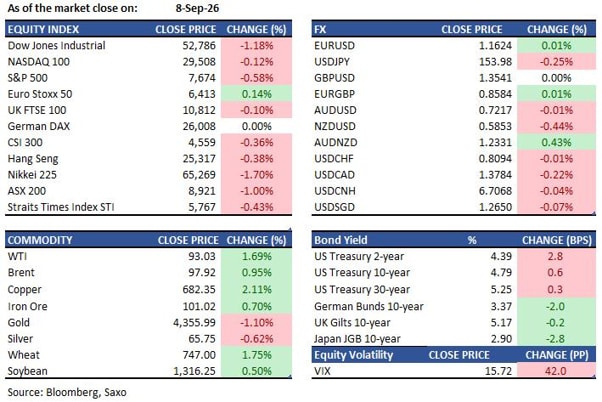
- US — S&P 500 fell 0.6% to 7,673.52 on Tuesday, its second consecutive decline, as surging oil prices stoked rate-hike fears. The Dow Jones Industrial Average dropped 1.2% (628 points) and the Nasdaq 100 slipped 0.1%. Health care was the worst-performing sector, with Amgen posting its largest single-day drop since 2000. Verizon and Corning signed a multi-billion dollar deal for Corning to supply 80 million miles of high density optical fibre to Verizon. Optic and laser stocks rallied – Lumentum +11% while Coherent +7%. The Philadelphia Semiconductor Index (SOX) bucked the trend, rising 1.3%. Qualcomm gained 3% after it signed a deal with Amazon to develop customized AI chips for AWS.
- EU — The Stoxx 600 closed marginally lower at 649.60 on Tuesday, with health care the worst-performing sector, down 2.3%. Novartis fell as much as 11% — its worst day on record — after its del-desiran muscle-wasting disease treatment failed a late-stage clinical trial, marking the company's third setback in a week. The Swiss SMI dropped 1.6%. The DAX was little changed at 26,007.63, while the FTSE 100 edged lower to 10,811.66, with AstraZeneca and Computacenter (down 7.8%) among the notable decliners. Basic resources stocks outperformed, with copper miners Antofagasta and Boliden rising over 6% as copper hit a new record high.
- Asia — Asian markets on Tuesday were mixed, caught between AI-driven chip optimism and macro headwinds from rising oil prices and a strengthening yen. The Nikkei 225 faced pressure from yen strength, with inbound-related stocks hit hard — Seiko Group plunged 15% and Citizen Watch dropped 12% on concerns about weaker inbound tourism spending and watch exports. The Kospi had surged 3.3%–3.5% on Monday, driven by SK Hynix and Samsung Electronics on OpenAI's new Astra model optimism, though oil-driven selling erased some gains on Tuesday. The Hang Seng saw Shenzhen Longsys Electronics debut in the red, slipping 1% on its first trading day, marking the fourth consecutive large Hong Kong IPO to fall on debut. Copper-related stocks across the region gained as the metal hit a record $14,617 per ton on the LME. Korean equity futures pointed higher heading into Wednesday's open on sustained SOX gains.
Earnings this week:
- Wednesday: Inditex, GameStop, Apple IPhone event
- Thursday: Adobe, Oracle
FX:
- USD weakened modestly on Tuesday, with DXY edging down to 98.759, its lowest since May, as yen strength dominated G10 trading. Global markets stayed focused on Friday’s US CPI release, with over a 50% implied probability of another Fed hike and higher oil prices weighing on risk sentiment and oil-importing currencies.
- USDJPY briefly broke below 153 to 152.89 — its strongest yen level since February — driven by stops below 155 and options-related USD selling, leaving the pair down nearly 4% month-to-date.
- EURUSD and GBPUSD inched higher (to 1.1630 and 1.3546), while AUDUSD held firm at 0.7223 despite Middle East–driven risk-off.
- NOK was the best G10 performer vs USD at the New York close, and USDCAD slipped to 1.3783 on supportive US-Canada trade comments from Treasury Secretary Bessent, even as Canada imposed retaliatory tariffs.
- USDCNH eased slightly after new US Iran sanctions spared additional Chinese entities.
Commodities:
- Brent crude settled around $98/bbl on Tuesday and extended gains in early Asian trade Wednesday, with WTI trading above $94–$95/bbl, after the US military destroyed five Iranian IRGC tankers near Kharg Island. Houthi attacks on Saudi Aramco's southern facilities added further supply disruption fears. Vitol CEO Russell Hardy warned of tightness in oil-product markets, though noted Strait of Hormuz flows have partially recovered to around 10 million barrels per day.
- LME 3-month copper futures hit a fresh all-time high of $14,779/ton intraday on Tuesday, closing at $14,708.50/ton, up nearly 18% year-to-date. The rally is driven by tight near-term supply, expectations of US tariffs on refined copper imports, and structural demand from AI data centres and the energy transition. Chile's Collahuasi mine is reportedly restarting a mothballed processing plant amid record prices.
- Spot gold fell as much as 1.1%, holding near $4,350/oz, as rising oil prices stoked rate hike expectations — a headwind for the non-yielding metal. Bullion has dropped approximately 2.6% over the past three sessions as the Fed rate hike probability has risen above 50%.
Fixed income:
- Treasuries sold off as US markets returned from the Labor Day holiday, with the curve bear-flattening — 2-year yields rose 3bps while 10-year yields held around 4.79–4.81%. A $58bn 3-year note auction and heavy corporate supply added pressure. All eyes are on Wednesday's Treasury announcement of the expanded buyback size in the 10- to 20-year bucket, with Bessent signalling at least $4bn.
- The UK sold £4.25bn of 30-year gilts at 5.82%, the highest yield at any gilt sale since the Debt Management Office was created. BOE Governor Bailey flagged upside inflation risks, and Barclays expects the BOE to slow its QT pace to £50bn at next week's policy meeting. UK house prices posted their first annual decline since 2023, per Lloyds data.
- Japan's 5-year auction on Tuesday saw softer demand, with a bid-to-cover ratio of 3.42 versus a 12-month average of 3.44. The JGB 2s10s spread remains around 105bps — substantially steeper than Treasury and Gilt curves. JGBs are expected to decline on Wednesday, tracking the fall in US Treasuries and higher oil prices.
For a global look at markets – go to Inspiration.
This content is marketing content and should not be considered investment advice. Trading financial instruments carries risks and historic performance is not a guarantee for future performance. The instrument(s) mentioned in this content may be issued by a partner, from which Saxo receives promotion, payment or retrocessions. While Saxo receives compensation from these partnerships, all content is conducted with the intention of providing clients with valuable options and information.