
Access all our platforms from a single account.

Anthropic IPO: when can you trade ANT options, and what to expect when you can

Summary: Anthropic started trading on Nasdaq on 19 November, but listed options cannot open on day one. When they may arrive, what the SpaceX debut showed about a brand-new options chain, and a few IPO pointers.
A fast options listing is likely. A cheap or liquid one, on the first day, is not.
Anthropic, the company behind the Claude AI models, started trading on the Nasdaq Global Select Market on 19 November 2026 under the ticker ANT. The company priced 980 million Class A shares at $83 each, above its filed range of $70 to $78, making it the largest IPO on record by amount raised (Source: Anthropic final prospectus, CNBC, Bloomberg as of 18 November 2026). Its first trade printed at $111.50 per share at 17:48 CET, and the shares closed their first session at $97.17, well below that opening trade but still about 17% above the IPO price (Source: Saxo, Bloomberg as of 19 November 2026).
For options traders, the first question is simple: when can I trade ANT options? The short answer is probably sooner than with a typical IPO, but not on the first day.
Why there are no options on day one
A listed option needs a listed stock underneath it. Before an exchange can list options, the stock has to trade, the exchange has to file the new class with the Options Clearing Corporation (OCC), and strikes and expiries have to be built.
For most IPOs that takes several business days. Since 2023, US options exchanges have a faster track for large listings. If a company is worth at least $3 billion at its IPO price, options may list from the second business day after the IPO day (Source: Cboe and MIAX rule filings approved by the SEC, 2023). At its IPO price, Anthropic clears that bar by a very wide margin.
For ANT, the IPO day is Thursday 19 November. The first business day after that is Friday 20 November, the second is Monday 23 November. So Monday 23 November 2026 appears to be the earliest possible date. That is a permission, not a promise: no exchange had announced a start date at the time of writing.
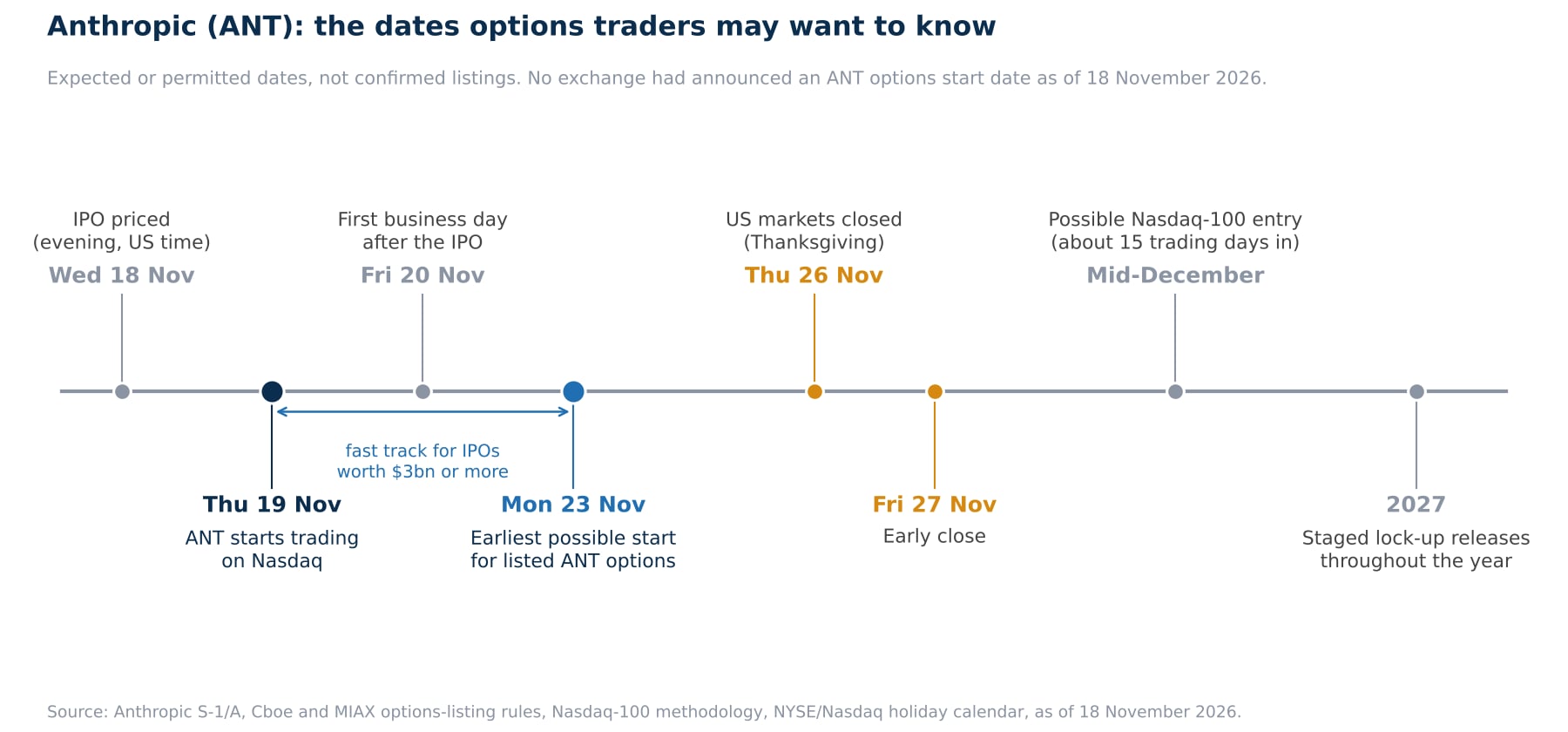 Anthropic (ANT): expected and permitted dates for the stock, the options, the Thanksgiving holiday, index entry and lock-up releases. Source: Anthropic S-1/A, Cboe and MIAX listing rules, Nasdaq-100 methodology, as of 18 November 2026.
One practical note. Contracts marketed as "Anthropic options" before the stock listed, such as products on crypto platforms that settle on a pre-IPO price index, are not exchange-listed ANT options. They are cleared differently, priced off a different reference, and carry different risks.
The SpaceX precedent
SpaceX is the closest comparison. Its shares started trading on Nasdaq on Friday 12 June 2026 and options followed on Tuesday 16 June, the second business day, exactly as the fast-track rule allows (Source: Bloomberg, Cboe as of 12 June 2026).
Demand was not the problem. More than 1.5 million contracts traded on the first day, one of the busiest options debuts on record for a single stock (Source: Cboe data reported by Yahoo Finance and TradingKey, June 2026).
What that first chain looked like matters more for traders:
- Very high implied volatility. Implied volatility is the price of uncertainty built into an option. With no trading history to anchor it, market makers priced the shortest expiry at roughly 169% at the money, about twice the level of the longest expiries (Source: Saxo platform as of 16 June 2026 close).
- No open interest. Every contract was new, so there was no positioning data to read and no established hedging pattern to lean on.
- Wider spreads. Near-the-money options in the nearest monthly expiry traded around 1.5% to 2.5% wide, and a few strikes further out the gap was often 4% or more (Source: Saxo platform as of 16 June 2026).
- A limited menu. Strikes and expiries are added over time. On day one the choice is narrower than on a mature name.
Then came the part that day-one buyers felt most. SpaceX closed its first session about 19% above its IPO price, but by mid-July it had slipped back below it, and in early August it closed almost half below the peak it reached on the day options opened (Source: Saxo, Nasdaq daily closes, June to August 2026). Options bought at very high implied volatility lost value from two sides: the move and the fall in volatility as the stock settled.
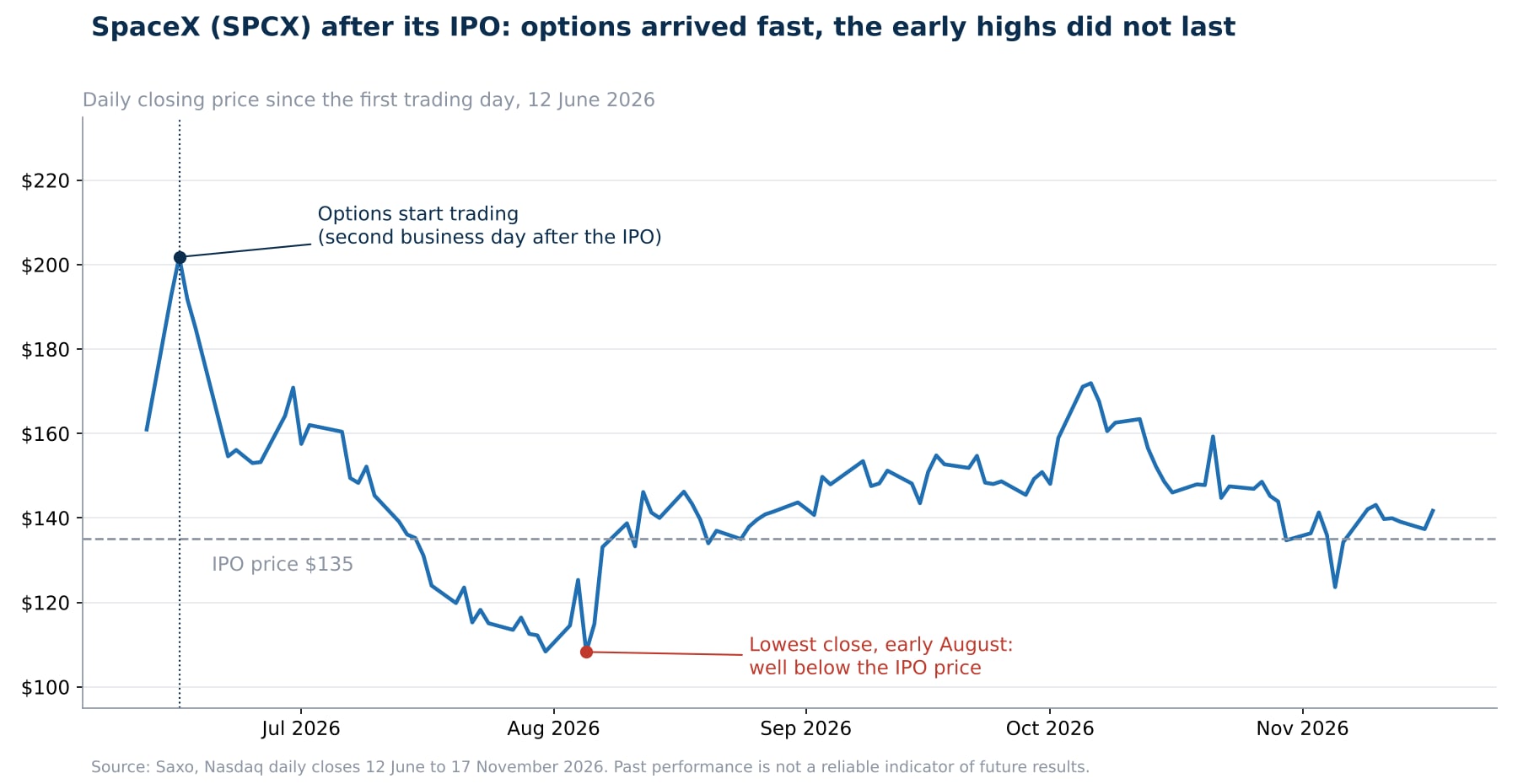 SpaceX (SPCX) daily closing price since its IPO on 12 June 2026, with the options start date and the IPO price marked. Source: Saxo, Nasdaq daily closes to 17 November 2026. Past performance is not a reliable indicator of future results.
Options carry a high risk of rapid loss, and newly listed options can be especially volatile.
Important note: The strategies and examples provided in this article are purely for educational purposes. They are intended to assist in shaping your thought process and should not be replicated or implemented without careful consideration. Every investor or trader must conduct their own due diligence and take into account their unique financial situation, risk tolerance, and investment objectives before making any decisions. Remember, investing in the stock market carries risk, and it’s crucial to make informed decisions.
What to watch once ANT options open
There is no obligation to trade on the first options day. For traders considering it, the first sessions are mostly about information: how the market prices risk on a stock it has never priced before.
- Let the chain settle. The first 30 to 60 minutes typically have the widest spreads. Volatility levels are set with very little to go on and can shift quickly as orders arrive.
- Use limit orders. A market order on a wide spread can cost a lot in one click. If a limit order at the mid-price does not fill, that tells you something about real liquidity.
- Be careful with very short expiries. The nearest weekly contracts carry the most noise and the highest volatility. Note also that US markets close on 26 November for Thanksgiving and close early on 27 November, which compresses the first expiry week.
- Selling premium is not automatically easier. High implied volatility looks attractive to option sellers, but on a stock with no trading history, gaps can be large. Defined-risk structures limit the damage if the stock moves sharply.
- Track open interest as it builds. After a few sessions, the strikes where positions concentrate start to show where traders see support, resistance or protection demand.
General IPO pointers
A few points apply to the stock as much as to the options.
- A first-day pop says little about the following months. SpaceX showed that clearly.
- Know the dated catalysts. Under Nasdaq’s fast-entry rule, adopted in May 2026, a new listing large enough to rank among the top 40 members can join the Nasdaq-100 after about 15 trading days (Source: Nasdaq methodology, as reported by Leverage Shares, October 2026). Index funds would then need to buy. Later, Anthropic’s lock-up releases insider shares in stages over roughly a year rather than on one date (Source: Anthropic S-1/A, as reported by Business Insider and Leverage Shares). Both can move supply, demand and volatility.
- Watch the overlap. If you hold Nasdaq-100 or broad AI-themed funds, a position in ANT may add concentration on top of exposure you already have.
- Expect fewer tools at first. Research coverage, borrow for short selling and the full options menu build over weeks, not days.
Final thought
In our view, the more useful question is not when ANT options arrive, but what they will cost when they do. If SpaceX is a guide, the chain could open fast, busy and expensive. Traders who wait a few sessions may give up the first move, but could gain clearer pricing, tighter spreads and real open interest to read.
The Author is permitted to wait at least 24 hours from the time of the publication before they trade the instruments themselves.
| Related articles/content |
|---|
| After the sell-off an options plan for three outcomes | 20 Nov 2026 US midterms the market ended close to where it started after a week of sharp swings | 5 Nov 2026 Five earnings reports later what the options priced and what the shares did | 4 Nov 2026 Finding unusually expensive or cheap options in the Saxo screener | 18 Sep 2026 Implied volatility rank what it measures and what it misses | 11 Sep 2026 Nine prints later what Q2 earnings season taught us | 11 Aug 2026 What IV crush really means in practice reviewed version | 9 April 2026 Trading earnings with defined | 31 Mar 2026 |
| More from the author |
|---|