
Is the Minsky moment upon us?

Hiding for safety: Screening for low volatility stocks with high dividends

Key points:

  • Defensive investment strategy: Investors looking for capital preservation and consistent returns in uncertain times may benefit from exposure to high-dividend, low-volatility stocks.
  • How this strategy works: Low-volatility stocks reduce overall portfolio risk, while dividend-paying stocks provide regular income even during market downturns. This combination can provide both capital preservation and steady cash flow, making them an attractive option for defensive investors.
  • Sector diversification: Our screener showed up a list of stocks with the above characteristics in several defensive sectors such as consumer staples (PG, KO, PEP), healthcare (JNJ, ABBV), utilities (SO, DUK) and telecom (T, VZ).

We talked about the risks of U.S. exceptionalism fading and the diluting Magnificent 7 leadership in previous articles. This is leading to a risk-off sentiment in global markets, and a rush to safe havens.

When markets get choppy, some investors reach for cash. Others look for the smoothest ride possible, and that’s where low-volatility stocks come in. These are companies with steady earnings, strong balance sheets, and a history of riding out economic turbulence better than the broader market.

That’s where low-volatility, high-dividend stocks come into play. These stocks tend to have low beta values, meaning they move less dramatically than the overall market, while also offering attractive dividend yields. This combination can provide both capital preservation and steady cash flow, making them an excellent option for defensive investors.

Why low volatility matters

Volatility is often an investor’s worst enemy, especially during market downturns. Low-volatility stocks tend to hold their ground better, reducing overall portfolio risk. They are typically found in sectors such as utilities, consumer staples, and healthcare—industries where demand remains stable regardless of economic cycles.

A stock’s beta measures its sensitivity to market movements. A beta below 1 indicates lower volatility compared to the broader market, meaning these stocks tend to decline less in bear markets while still participating in bull markets, albeit to a lesser extent.

The power of high dividends

Dividend-paying stocks offer an additional layer of security by providing regular income, even during market downturns. Companies with strong, sustainable dividends often have healthy balance sheets, stable earnings, and a commitment to returning value to shareholders. High-yield stocks can help offset price declines and enhance total return over time.

Screening for low-volatility, high-dividend stocks

We ran a defensive equity screener on Bloomberg, based on the following criterion:

  1. 30-day annualized volatility < 30% - Ensures relatively stable stock performance
  2. 6-month beta < 0.5 - Focuses on low-volatility stocks
  3. 12-month dividend yield > 2% - Targets income-generating stocks
  4. Current price/earnings < 25 - Avoids overpriced stocks

Several standout stocks fit this defensive profile. Here are a few notable names grouped by sector:

Consumer Staples

  • Procter & Gamble (PG) – With a beta of 0.25 and a 2.33% dividend yield, this consumer staples leader provides steady income and low volatility.
  • Coca-Cola (KO) – A household name with a beta of 0.28 and a 2.70% yield, benefiting from consistent global demand.
  • PepsiCo (PEP) – With a beta of 0.26 and a 2.83% yield, PepsiCo remains a resilient consumer staples giant.
  • Mondelez International (MDLZ) – A low-beta consumer goods stock (0.21) with a 2.15% dividend yield, benefiting from steady snack food demand.
  • Altria Group (MO) – This tobacco giant provides a massive 8.74% yield and a beta of 0.26, appealing to income-focused investors.

Healthcare & Pharmaceuticals

  • Johnson & Johnson (JNJ) – A healthcare giant with a beta of 0.25 and a 2.93% dividend yield, offering stability through its diversified health businesses.
  • AbbVie (ABBV) – This pharmaceutical company features a beta of 0.33 and a strong 4.10% dividend yield, making it a solid defensive pick.

Utilities

  • Southern Co. (SO) – A regulated utility stock with a beta of 0.21 and a high dividend yield of 4.15%, offering stability through predictable cash flows.
  • Duke Energy (DUK) – A utility stock with a beta of 0.26 and a 4.20% yield, offering steady cash flow and defensive characteristics.

Telecommunications

  • AT&T (T) – A telecom giant with a beta of 0.30 and a 6.11% dividend yield, offering a stable revenue stream through its communications services.
  • Verizon Communications (VZ) – Another major telecom provider with a beta of 0.32 and a strong 6.45% dividend yield, making it a solid defensive pick.
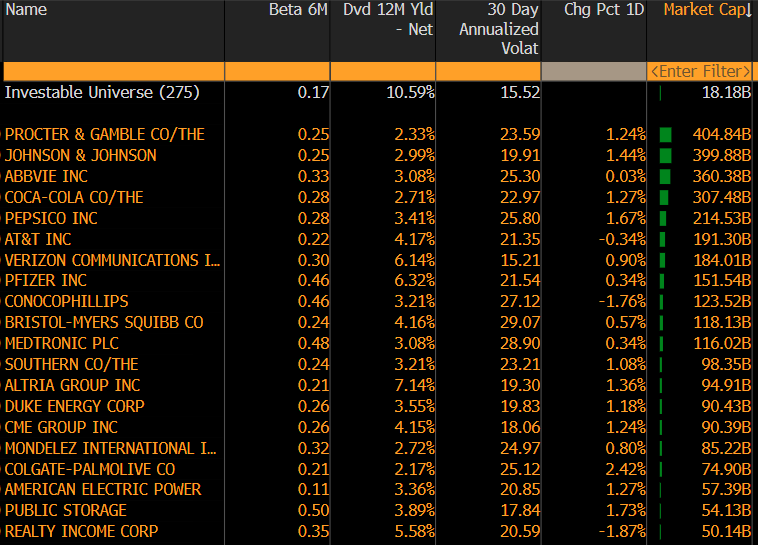
  Below are the top 20 stocks by market cap that came up from the screener:

26_CHCA_Low vol screener
Source: Bloomberg

Positioning for stability

For investors seeking a balance of risk management and income, a mix of low-volatility, high-dividend stocks can be a smart addition to a diversified portfolio. These stocks provide protection during market downturns while still generating returns through dividends.

While no investment is without risk, these stocks present a strong case for those looking to minimize volatility without sacrificing yield. By focusing on companies with stable cash flows and sustainable dividends, investors can create a more resilient portfolio in today’s uncertain market environment.

Disclaimer

Confidentiality and Usage:
You may not reproduce, distribute, or transmit this material or any portion thereof without prior written permission from Saxo.

Nature of Information:
The information provided herein is based on current market conditions and analysts' opinions, which may reflect personal views of the author, and are subject to change without notice. This material does not include a record of any trading prices, or an offer of, or solicitation for, or endorsement to enter into any transaction in any investment product. Any forecast on the economy, markets and economic trends of the markets provided is not necessarily indicative of the future or likely performance of the investment product subject of this material.

Responsibility and Liability:
Saxo accepts no liability for any use that may be made of these comments or for any consequences that arise from such use. Saxo does not guarantee the accuracy or completeness of any information provided and assumes no liability for any errors, omissions, losses, or damages resulting from the use of this information.

The information provided in this material is solely for information only. It is intended for general circulation and does not take into account the specific investment objectives, financial situation or particular needs of any particular person. Accordingly, it should not be relied on or treated as a substitute for specific advice concerning specific situations of any person. Please seek advice from a financial adviser regarding the suitability of any investment product taking into account your specific investment objectives, financial situation or particular needs before you make a commitment to purchase an investment product. In the event that you choose not to seek advice from a financial adviser, you should consider whether any investment product mentioned in this publication is suitable for you.

Notwithstanding the above, insofar as any information provided herein contains research analyses or reports concerning any investment product authored by any foreign research house and is issued or promulgated to a person in Singapore who is not an accredited investor, expert investor, and/or institutional investor, Saxo Capital Market Pte. Ltd. accepts legal responsibility for the contents of this material to the extent required by law. Recipients of such material are to contact Saxo Capital Markets Pte. Ltd. in respect of any matters arising from, or in connection with, this material.

Risk Disclosure:
Trading in investment products involve significant risk, including the risk of losing your entire investment. Historical returns are not a guarantee of future returns. Prices can both rise and fall, and there is a risk that you will not get back the money you invested.

Conflicts of interest:
The author may hold positions in the investment products mentioned. The author does not own positions in the underlying investment product exceeding 0.5% of its market capitalisation, save as otherwise declared. The author is not permitted to trade the mentioned investment products within the first 24 hours after the publication of this article.

Saxo maintains partnerships with companies that compensate Saxo for promotional activities conducted on its platform. Additionally, Saxo has agreements with certain partners who provide retrocession contingent upon clients purchasing specific investment products offered by these partners. While Saxo receives compensation from these partnerships, all content is conducted with the intention of providing clients with valuable options and information.

Publication details:
If any listed companies are the subject of the material, the content has not been submitted to the companies in question prior to publication.

Please refer to our full disclaimer and notification on non-independent investment research for more details.

Saxo Markets
88 Market Street
CapitaSpring #31-01
Singapore 048948

Contact Saxo

Singapore
Singapore

Saxo Capital Markets Pte Ltd ('Saxo Markets') is a company authorised and regulated by the Monetary Authority of Singapore (MAS) [Co. Reg. No.: 200601141M ] and is a wholly owned subsidiary of Saxo Bank A/S, headquartered in Denmark. Please refer to our General Business Terms & Risk Warning to consider whether acquiring or continuing to hold financial products is suitable for you, prior to opening an account and investing in a financial product.

Saxo is part of the J. Safra Sarasin Group.

Trading in financial instruments carries various risks, and is not suitable for all investors. Please seek expert advice, and always ensure that you fully understand these risks before trading. Trading in leveraged products such as Margin FX products may result in your losses exceeding your initial deposits. Saxo Markets does not provide financial advice, any information available on this website is ‘general’ in nature and for informational purposes only. Saxo Markets does not take into account an individual’s needs, objectives or financial situation.

The Saxo trading platform has received numerous awards and recognition. For details of these awards and information on awards visit www.home.saxo/en-sg/about-us/awards.

The information or the products and services referred to on this website may be accessed worldwide, however is only intended for distribution to and use by recipients located in countries where such use does not constitute a violation of applicable legislation or regulations. Products and Services offered on this website are not intended for residents of the United States, Malaysia and Japan. Please click here to view our full disclaimer.

This advertisement has not been reviewed by the Monetary Authority of Singapore.

Apple and the Apple logo are trademarks of Apple Inc, registered in the US and other countries and regions. App Store is a service mark of Apple Inc. Google Play and the Google Play logo are trademarks of Google LLC.