
Access both platforms from your single Saxo account.

Asia Market Quick Take – 17 March, 2026

Asia Market Quick Take – 17 March, 2026
Key points:
- Macro: Fears ease as tankers manage to navigate the Straits of Hormuz
- Equities: Nvidia’s Huang unveils new products, sees $1tn AI‑chip sales by 2027
- FX: USD weakens; AUD, NZD and SEK outperform on improved risk sentiment shift
- Commodities: Brent above $100 for a third day; gold near $5,000
- Fixed income: Swaps price a 68% chance RBA lifts its cash rate to 4.1%
------------------------------------------------------------------
Disclaimer: Past performance does not indicate future performance.
Macro:
- Fears of a prolonged Strait of Hormuz closure eased as tankers navigated the chokepoint, raising reopening hopes. Countries are negotiating with Iran for safe passage. The US allows crude shipping and seeks global support, with a US-Iran communication channel active. Emergency crude reserves may be released, and the IEA could tap more stockpiles.
- Canada's inflation rate dropped to 1.8% in February 2026 from 2.3% in January, the lowest since July. The decline followed the end of tax breaks, slowing food inflation to 5.3%. Price growth eased for various sectors, and BoC's core rates hit a four-year low of 2.3%.
- US industrial production rose 0.2% in February 2026, surpassing the 0.1% forecast. Manufacturing output increased 0.2%, and mining rose 0.8%, while utilities fell 0.6%. Capacity utilization remained at 76.3%, below the long-term average.
Equities:
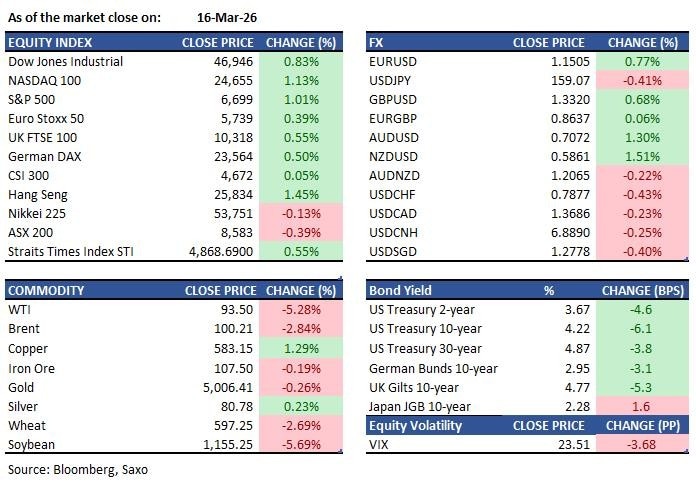
- US - US equities rebounded Monday, with the S&P 500 up 1.1%, the Dow rising 1%, and the Nasdaq gaining 1.2% as markets dialed back fears of a prolonged energy shock. Sentiment improved after several tankers successfully passed through the Strait of Hormuz, easing concerns about sustained supply disruptions and pulling oil prices off recent highs. Chipmakers outperformed, with Nvidia up 1.6% and Micron gaining 3.7%, while Meta rose 2.3% on reports of potential workforce changes. Nvidia CEO Jensen Huang unveiled new products at its biggest annual event, forecasting its flagship AI chips will drive $1 trillion in sales through 2027.EU – European stocks rose on Monday, breaking a three‑session selloff as investors reassessed the scale of the Persian Gulf energy shock. The STOXX 50 gained 0.4% to 5,740 and the STOXX 600 rose 0.5% to 599. Oil prices eased after LPG tankers passed through the Strait of Hormuz, signaling limited export leniency from Tehran and tempering global inflation concerns. Financials tracked firmer bond markets, with Allianz and Deutsche Bank up 1.5%. UniCredit added 0.5% after its €35 billion Commerzbank bid, while chipmakers strengthened globally, lifting ASML by 1.5%.
- HK - HangSeng Index rose 1.45%, to 25,834 on Monday, snapping a three‑session decline as gains broadened across sectors. Sentiment improved after China’s January–February activity data beat expectations, with industrial output, retail sales, and fixed investment all surprising to the upside. However, a third day of losses in mainland equities capped advances amid speculation that the Trump–Xi meeting may be delayed due to the war. BYD gained 7% after BYD's Brazil plant won 100k export orders - 50k each from Argentina and Mexico.
Earnings this week:
- Tuesday: Tencent music entertainment, Lululemon, Docusign, Oklo,
- Wednesday: Geely Auto, Tencent, Geely, Micron,
- Thursday: AIA Group, Alibaba, Fed Ex, Accenture
- Friday: Xpeng, Meituan
FX:
- USD weakened against major currencies, influenced by falling oil prices and increased investor optimism about shipping in the Strait of Hormuz, following President Trump's call for NATO's support to de-escalate regional tensions. DXY fell below 100 level.
- USDJPY fell to 159.22, retreating from Friday's high of 159.75, the highest since July 2024. Japanese Finance Minister Satsuki Katayama vowed preparedness for bold measures in forex markets, although ING strategists see low chances for US-Japan coordinated intervention.
- EURUSD increased to 1.1518, supported by favorable conditions. USDCAD dipped to 1.3680 after disappointing Canadian inflation fell to 1.8% for February. GBPUSD rose 0.8% to 1.3333.
- Among G-10 currencies, the NZD and SEK outperformed, with NZDUSD up 1.6% to 0.5863 and AUDUSD gaining 1.3% to 0.7075, driven by improved risk appetite.
Commodities:
- Gold was little changed near $5,000 an ounce as the US dollar weakened and traders weighed efforts to contain a Middle East oil‑supply shock, with bullion steady after a 0.3% fall in the prior session and a dollar gauge down 0.6%. Silver edged up 0.1% to $80.90, while platinum and palladium advanced.
- Oil rebounded after Monday’s 5% slide as investors weighed Middle East supply risks against prospects of more crude, with WTI near $95 and Brent above $100 for a third day as the US readied emergency releases and the IEA signalled further stockpile draws.
Fixed income:
- Treasury futures closed near session highs after a global bond rally on slumping oil, with downside hedge unwinds persisting in short‑tenor rate options; Treasuries outperformed swaps as volatility eased, and long‑end swap spreads saw their biggest widening in almost a year, aided by gains in gilts and bunds. Attention turns to the RBA, with swaps pricing about 72bp of tightening by year‑end and a 68% chance of a 25 bpshike today, even as nine economists expects rates to hold at 3.85%.
For a global look at markets – go to Inspiration.
This content is marketing content and should not be considered investment advice. Trading financial instruments carries risks and historic performance is not a guarantee for future performance. The instrument(s) mentioned in this content may be issued by a partner, from which Saxo receives promotion, payment or retrocessions. While Saxo receives compensation from these partnerships, all content is conducted with the intention of providing clients with valuable options and information.