ChatGPT Image Apr 28 2026 013548 PM

BOJ’s hawkish hold: When inflation risk beats growth fear

Macro 5 minutes to read
Charu Chanana 400x400
Charu Chanana

Chief Investment Strategist

Key points:

  • BOJ’s hold was hawkish beneath the surface: The 6–3 vote split shows more policymakers are leaning toward rate hikes as imported inflation risks rise from higher energy costs and Middle East tensions.
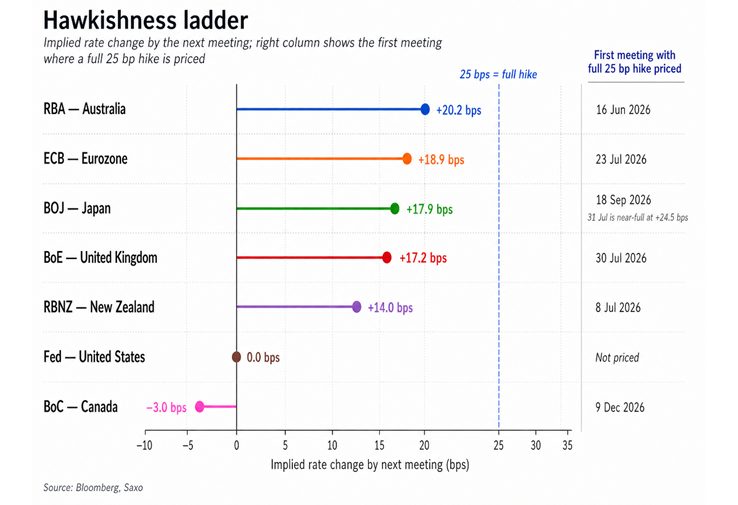
  • The hawkish bias is spreading globally: Markets are pricing renewed tightening risk across several central banks, with the RBA, BOJ, ECB, BoE and RBNZ all showing meaningful hike pricing. The Fed remains the main outlier.
  • This could be a tougher setup for equities and short-end bonds: If inflation arrives before growth weakness becomes obvious, central banks may stay restrictive for longer. That could keep short-end yields elevated and pressure equity valuations, especially in long-duration growth and margin-sensitive sectors. 

The Bank of Japan’s latest decision may look like a hold on the surface, but the message beneath it was more important: even one of the world’s most cautious central banks is becoming less comfortable waiting when energy-driven inflation risks are rising.

The BOJ kept its policy rate unchanged at 0.75%, but the vote split was the real signal. The decision passed by a 6–3 majority, compared with an 8–1 split at the previous meeting, meaning two more policymakers shifted into the rate-hike camp. That growing dissent suggests the debate inside the BOJ is moving from whether inflation is sustainable enough to justify tightening, to how long the central bank can afford to wait as imported inflation risks rise.

The hawkish dissent reflected rising concern that inflation pressures from the Middle East conflict and higher energy costs are becoming harder to ignore.

That matters well beyond Japan.

The BOJ is exposing the central-bank dilemma

The Middle East conflict and disruption risk around the Strait of Hormuz have created a difficult policy mix: higher imported costs, weaker growth, and more volatile inflation expectations.

For central banks, that is the worst kind of shock. It is not a clean demand boom where tighter policy clearly cools activity. It is a supply shock, where higher energy and raw material costs hurt households and companies even as they push inflation higher.

But the BOJ’s hawkish tilt suggests policymakers may still feel forced to act. Inflation shows up in the data faster than growth weakness does. That means central banks may fight the inflation battle in front of them before they get enough evidence of the growth damage behind it.

The BOJ is not alone: the hawkish bias is spreading

The key read-through is not that every central bank will suddenly hike. It is that the bar for dovishness has risen.

The BOJ’s hawkish hold now sits within a broader global repricing of central-bank risk. The chart below shows how much tightening markets are pricing by each central bank’s next meeting, and when a full 25bp hike is first implied. Australia stands out as the most hawkish near-term case, with around 20bp priced by the RBA’s next meeting and a full hike priced by June. The BOJ, ECB and Bank of England are not far behind, with roughly 17–19bp priced by their next meetings and a full hike priced by July or September. The RBNZ also shows meaningful July hike risk, while Canada looks more delayed, with a full hike only priced by December. The Fed remains the clear outlier: markets are not pricing renewed tightening, reinforcing the idea that global policy expectations are no longer moving as one block.

28_CHCA_CBs

The common thread is clear: central banks may still worry about growth, but they are becoming less willing to look through inflation shocks. In a world of disrupted energy supply, higher transport costs and more fragile inflation expectations, policymakers may prefer to move too early on inflation rather than too late.

For markets, that means the old “growth scare equals rate cuts” playbook may not work as cleanly. If inflation concerns dominate first, short-end yields can stay under pressure, rate-cut hopes can be delayed, and equities may struggle to find relief from central banks even as the growth outlook softens.

Why this matters for global markets

The key message is not just about Japan. It is about the global policy reaction function.

If energy costs remain elevated, central banks may find it harder to talk about rate cuts, even if growth risks are building. That could keep pressure on short-end bonds, where pricing is most sensitive to policy expectations. It could also weigh on equities, especially:

  • Long-duration growth stocks that depend heavily on lower discount rates

  • Companies with limited pricing power and greater exposure to margin pressure

  • Sectors where valuations assume stable inflation, falling yields and benign financing conditions

The BOJ’s situation is especially striking because Japan has historically moved cautiously. If even the BOJ is being pushed toward a tighter stance, investors may need to take seriously the risk that the global central-bank put is weaker than markets assume.

Equities: the risk is not just earnings, but multiples

For stocks, the danger is twofold.

  • Higher energy and input costs can squeeze margins, especially for companies with weak pricing power.

  • Higher policy-sensitive yields can pressure valuations, particularly in long-duration growth stocks.

This does not mean equities need to fall sharply from here. Markets can still look through geopolitical shocks if investors believe there is an eventual off-ramp. But the BOJ’s message makes the “benign shock” narrative harder to sustain. If inflation expectations rise and central banks lean hawkish into slowing growth, the equity market faces a tougher mix.


Bottom line

The BOJ’s hawkish hold is a warning shot. The Middle East shock is no longer just a geopolitical risk for markets; it is becoming a central-bank risk.

If inflation pressure arrives before growth weakness becomes undeniable, policymakers may tighten or stay restrictive for longer than markets expect. That keeps upward pressure on short-end yields, complicates the case for equities, and makes the next round of global central-bank meetings more important than usual.

The uncomfortable message from Tokyo is simple: in a stagflationary shock, central banks may not come to the market’s rescue as quickly as investors hope.


This content is marketing material and should not be regarded as investment advice. Trading financial instruments carries risks and historic performance is not a guarantee of future results.
The instrument(s) referenced in this content may be issued by a partner, from whom Saxo receives promotional fees, payment or retrocessions. While Saxo may receive compensation from these partnerships, all content is created with the aim of providing clients with valuable information and options..

Outrageous Predictions 2026

01 /

  • Switzerland's Green Revolution: CHF 30 Billion Initiative by 2050

    Outrageous Predictions

    Switzerland's Green Revolution: CHF 30 Billion Initiative by 2050

    Katrin Wagner

    Head of Investment Content Switzerland

    Switzerland launches a CHF 30 billion energy revolution by 2050, rivaling Lindt & Sprüngli's market ...

  • The Swiss Fortress – 2026

    Outrageous Predictions

    The Swiss Fortress – 2026

    Erik Schafhauser

    Senior Relationship Manager

    Swiss voters reject EU ties, boosting the Swiss Franc and sparking Switzerland's "Souveränität Zuers...
  • A Fortune 500 company names an AI model as CEO

    Outrageous Predictions

    A Fortune 500 company names an AI model as CEO

    Charu Chanana

    Chief Investment Strategist

    Can AI be trusted to take over in the boardroom? With the right algorithms and balanced human oversi...
  • Executive Summary: Outrageous Predictions 2026

    Outrageous Predictions

    Executive Summary: Outrageous Predictions 2026

    Saxo Group

    Read Saxo's Outrageous Predictions for 2026, our latest batch of low probability, but high impact ev...
  • Dollar dominance challenged by Beijing’s golden yuan

    Outrageous Predictions

    Dollar dominance challenged by Beijing’s golden yuan

    Charu Chanana

    Chief Investment Strategist

    Beijing does an end-run around the US dollar, setting up a framework for settling trade in a neutral...
  • Dumb AI triggers trillion-dollar clean-up

    Outrageous Predictions

    Dumb AI triggers trillion-dollar clean-up

    Jacob Falkencrone

    Global Head of Investment Strategy

    Agentic AI systems are deployed across all sectors, and after a solid start, mistakes trigger a tril...
  • Quantum leap Q-Day arrives early, crashing crypto and destabilizing world finance

    Outrageous Predictions

    Quantum leap Q-Day arrives early, crashing crypto and destabilizing world finance

    Neil Wilson

    Investor Content Strategist

    A quantum computer cracks today’s digital security, bringing enough chaos with it that Bitcoin crash...
  • SpaceX announces an IPO, supercharging extraterrestrial markets

    Outrageous Predictions

    SpaceX announces an IPO, supercharging extraterrestrial markets

    John J. Hardy

    Global Head of Macro Strategy

    Financial markets go into orbit, to the moon and beyond as SpaceX expands rocket launches by orders-...
  • Taylor Swift-Kelce wedding spikes global growth

    Outrageous Predictions

    Taylor Swift-Kelce wedding spikes global growth

    John J. Hardy

    Global Head of Macro Strategy

    Next year’s most anticipated wedding inspires Gen Z to drop the doomscrolling and dial up the real w...
  • Despite concerns, U.S. 2026 mid-term elections proceed smoothly

    Outrageous Predictions

    Despite concerns, U.S. 2026 mid-term elections proceed smoothly

    John J. Hardy

    Global Head of Macro Strategy

    In spite of outstanding threats to the American democratic process, the US midterms come and go cord...

This content is marketing material.

None of the information provided on this website constitutes an offer, solicitation, or endorsement to buy or sell any financial instrument, nor is it financial, investment, or trading advice. Saxo Bank Switzerland and its entities within the Saxo Bank Group provide execution-only services, with all trades and investments based on self-directed decisions. Analysis, research, and educational content is for informational purposes only and should not be considered advice nor a recommendation.

Saxo Bank Switzerland’s content may reflect the personal views of the author, which are subject to change without notice. Mentions of specific financial products are for illustrative purposes only and may serve to clarify financial literacy topics. Content classified as investment research is marketing material and does not meet legal requirements for independent research.

Saxo Bank Switzerland partners with companies that provide compensation for promotional activities conduced on its platform. Additionally, Saxo Bank Switzerland has agreements with certain partners who provide retrocession contingent upon clients purchasing specific products offered by these partners.

While Saxo Bank Switzerland receives compensation from these partnerships, all educational and research content remains focused on providing information to clients.  

Before making any investment decisions, you should assess your own financial situation, needs, and objectives, and consider seeking independent professional advice. Saxo Bank Switzerland does not guarantee the accuracy or completeness of any information provided and assumes no liability for any errors, omissions, losses, or damages resulting from the use of this information.

The content of this website represents marketing material and is not the result of financial analysis or research. It has therefore not been prepared in accordance with directives of the Swiss Bankers Association designed to promote the independence of financial research and is not subject to any prohibition on dealing ahead of the dissemination of the marketing material.

Saxo Bank (Schweiz) AG
The Circle 38
CH-8058
Zürich-Flughafen
Switzerland

Contact Saxo

Switzerland
Switzerland

All trading carries risk. Losses can exceed deposits on margin products. You should consider whether you understand how our products work and whether you can afford to take the high risk of losing your money. To help you understand the risks involved we have put together a general Risk Warning series of Key Information Documents (KIDs) highlighting the risks and rewards related to each product. The KIDs can be accessed within the trading platform. Please note that the full prospectus can be obtained free of charge from Saxo Bank (Switzerland) Ltd. or the issuer.

This website can be accessed worldwide however the information on the website is related to Saxo Bank (Switzerland) Ltd. All clients will directly engage with Saxo Bank (Switzerland) Ltd. and all client agreements will be entered into with Saxo Bank (Switzerland) Ltd. and thus governed by Swiss Law. 

The content of this website represents marketing material and has not been notified or submitted to any supervisory authority.

If you contact Saxo Bank (Switzerland) Ltd. or visit this website, you acknowledge and agree that any data that you transmit to Saxo Bank (Switzerland) Ltd., either through this website, by telephone or by any other means of communication (e.g. e-mail), may be collected or recorded and transferred to other Saxo Bank Group companies or third parties in Switzerland or abroad and may be stored or otherwise processed by them or Saxo Bank (Switzerland) Ltd. You release Saxo Bank (Switzerland) Ltd. from its obligations under Swiss banking and securities dealer secrecies and, to the extent permitted by law, data protection laws as well as other laws and obligations to protect privacy. Saxo Bank (Switzerland) Ltd. has implemented appropriate technical and organizational measures to protect data from unauthorized processing and disclosure and applies appropriate safeguards to guarantee adequate protection of such data.

Apple, iPad and iPhone are trademarks of Apple Inc., registered in the U.S. and other countries. App Store is a service mark of Apple Inc.