ChatGPT Image Apr 28 2026 013548 PM

BOJ’s hawkish hold: When inflation risk beats growth fear

Macro 5 minutes to read
Charu Chanana 400x400
Charu Chanana

Chief Investment Strategist

Key points:

  • BOJ’s hold was hawkish beneath the surface: The 6–3 vote split shows more policymakers are leaning toward rate hikes as imported inflation risks rise from higher energy costs and Middle East tensions.
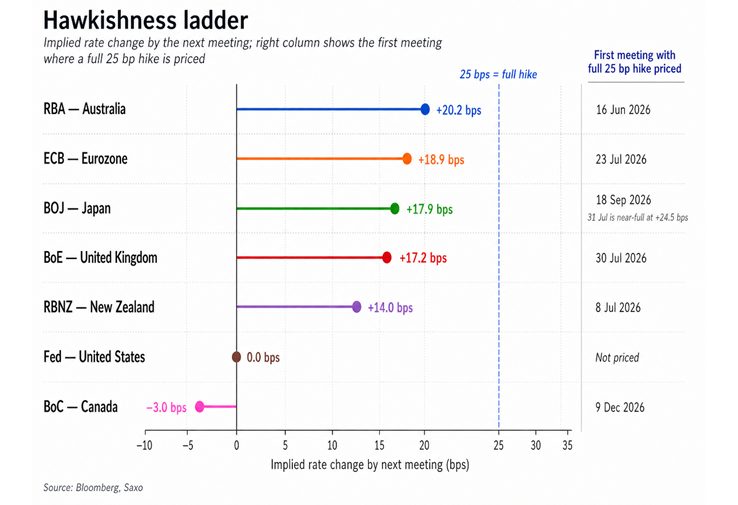
  • The hawkish bias is spreading globally: Markets are pricing renewed tightening risk across several central banks, with the RBA, BOJ, ECB, BoE and RBNZ all showing meaningful hike pricing. The Fed remains the main outlier.
  • This could be a tougher setup for equities and short-end bonds: If inflation arrives before growth weakness becomes obvious, central banks may stay restrictive for longer. That could keep short-end yields elevated and pressure equity valuations, especially in long-duration growth and margin-sensitive sectors. 

The Bank of Japan’s latest decision may look like a hold on the surface, but the message beneath it was more important: even one of the world’s most cautious central banks is becoming less comfortable waiting when energy-driven inflation risks are rising.

The BOJ kept its policy rate unchanged at 0.75%, but the vote split was the real signal. The decision passed by a 6–3 majority, compared with an 8–1 split at the previous meeting, meaning two more policymakers shifted into the rate-hike camp. That growing dissent suggests the debate inside the BOJ is moving from whether inflation is sustainable enough to justify tightening, to how long the central bank can afford to wait as imported inflation risks rise.

The hawkish dissent reflected rising concern that inflation pressures from the Middle East conflict and higher energy costs are becoming harder to ignore.

That matters well beyond Japan.

The BOJ is exposing the central-bank dilemma

The Middle East conflict and disruption risk around the Strait of Hormuz have created a difficult policy mix: higher imported costs, weaker growth, and more volatile inflation expectations.

For central banks, that is the worst kind of shock. It is not a clean demand boom where tighter policy clearly cools activity. It is a supply shock, where higher energy and raw material costs hurt households and companies even as they push inflation higher.

But the BOJ’s hawkish tilt suggests policymakers may still feel forced to act. Inflation shows up in the data faster than growth weakness does. That means central banks may fight the inflation battle in front of them before they get enough evidence of the growth damage behind it.

The BOJ is not alone: the hawkish bias is spreading

The key read-through is not that every central bank will suddenly hike. It is that the bar for dovishness has risen.

The BOJ’s hawkish hold now sits within a broader global repricing of central-bank risk. The chart below shows how much tightening markets are pricing by each central bank’s next meeting, and when a full 25bp hike is first implied. Australia stands out as the most hawkish near-term case, with around 20bp priced by the RBA’s next meeting and a full hike priced by June. The BOJ, ECB and Bank of England are not far behind, with roughly 17–19bp priced by their next meetings and a full hike priced by July or September. The RBNZ also shows meaningful July hike risk, while Canada looks more delayed, with a full hike only priced by December. The Fed remains the clear outlier: markets are not pricing renewed tightening, reinforcing the idea that global policy expectations are no longer moving as one block.

28_CHCA_CBs

The common thread is clear: central banks may still worry about growth, but they are becoming less willing to look through inflation shocks. In a world of disrupted energy supply, higher transport costs and more fragile inflation expectations, policymakers may prefer to move too early on inflation rather than too late.

For markets, that means the old “growth scare equals rate cuts” playbook may not work as cleanly. If inflation concerns dominate first, short-end yields can stay under pressure, rate-cut hopes can be delayed, and equities may struggle to find relief from central banks even as the growth outlook softens.

Why this matters for global markets

The key message is not just about Japan. It is about the global policy reaction function.

If energy costs remain elevated, central banks may find it harder to talk about rate cuts, even if growth risks are building. That could keep pressure on short-end bonds, where pricing is most sensitive to policy expectations. It could also weigh on equities, especially:

  • Long-duration growth stocks that depend heavily on lower discount rates

  • Companies with limited pricing power and greater exposure to margin pressure

  • Sectors where valuations assume stable inflation, falling yields and benign financing conditions

The BOJ’s situation is especially striking because Japan has historically moved cautiously. If even the BOJ is being pushed toward a tighter stance, investors may need to take seriously the risk that the global central-bank put is weaker than markets assume.

Equities: the risk is not just earnings, but multiples

For stocks, the danger is twofold.

  • Higher energy and input costs can squeeze margins, especially for companies with weak pricing power.

  • Higher policy-sensitive yields can pressure valuations, particularly in long-duration growth stocks.

This does not mean equities need to fall sharply from here. Markets can still look through geopolitical shocks if investors believe there is an eventual off-ramp. But the BOJ’s message makes the “benign shock” narrative harder to sustain. If inflation expectations rise and central banks lean hawkish into slowing growth, the equity market faces a tougher mix.


Bottom line

The BOJ’s hawkish hold is a warning shot. The Middle East shock is no longer just a geopolitical risk for markets; it is becoming a central-bank risk.

If inflation pressure arrives before growth weakness becomes undeniable, policymakers may tighten or stay restrictive for longer than markets expect. That keeps upward pressure on short-end yields, complicates the case for equities, and makes the next round of global central-bank meetings more important than usual.

The uncomfortable message from Tokyo is simple: in a stagflationary shock, central banks may not come to the market’s rescue as quickly as investors hope.


This content is marketing material and should not be regarded as investment advice. Trading financial instruments carries risks and historic performance is not a guarantee of future results.
The instrument(s) referenced in this content may be issued by a partner, from whom Saxo receives promotional fees, payment or retrocessions. While Saxo may receive compensation from these partnerships, all content is created with the aim of providing clients with valuable information and options..

Prévisions "chocs" 2026

01 /

  • Révolution Verte en Suisse : un projet de CHF 30 milliards d’ici 2050

    Outrageous Predictions

    Révolution Verte en Suisse : un projet de CHF 30 milliards d’ici 2050

    Katrin Wagner

    Head of Investment Content Switzerland

    la Suisse se lance dans une révolution énergétique de CHF 30 milliards d'ici 2050, rivalisant avec l...

  • « La Forteresse Suisse – 2026 »

    Outrageous Predictions

    « La Forteresse Suisse – 2026 »

    Erik Schafhauser

    Senior Relationship Manager

    les électeurs suisses rejettent les liens avec l'UE, renforçant le franc suisse et déclenchant la d...
  • Prévisions "chocs" 2026

    Outrageous Predictions

    Prévisions "chocs" 2026

    Saxo Group

  • Une entreprise du classement Fortune 500 nomme un modèle d’intelligence artificielle comme directeur général.

    Outrageous Predictions

    Une entreprise du classement Fortune 500 nomme un modèle d’intelligence artificielle comme directeur général.

    Charu Chanana

    Chief Investment Strategist

  • La domination du dollar remise en cause par le « yuan doré » de Pékin

    Outrageous Predictions

    La domination du dollar remise en cause par le « yuan doré » de Pékin

    Charu Chanana

    Chief Investment Strategist

  • Malgré certaines inquiétudes, les élections américaines de mi-mandat de 2026 se déroulent sans heurts

    Outrageous Predictions

    Malgré certaines inquiétudes, les élections américaines de mi-mandat de 2026 se déroulent sans heurts

    John J. Hardy

    Global Head of Macro Strategy

  • Des médicaments contre l’obésité pour tous – même pour les animaux de compagnie

    Outrageous Predictions

    Des médicaments contre l’obésité pour tous – même pour les animaux de compagnie

    Jacob Falkencrone

    Global Head of Investment Strategy

  • Le grand bug de l’IA : un reset à mille milliards de dollars

    Outrageous Predictions

    Le grand bug de l’IA : un reset à mille milliards de dollars

    Jacob Falkencrone

    Global Head of Investment Strategy

  • Le grand saut quantique arrive plus tôt que prévu : le « Q-Day » fait s’effondrer les cryptomonnaies et déstabilise la finance mondiale.

    Outrageous Predictions

    Le grand saut quantique arrive plus tôt que prévu : le « Q-Day » fait s’effondrer les cryptomonnaies et déstabilise la finance mondiale.

    Neil Wilson

    Investor Content Strategist

  • SpaceX annonce son introduction en Bourse, dopant les marchés liés à l’exploration spatiale.

    Outrageous Predictions

    SpaceX annonce son introduction en Bourse, dopant les marchés liés à l’exploration spatiale.

    John J. Hardy

    Global Head of Macro Strategy

Ce contenu est un document à caractère marketing.

Aucune des informations fournies sur ce site ne constitue une offre, une sollicitation ou une recommandation d'acheter ou de vendre un instrument financier, ni un conseil financier, d'investissement ou de trading. Saxo Bank Suisse et ses entités au sein du groupe Saxo Bank fournissent des services d'exécution uniquement, avec toutes les transactions et investissements basés sur des décisions autonomes. Les analyses, les travaux de recherche et le contenu éducatif sont fournis à des fins d'information uniquement et ne doivent pas être considérés comme des conseils ou des recommandations.

Le contenu de Saxo Bank Suisse peut refléter les opinions personnelles de l’auteur, susceptibles d’être modifiées sans préavis. Les mentions de produits financiers spécifiques sont données à titre purement illustratif et peuvent servir à clarifier des notions liées à la culture financière. Les contenus classés comme recherches en investissement sont considérés comme du matériel marketing et ne répondent pas aux exigences légales en matière de recherche indépendante.

Saxo Bank Suisse entretient des partenariats avec des entreprises qui la rémunèrent pour les activités promotionnelles menées sur sa plateforme. De plus, Saxo Bank Suisse a des accords avec certains partenaires qui fournissent des rétrocessions conditionnées à l'achat par les clients de produits spécifiques proposés par ces partenaires.

Bien que Saxo Bank Suisse reçoive une compensation de ces partenariats, tous les contenus éducatifs et inspirants sont réalisés dans l'intention de fournir aux clients des options et des informations pertinentes.

Avant de prendre des décisions d'investissement, vous devez évaluer votre propre situation financière, vos besoins et vos objectifs, et envisager de demander des conseils professionnels indépendants. Saxo Bank Suisse ne garantit ni l'exactitude ni l'exhaustivité des informations fournies et décline toute responsabilité en cas d’erreurs, d’omissions, de pertes ou de dommages résultant de l’utilisation de ces informations.

Le contenu de ce site Web représente du matériel de marketing et n'est pas le résultat d'une analyse ou d'une recherche financière. Il n'a donc pas été préparé conformément aux directives de l'association suisse des banquiers visant à promouvoir l'indépendance de la recherche financière et n'est soumis à aucune interdiction de négociation avant la diffusion du matériel de marketing. 

Saxo Bank (Suisse) SA
The Circle 38
CH-8058
Zürich-Flughafen
Suisse

Nous contacter

Suisse
Suisse

Le trading d’instruments financiers comporte des risques. Les pertes peuvent dépasser les dépôts sur les produits de marge. Vous devez comprendre comment fonctionnent nos produits et quels types de risques ils comportent. De plus, vous devez savoir si vous pouvez vous permettre de prendre un risque élevé de perdre votre argent. Pour vous aider à comprendre les risques impliqués, nous avons compilé une divulgation des risques ainsi qu'un ensemble de documents d'informations clés (Key Information Documents ou KID) qui décrivent les risques et opportunités associés à chaque produit. Les KID sont accessibles sur la plateforme de trading. Veuillez noter que le prospectus complet est disponible gratuitement auprès de Saxo Bank (Suisse) SA ou directement auprès de l'émetteur.

Ce site web est accessible dans le monde entier. Cependant, les informations sur le site web se réfèrent à Saxo Bank (Suisse) SA. Tous les clients traitent directement avec Saxo Bank (Suisse) SA. et tous les accords clients sont conclus avec Saxo Bank (Suisse) SA et sont donc soumis au droit suisse.

Le contenu de ce site web constitue du matériel de marketing et n'a été signalé ou transmis à aucune autorité réglementaire.

Si vous contactez Saxo Bank (Suisse) SA ou visitez ce site web, vous reconnaissez et acceptez que toutes les données que vous transmettez, recueillez ou enregistrez via ce site web, par téléphone ou par tout autre moyen de communication (par ex. e-mail), à Saxo Bank (Suisse) SA peuvent être transmises à d'autres sociétés ou tiers du groupe Saxo Bank en Suisse et à l'étranger et peuvent être enregistrées ou autrement traitées par eux ou Saxo Bank (Suisse) SA. Vous libérez Saxo Bank (Suisse) SA de ses obligations au titre du secret bancaire suisse et du secret des négociants en valeurs mobilières et, dans la mesure permise par la loi, des autres lois et obligations concernant la confidentialité dans le cadre des divulgations de données du client. Saxo Bank (Suisse) SA a pris des mesures techniques et organisationnelles de pointe pour protéger lesdites données contre tout traitement ou transmission non autorisés et appliquera des mesures de sécurité appropriées pour garantir une protection adéquate desdites données.

Apple, iPad et iPhone sont des marques déposées d'Apple Inc., enregistrées aux États-Unis et dans d'autres pays. App Store est une marque de service d'Apple Inc.