Global Market Quick Take: Asia – May 22, 2025
Key points:
- Macro: Concerns regarding Trump’s tax bill creating a larger deficit
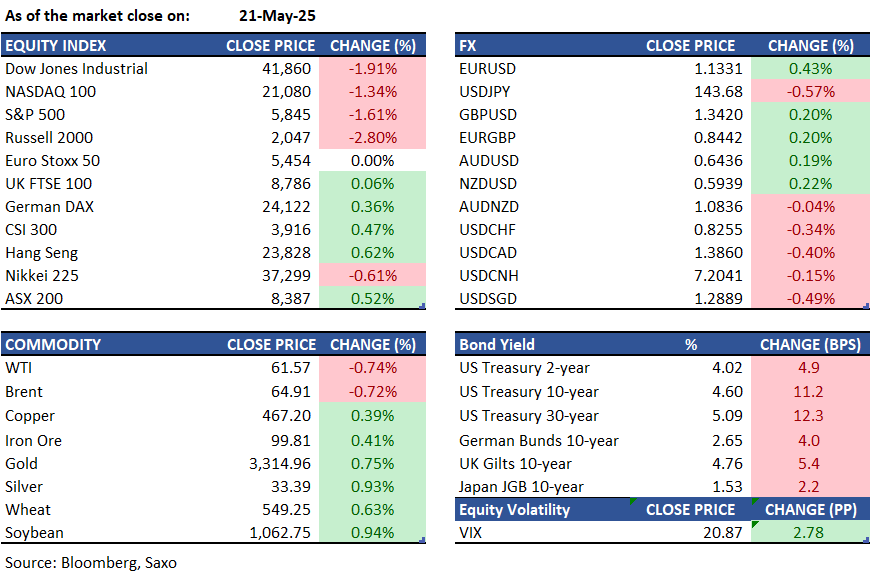
- Equities: Higher US yields led to US equities selling. S&P 500 down 1.6%
- FX: USD weakens on 20-year bond auction and deficit concerns
- Commodities: Gold rose for the third day, aided by a weaker dollar
- Fixed income: Treasury yield curve bear steepens as 20-year yield hits 5.12%
------------------------------------------------------------------
Disclaimer: Past performance does not indicate future performance.
Macro:
- Concerns regarding Trump’s tax bill with an agreement on SALT deductions. Some Republican hardliners remain concerned about insufficient spending cuts, while the CBO estimates the bill will add USD 2.3 trillion to deficits over the next decade, raising fiscal fears.
- Japan's core machinery orders rose 13% to ¥1.01 trillion in March 2025, surpassing expectations and reaching a two-decade high due to strong demand. The au Jibun Bank Japan Manufacturing PMI increased to 49.0 in May, marking the eleventh consecutive month of contraction but the softest decline since February, with softer falls in new orders and continued declines in foreign sales.
- The average interest rate for 30-year fixed-rate mortgages in the US increased by 6bps to 6.92%, the highest in three months, due to higher Treasury yields amid inflation and deficit concerns. A year ago, rates were 7.08%. Jumbo loan rates rose to 6.94%, and FHA-backed mortgage rates went up to 6.6%.
- UK's inflation rate rose to 3.5%, the highest since January 2024, from 2.6% in March, surpassing the forecast of 3.3%. Housing and utilities prices drove the increase, with electricity and gas prices rising due to the new Ofgem energy price cap. Housing rents rose by 6.3%, slower than March's 7.2%.
Equities:
- US - US stocks fell sharply on Wednesday due to rising Treasury yields and fiscal concerns. The S&P 500 and Nasdaq dropped 1.6% and 1.3%, respectively, while the Dow Jones fell by 817 points. Longer-term bond yields surged after a weak $16 billion auction of 20-year Treasuries, with the 30-year yield hitting 5.08%—the highest since 2023. Concerns about a tax-and-spending bill inflating the federal deficit heightened. Retail earnings added to investor concerns: Target declined 5.2% after missing estimates and revising outlook amid weak consumer demand linked to tariffs; Lowe’s (-3%) and TJX (-2.9%) offered limited reassurance. UnitedHealth fell 5.7% after reports of payments to nursing homes to reduce hospital transfers. Conversely, Alphabet gained 3% due to new AI tools rolled out in the annual I/O show. Snowflake gained 7% post market after reporting strong earnings and raising annual product revenue forecast.
- EU- European stocks remained steady on Wednesday, maintaining the near two-month highs reached previously, as the outlook for increased government spending in Europe supports investment among major corporations. The STOXX 50 held at 5,455, while the STOXX 600 stayed at 554. Technology shares led gains with Infineon rising 2.5% after announcing a partnership with Nvidia for developing new power delivery systems for data centres. Deutsche Telekom, Nokia, ASML, and Prosus also saw strong performance. Conversely, consumer discretionary stocks faced losses due to ongoing concerns about spending by major Asian consumers, with Hermes, LVMH, and Kering dropping over 2%. Outside the Eurozone, Scottish energy firm SSE fell 1.7% after releasing results and reducing its investment plan by £3 billion.
- HK – HSI rose 0.6%, closing at 23,828 on Wednesday, its highest since late March and marking two consecutive sessions of gains. The rise was supported by Morgan Stanley's optimistic outlook on Chinese stock indexes due to structural improvements and progress in tariffs and earnings. However, gains were capped by a sharp decline in U.S. futures amid doubts about Wall Street's rally strength. Morgan Stanley also cautioned that deflation risks in China might persist until at least 2026. Mining stocks rose as gold prices peaked for the week, with Zijin Mining surging 7.5%. EV battery firm CATL jumped 9% following a strong market debut, gaining 28% since the IPO.
Earnings this week:
- Thursday: Toronto-Dominion Bank, Analog Devices, Autodesk, Intuit, BJ’s Wholesale Club, Ralph Lauren
- Friday: Booz Allen Hamilton, Workday
FX:
- USD weakened despite limited news and absence of US data and Fed commentary, affected by a poor 20-year bond auction and concerns over the US tax bill's impact on the deficit. DXY fell below 99.6.
- USDJPY dropping to 143.4 from a high of 144.59, amid news of Economy Minister Akazawa's upcoming US visit.
- AUD recovered some losses post-RBA, reaching 0.6440 against USD, but struggled to test 0.65, while NZDUSD traded within a narrow range around 0.5930.
- GBP was the G10 'underperformer' but still gained strength despite volatile reactions to UK CPI data, which exceeded expectations with a year-on-year rise to 3.5% from 2.6%. Cable hit a multi-year peak at 1.3468 but lost momentum due to concerns over a stagflationary outlook.
- EUR capitalised on the dollar's weakness but saw limited gains and volatile trading in US markets.
- Economic data – JP BoJ Noguchi Speech, EU HCOB Manufacturing PMI Flash, UK S&P Global Services Flash, US Initial Jobless Claims, US S&P Global Composite PMI Flash, US Existing Home Sales
Commodities:
- Oil prices dropped as US crude inventories rose for the second week, overshadowing news of Israel's potential strike on Iran. WTI fell 0.7% to below $62 a barrel, while Brent slid below $65. A weak Treasury sale also pressured markets.
- Gold rose for the third day, driven by a weaker dollar and concerns over US fiscal policy and Middle East conflict. It topped $3,310 an ounce, after a 2.5% gain in two sessions.
Fixed income:
- Treasuries bear-steepened, with yields closing near session highs, at least 10 basis points cheaper from the 10-year to 30-year sector, due to weak 20-year bond auction demand. Dollar swap spreads remained well offered, with the 30-year tightening for a seventh session. US 30-year yields rose after the 20 year auction reaching to 5.09%, the lowest since October 2023, adding to bear-steepening pressures.
For a global look at markets – go to Inspiration.